Ask most people to picture a Norse or Germanic dragon and they will reach for something specific: wings, fire, a coiled body guarding a mound of gold, perhaps Smaug’s voice or Fafner’s cave in a Wagner staging. The medieval texts behind these images are stranger company. Open Snorri Sturluson’s Edda, or the Old Norse Völsunga saga, or the Old English Beowulf, or the Middle High German Nibelungenlied, and the vocabulary keeps sliding between the monstrous and the mundane — the same word doing service for a coiled adder in the heather and for a three-hundred-year-old hoard-guardian breathing fire. Old Norse and Old English, it turns out, never developed a word that means “dragon” and nothing else. What they had was ormr, wyrm — worm, serpent — stretched to hold both.
This article follows that elasticity across four sources and three languages: the eddic and skaldic material behind Jörmungandr, the serpent that circles the inhabited world, and Níðhöggr, gnawing at the roots of the world tree; the Old Norse Völsunga saga and the Middle High German Nibelungenlied, where the same dragon-and-cursed-treasure story splits into two remarkably different shapes depending on which language is telling it; and the Old English Beowulf, where a nameless hoard-guardian dies by exactly the word that opens the whole inquiry. Old Norse, Old English, and Middle High German, three branches of the same language family, each work out, independently and never quite consistently, where the ordinary serpent ends and the extraordinary dragon begins.
Ormr, Wyrm, Worm
They ride up onto the heath together, Sigurd and Reginn, along the track where Fáfnir is known to crawl down to the water. Sigurd has heard the boast before — Reginn has told him, more than once, that the creature is no bigger than any common serpent — and now, looking at the tracks worn into the ground, he wants it said again, to his face. “You told me, Reginn, that this dreki was no bigger than a single lyngormr” — a heath-serpent, the smallest and most unremarkable kind there is — “but these tracks look enormous to me.” Reginn does not flinch. Dig a pit, he says, and sit in it, and wait for the ormr to crawl toward the water, and strike upward into its heart.
Three words, one creature, in the space of four sentences. Dreki, the newcomer, borrowed from Latin draco somewhere in the early medieval centuries and never quite naturalized. Lyngormr, built from native material — lyng, heather or heath-scrub, plus ormr, worm or serpent — denoting the ordinary snake of the moor, the kind a farmer might step over without breaking stride. And ormr itself, bare, used by Reginn a moment later for the same monstrous thing Sigurd has just called a dreki. Old Norse has, at this precise dramatic hinge, no settled answer to the question a modern reader keeps wanting to ask: is this a dragon, or is it a snake? The saga does not distinguish, because the language underneath it does not distinguish either.
Neither Old Norse nor Old English possesses a word that does for “dragon” what draco already did in Latin — mark out a distinct category of monstrous reptile, separate in kind from the serpent underfoot. Dreki is exactly that borrowed Latin word, filtered through Old Norse sound-changes; its Old English cousin draca, ancestor of modern “drake,” comes from the same root. The native Germanic word survives too, but barely, and not as a living category: Old Norse linnr survives today only as the first element of German Lindwurm, a fossil pressed into a single compound rather than a productive noun. Everywhere else in the record, ormr and its Old English relative wyrm do the job alone, stretched to cover everything from a garden adder to the beast guarding a hall’s worth of gold.
The absence is not for lack of a crawl-or-fly distinction — that axis exists, and it matters on its own terms. Rudolf Simek notes that the dragons of Beowulf and of the Old Norse Fáfnismál both belong to a rampant, earthbound type, while later saga tradition develops airborne dragons, flugdreki, closer to imported continental motifs. But crawling and flying cut across the ormr/dreki divide rather than tracking it: the same word, ormr, covers a legless thing sliding through heather and a monster old enough to have hoarded a kingdom’s gold. The category modern readers reach for automatically — dragon as against serpent — is not one either language was equipped to make.
Serpents carried weight in the wider religious record of the Germanic north well before any of these narratives were written down. Simek’s dictionary finds no evidence of an organized serpent cult as such, but does find, from the Bronze Age onward, a consistent symbolic charge binding the animal to fertility and to the cult of the dead — the two poles, roughly, that Miðgarðsormr and Níðhöggr will occupy in the sections that follow. And on etymology, one thread is worth holding onto now, to be picked up again at the very end: the compound behind modern German Lindwurm, and the medieval form lintrache, encodes not a tree but a quality. The lind- element goes back to a Germanic adjective meaning pliant, supple, mild — kin to Old English liðe, ancestor of modern “lithe” — not to the linden tree the popular etymology likes to reach for. A serpent named for its flexibility. Keep that in mind. It returns at the close of this article, in a poem composed in a different Germanic language, on the other side of the North Sea.
Jörmungandr: The One Who Encircles
Thor’s feet go through the planking of the boat. He has hauled the line up from depths no ordinary fisherman would risk, and now, braced against the hull with his heels driven clean through the bottom of the vessel, he stares down into the upturned face of the thing he has caught. It blows poison at him. Snorri gives the scene almost no ornament — the encounter is close enough to hand-to-hand combat that ornament would only slow it down. Jörmungandr, hauled halfway into the visible world, looks back.
The serpent’s origin is told earlier, and more briskly: three children born to Loki and the giantess Angrboða — the wolf Fenrir, the serpent Snorri names outright as Miðgarðsormr, and Hel. Forewarned that all three will bring the gods harm, Odin seizes the serpent and throws it into the ocean that surrounds the inhabited world, where it grows without stopping until it has closed its own circuit, tail in mouth, holding Miðgarðr the way a belt holds a coat shut.
The name is old, older than Snorri’s thirteenth-century retelling by some three centuries at least. Bragi Boddason uses a form of it in the Ragnarsdrápa, composed in the ninth century — among the earliest skaldic references to Norse mythology to survive at all. The first element, jǫrmun-, means something like “vast” or “immense,” a root shared with Old English eormengrund (“the vast earth”) and with the name of the Continental Saxon pillar Irminsûl — thin evidence, but evidence nonetheless, that this serpent’s scale was imagined in genuinely cosmic terms from an early date, not invented wholesale for Snorri’s compilation.
Two episodes carry the serpent through the mythology. The first reads almost as a joke that turns serious only in hindsight: at the hall of the giant Útgarðaloki, Thor is set the humiliating task of lifting a cat off the floor and barely manages to raise one paw before his host calls a halt — revealed afterward to have been Miðgarðsormr in disguise all along, so that Thor’s small feat of moving it at all bordered on the impossible. The second is the fishing trip already described: Thor goes out with the giant Hymir, baits his hook with an ox’s head, and hauls the serpent up from the seabed until the two of them are staring at each other over the gunwale.
Here the sources stop agreeing. Snorri’s Gylfaginning has Hymir cut the line in terror before the killing blow can land — the serpent sinks back, and Snorri’s narrator, Hár, states plainly that Miðgarðsormr lifir enn, still lives. But the Húsdrápa of Úlfr Uggason, a skaldic poem composed for a wedding at Hjarðarholt somewhere between about 978 and 985 — two and a half centuries before Snorri wrote, on either dating — tells it differently. Its sixth stanza, in the reading of its modern editors, has Thor strike the serpent’s head clean off. A third witness complicates matters rather than resolving them. In the eddic poem Hymiskviða, as it survives, the serpent simply sinks back into the sea — neither confirmed dead nor confirmed alive, with the possibility that a stanza recording the actual outcome has been lost from the manuscript tradition.
Snorri, notably, does not pretend the disagreement isn’t there. His narrator Hár remarks that people hold differing opinions about what became of Miðgarðsormr, before settling, for the purposes of his own account, on survival. It is a rare moment of a medieval Christian mythographer showing his seams rather than smoothing them into a single, tidy narrative.
Four Viking-Age picture stones — from Altuna in Sweden, Ardre on Gotland, Gosforth in Cumbria, and Hørdum in Denmark — carve the scene independently of any surviving written version: Thor in a boat, an ox-head on the line, a coiled serpent beneath the hull. None of the stones settles which literary tradition, if either, it illustrates. What they confirm is only that the image itself — Thor fishing for the world-serpent — was current and durable enough to be worth carving in stone from Denmark to northern England, well before any of the surviving texts describing it in words were copied down.
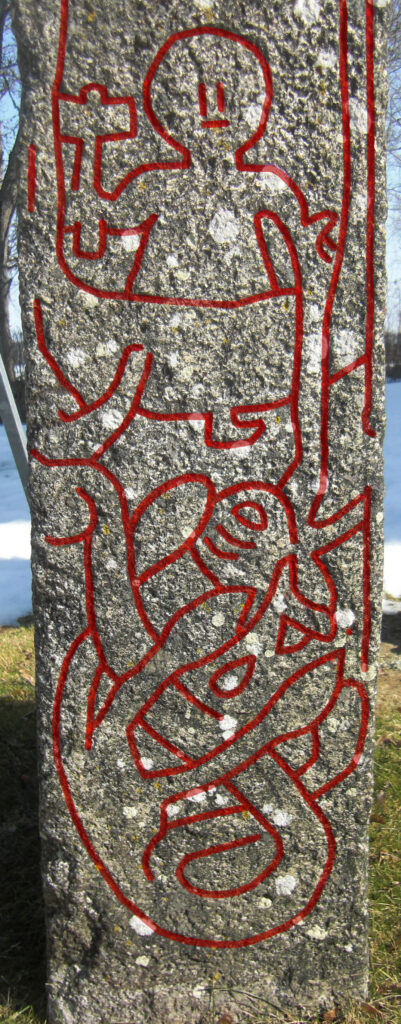
The serpent’s end comes at Ragnarök, and there every source agrees on the outcome even if none lingers on it. Thor kills Miðgarðsormr — kills it decisively this time, no giant left to cut a line — and takes nine steps away from the body before he too falls, poisoned by the venom the dying serpent has breathed into the air around him. A fatal victory, symmetrical with the death it delivers — and not the last dragon-slayer in this article to die within moments of his own kill.
Níðhöggr: The One Who Gnaws
Somewhere in the middle of all this cosmic architecture — the world tree, its three roots reaching toward the homes of gods, of frost giants, and of the dead — a squirrel spends its days running up and down the trunk carrying insults. Ratatoskr’s job, as Snorri describes it with something close to deadpan comedy, is to relay abuse between an eagle perched at the crown of Yggdrasill and a creature gnawing at the roots far below: Níðhöggr. It is an oddly domestic detail to find wedged into a description of the structure holding up the entire world, and that, more than anything, is the point — this cosmology has room for pettiness alongside catastrophe.
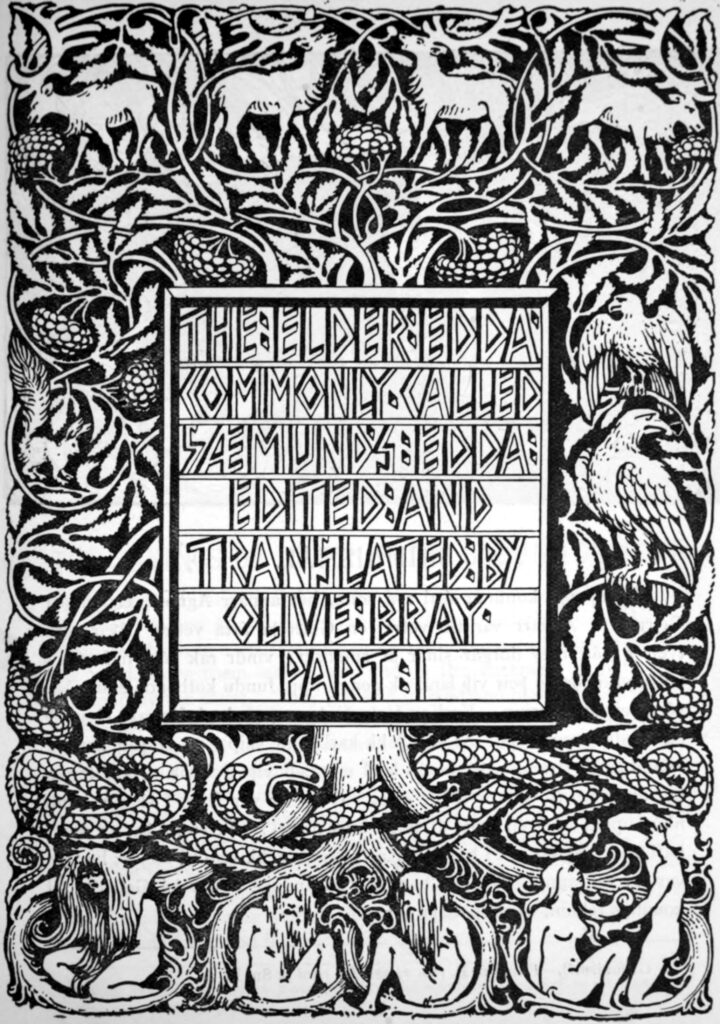
Yggdrasill’s three roots reach toward the dwelling of the gods, toward the home of the frost giants where once stood the primordial void Ginnungagap, and down over Niflheim, the mist-world, where the spring Hvergelmir wells up. It is in and around Hvergelmir that Grímnismál situates an almost absurd density of serpents — so many, the poem says, that no one could count them — before naming seven outright: Góinn, Móinn, Grafvitnir, Grábakr, Grafvǫlluðr, Ófnir, and Sváfnir, in addition to Níðhöggr itself, gnawing at the root from below.
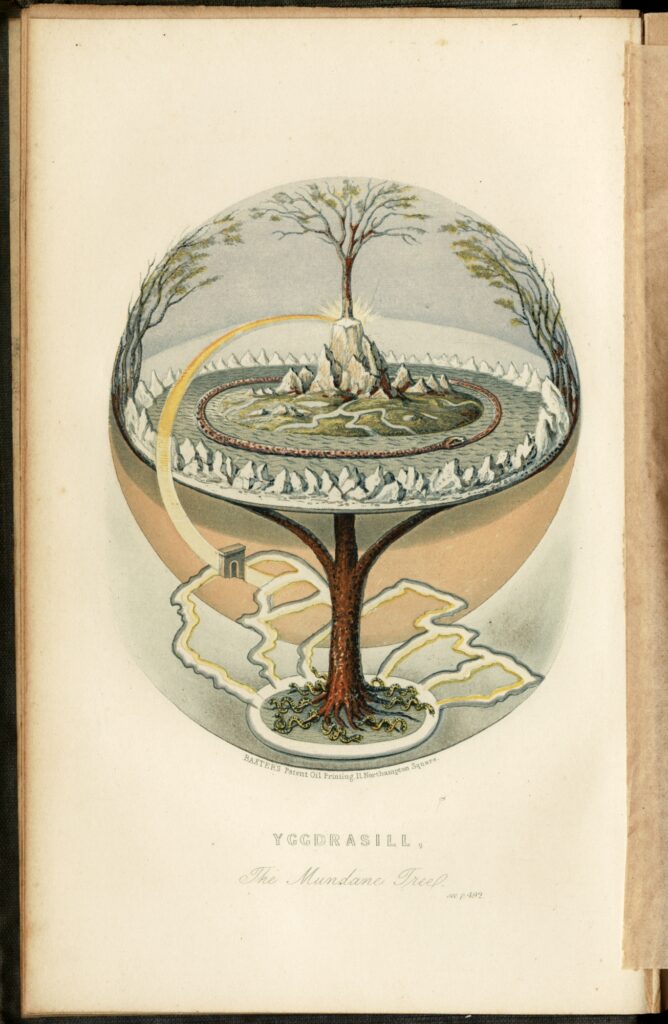
Snorri does not simply report this list; he constructs it, and the seams show under scrutiny. The eddic stanzas he draws on — Grímnismál 32, 34, and 35 — do not agree cleanly among themselves on how many serpents live at the root of the tree. Snorri’s prose smooths a genuine discrepancy in his source material into a single confident inventory: a small, self-contained instance of exactly the compiling work Snorri performs throughout Gylfaginning, visible here on a scale small enough to hold in one paragraph, rather than spread across a whole mythological cycle as with Miðgarðsormr.
Where Níðhöggr’s gnawing matters most is at Náströnd, the Shore of Corpses, a hall woven — Snorri says — from the backs of serpents, its doorways facing north, its interior running with rivers of venom. Oath-breakers and murderers wade there; Níðhöggr sucks at the corpses. But the text as it survives in the Codex Regius does not, strictly, place Níðhöggr at Hvergelmir and at Náströnd as a single continuous location — these are separate mentions in the eddic material that Snorri links into one coherent picture. The dragon-serpent gnawing roots and the dragon-serpent tormenting the dead may originally have been closer to two functions loosely attached to the same name than a single figure moving between two addresses. Snorri’s synthesis is plausible. It is also, on the evidence, a synthesis.
Níðhöggr’s fate after Ragnarök resists tidy resolution. Best to leave it that way. Völuspá‘s final stanza shows the dragon flying, corpses in its wings, before it “sinks down” — a verb ambiguous enough to support several readings. Snorri, meanwhile, places Niðavellir and its golden hall in the renewed world that rises after the catastrophe, without quite specifying what has become of the serpent who once gnawed the old world’s roots. The two pictures do not contradict each other outright. They simply decline to meet.
What ties Níðhöggr back to Miðgarðsormr is not narrative but function. Simek’s dictionary reads the two figures as expressions of a single underlying symbolic complex running through the pre-Christian north — fertility on one side, the cult of the dead on the other, both mediated through the same animal. Miðgarðsormr encircles and threatens the living world; Níðhöggr gnaws at its foundations and torments its dead. Different registers, same creature, same word underneath both.
Fáfnir, Fafner: One Legend, Two Languages
Sigurd strikes upward from his pit, and Fáfnir, dying, wants to talk. He asks who has killed him, urges the young man to flee before the gold destroys him too, invokes the Norns and the coming fire of Surt at the world’s end — the vocabulary of full cosmic reckoning, borrowed for a moment by a dying creature in a hole in the heath. Even here, at the most intimate death scene in the entire dossier, the language reaches for Ragnarök. Fáfnir describes his own transformation in terms that echo the previous two sections — he raised, he says, a crest of terror, and breathed out poison — while the narrative keeps calling him, throughout, by the vocabulary of the serpent.
The Norse strand of the story runs like this: Fáfnir’s brother Reginn, a dwarf posing as a smith, raises Sigurd specifically to kill him, driven by a claim on their dead father’s gold — gold that came, originally, cursed, from the dwarf Andvari. Reginn’s strategy is the pit; Sigurd’s disguise for the ambush is Odin himself, appearing as a bearded old man with better advice than Reginn’s own. After the kill, Sigurd tastes the dragon’s blood on his thumb by accident, understands the language of birds, hears them warn him to kill Reginn too, and takes the treasure — including the helm of terror, which had belonged, Simek’s dictionary notes, not to Fáfnir originally but to Hreiðmarr, the father both brothers murdered him for.
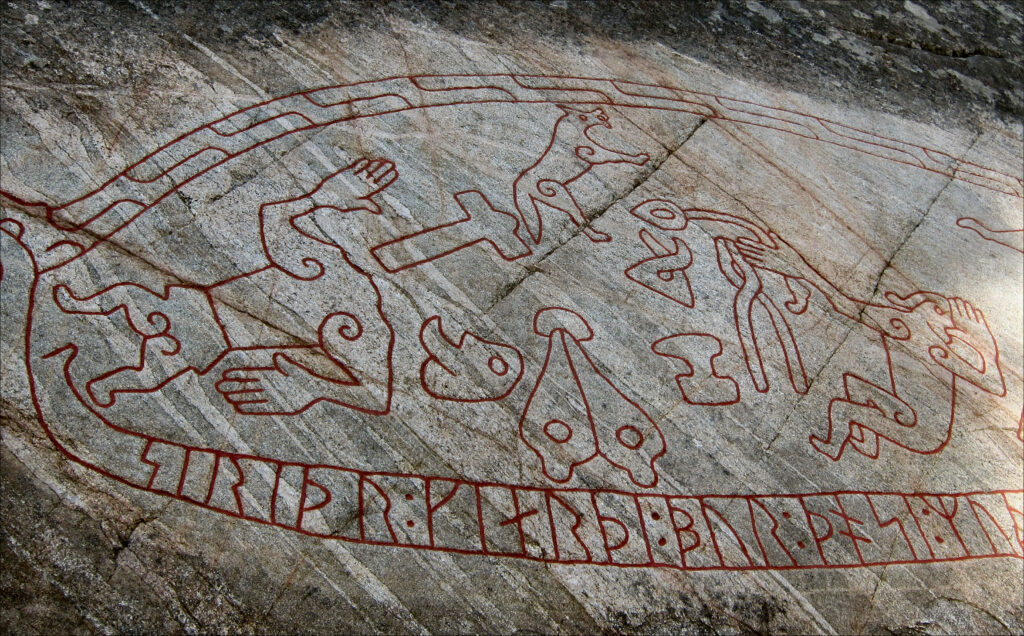
Beowulf itself remembers a version of this story, and remembers it differently. A minstrel at Hrothgar’s court sings of Sigemund’s dragon-slaying — not Sigurd’s, but his father’s, and without a Reginn or a pit: Sigemund goes alone under the grey rock, sword in hand, and drives it in until the blade sticks fast and the dragon perishes by the blow. The reward is the same treasure-laden ship. But the Old English poem gives the kill to the father; the Norse tradition, consistently, gives it to the son. Which generation first slew the dragon was evidently as unsettled a question, this far back, as what to call it.
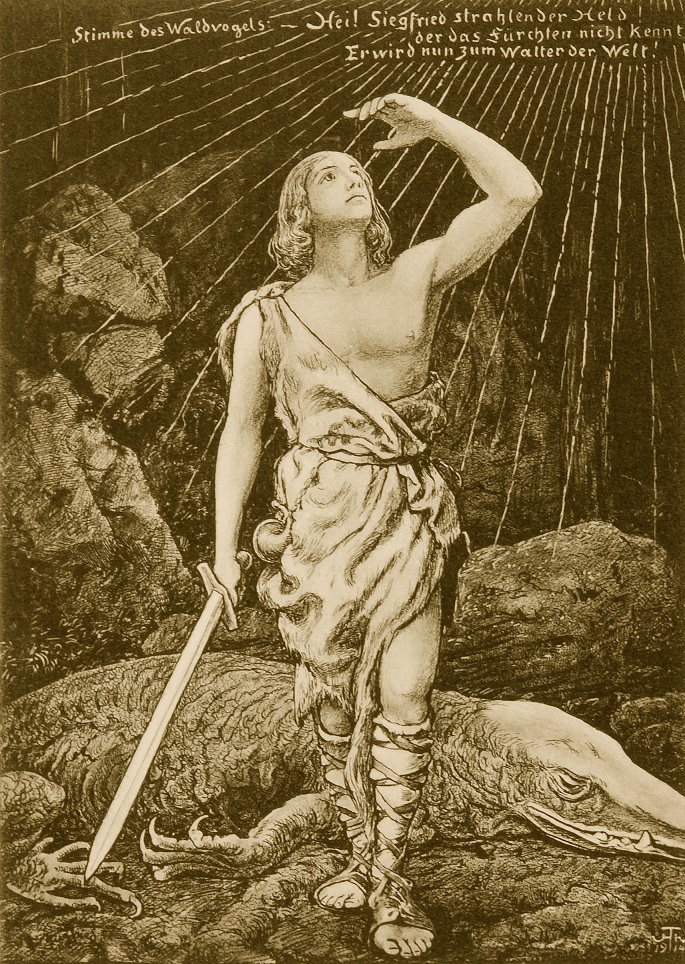
Cross the North Sea and the Rhine, into the Middle High German Nibelungenlied, and the same basic story of a cursed treasure and a young hero survives — but the dragon does not. Hagen tells the story of Siegfried’s youth in a handful of lines, almost as an aside; the dragon goes unnamed; and the treasure’s origin is severed cleanly from the dragon-slaying altogether, belonging instead to two dwarf brothers, Schilbung and Nibelung, whom Siegfried encounters in an entirely separate episode. The dragon’s sole narrative function in the German tradition is to explain something the Norse tradition has no need of: Siegfried’s invulnerability, acquired by bathing in the dragon’s blood, and the single vulnerable spot between his shoulder blades where a linden leaf fell and blocked the blood’s protection.
That detail is worth pausing on, because the poem names its dragon, once, in exactly the compound this article has been circling: lintrachen, in the accusative — “einen lintrachen sluoc des heldes hant,” the hero’s hand slew a lintrache — in the third Aventiure’s account of the bloodbath. A hybrid word, fusing the native Germanic element (the same lind- that means pliant, not linden) with the borrowed Latin draco. Two languages’ solutions to the same naming problem, welded into a single compound, inside the one sentence Middle High German spares for its dragon.
This is the real difference between the two traditions, and it has nothing to do with whether either language possesses a word for “dragon.” In the Norse material, Fáfnir is the treasure — dragon, gold, and doom fused into a single figure with a name, a genealogy, and a death speech. In the German material, the dragon is a detail, structurally amputated from the gold’s own story, kept alive only long enough to explain a hero’s skin. One tradition builds a monster who is also a character; the other keeps the monster just monstrous enough to perform a single piece of narrative work, and no more.
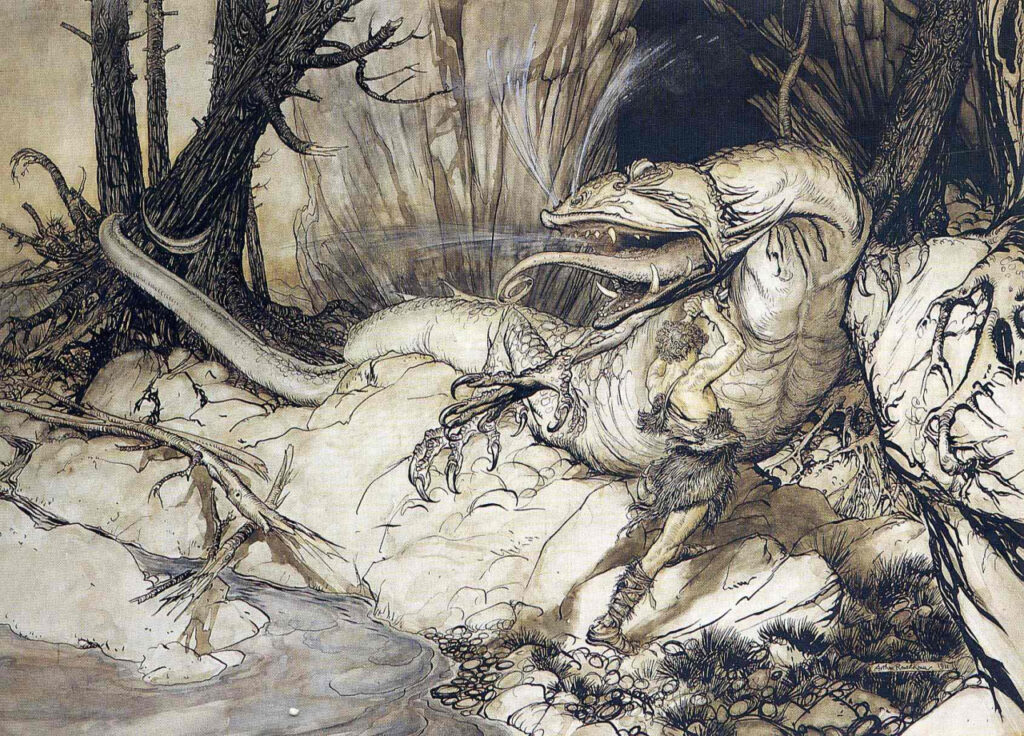
One name deserves a brief aside, if only to head off a confusion the nineteenth century created rather than inherited: “Fafner,” the name most opera-goers know, belongs to Wagner, not to medieval poetry. No medieval Norse or German source calls the dragon that. Wagner’s version has, for many readers, quietly replaced the medieval one in cultural memory.
The Lindworm and Beowulf: The Tail of the Problem
The Weder-lord cut the worm in the middle. Seven words, at the exact moment of the kill, and they carry the whole argument of this article inside them. Beowulf’s opponent has flown, breathed fire, guarded a hoard for three hundred years, and been given several grand descriptive names across the length of the poem — and at the one moment that matters most, the moment of the blade going in, the poet reaches for the same word Reginn used for the smallest heath-serpent at the start of this article: wyrm.
The dragon of Beowulf is, by design, closer in kind to Miðgarðsormr and Níðhöggr than to Fáfnir. It has no genealogy, no name of its own, no dialogue. It is simply the Last Survivor’s guardian, asleep on a hoard for three centuries until a fugitive steals a single cup and wakes it into three days of burning revenge across the land of the Geats. Where Fáfnir talks, negotiates, curses, and dies with a speech on his lips, Beowulf’s dragon is closer to a natural disaster with teeth — a cosmic hazard, not a character.
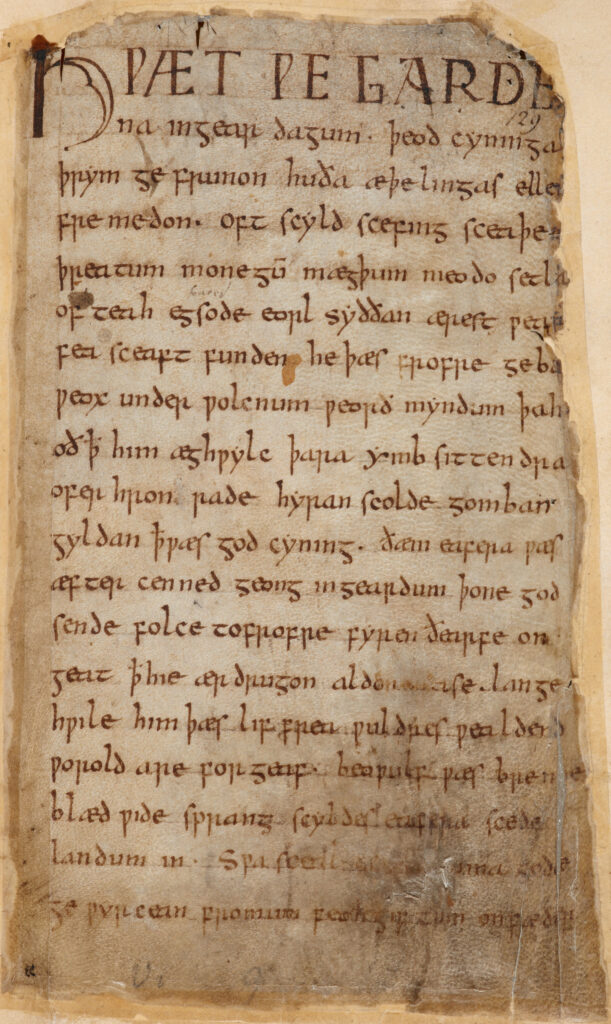
The poem’s vocabulary for the creature keeps moving, and that restlessness is doing real work. English translators have reached, over the length of the episode, for “dragon,” for “fire-drake,” for “the hateful air-goer.” The Old English text itself, at the death blow — line 2705 in the standard modern edition — gives wyrm: forwrāt Wedra helm wyrm on middan, the protector of the Weders cut the wyrm in the middle. A few lines further on, describing the wound the same creature had inflicted, the poet calls it eorðdraca, earth-dragon. Two names for one animal within a handful of lines, one native and one built on the borrowed Latin root — Old English performing, at the exact climax of the poem, the same lexical shrug that Old Norse performs across Sigurd’s exchange with Reginn. Even in the most maximalist dragon narrative to survive from the early medieval Germanic world — fire, flight, a three-hundred-year hoard — the poet, at this climactic moment, never reaches for a word that means dragon and only dragon. The vocabulary of the ordinary serpent underfoot is never retired.
Beowulf kills his dragon and dies of its poison within moments of the killing blow, struck in the neck during the fight, weakening fast, dead soon after the creature itself — close enough to Thor’s own fatal victory over Miðgarðsormr, nine steps and then dead, that recent scholarship has treated the resemblance as more than coincidence. Chenyun Zhu’s 2023 reassessment of Beowulf‘s relationship to the Ragnarök tradition builds on earlier work by Ursula Dronke to argue that the poem’s author knew the Norse material, or something close to it, and shaped Beowulf’s death scene with that cosmic parallel deliberately in view.
And so, at the very end, back to the word this whole article opened with. Lindworm — German Lindwurm, and behind it the Middle High German lintrache already met in the previous section — does not commemorate a tree. It commemorates a quality: linþa-, the Germanic root behind it, means pliant, flexible, mild, the same root that gives Old English liðe and modern “lithe.” A serpent named, at the root of its own name, for its suppleness rather than its size, its fire, or its hoard. It is a fitting word to end on, because it describes, almost by accident, the argument of this whole article: this complex of ormr, wyrm, worm, dreki, draca, and Lindwurm was never rigid. It bent to fit whatever stood in front of it — a heath-adder, a world-circling sea monster, a corpse-eater gnawing at tree roots, a talking treasure-guardian, a flying hoard-beast three centuries old — because the word for “serpent” in these languages was, from the start, the flexible one.
A Note on Sources and Scholarly Uncertainty
The Old Norse and Middle High German passages quoted in this article are my own working translations from the primary texts, checked against, but not reproduced from, the published English translations cited in the bibliography (R. G. Finch for Völsunga saga; Daniel B. Shumway and George Henry Needler for the Nibelungenlied). Readers wanting a full published English Völsunga saga or Nibelungenlied should consult those editions directly. The Beowulf passages are quoted from J. Lesslie Hall’s 1892 translation, now in the public domain.
Snorri Sturluson’s Edda survives in four independent medieval manuscripts that disagree with one another in places, none copied earlier than roughly half a century after Snorri’s death; his account should be read as a thirteenth-century Christian Icelandic synthesis of older material, not a transparent window onto pre-Christian belief. Two moments in this article make that synthesis visible on the page itself: Snorri’s own acknowledgment, voiced through his narrator Hár, that opinions differed on whether Thor killed Miðgarðsormr during the fishing trip; and his silent harmonizing of Grímnismál stanzas that do not agree among themselves on the number of serpents gnawing at Yggdrasill’s roots.
The divergence over Miðgarðsormr’s fate is grounded, in this article, in three witnesses read directly for its preparation: Snorri’s Gylfaginning (serpent survives), the skaldic Húsdrápa of Úlfr Uggason as edited in the modern critical edition of the Skaldic Poetry of the Scandinavian Middle Ages project (serpent decapitated by Thor), and the eddic Hymiskviða (ambiguous, possibly missing a stanza). The critical edition’s commentary to Húsdrápa st. 6 indicates that the full set of surviving skaldic attestations is larger than these three: it names a further composition referred to as Bragi Þórr, which like Hymiskviða does not explicitly confirm the serpent’s death, and one referred to as Ggnæv Þórr, which, like the Húsdrápa, does. Neither of these two additional sources was examined directly for this article, and the divergence is presented here on the basis of the three witnesses actually consulted, not as a complete survey of the tradition. The Húsdrápa‘s date rests on two distinct scholarly traditions rather than a single settled figure: Marold’s edition reports a dating of c. 983 or 985 following Finnur Jónsson (Skj; LH I, 504), against c. 978 for the wedding itself in Einar Ólafur Sveinsson’s edition of Laxdæla saga (ÍF 5, lix). This article follows the wider range rather than choosing between them. The eddic poems quoted or referenced throughout this article — Grímnismál, Hymiskviða, and Völuspá — were consulted only as they are embedded and cited within Snorri’s Gylfaginning and within the Húsdrápa commentary, not in an independent critical edition of the Poetic Edda; the same is true of Bragi Boddason’s Ragnarsdrápa, referenced here via Rudolf Simek’s dictionary rather than read directly. Fáfnismál is an exception: it was read in the English translation included in G. N. Garmonsway and Jacqueline Simpson’s Beowulf and Its Analogues (1968), a sourcebook of translated texts and analogues that also supplied the fourth section’s comparison between Beowulf‘s account of Sigemund’s dragon-slaying and the Norse attribution of the same feat to his son Sigurd; the critical commentary in that edition, not this article’s own judgment, is the basis for treating the two accounts as attached to different generations of the same family. The archaeological corroboration for the Thor-and-Miðgarðsormr scene — the picture stones at Altuna, Ardre, Gosforth, and Hørdum — is likewise drawn from Simek’s synthesis rather than from firsthand engagement with the archaeological literature on any of the four monuments.
Angrboða, the giantess named as Miðgarðsormr’s mother, is flagged by Simek as probably a twelfth-century mythographic invention grafted onto older material; this article treats her name accordingly, as attached to the tradition rather than necessarily original to it. The name “Fafner,” familiar from Wagner’s Ring, is a nineteenth-century invention absent from every medieval source discussed here and should not be mistaken for the medieval dragon’s name.
The comparison drawn in the fourth section, between the Norse and Middle High German treatments of the dragon-and-treasure story, currently rests in part on the introduction to George Henry Needler’s 1904 translation of the Nibelungenlied — useful for orientation, but not a citable modern academic source. Three monographs that would ground this comparison more securely were not accessible during the preparation of this article: Christine Rauer’s Beowulf and the Dragon: Parallels and Analogues (2000), for which no open-access copy could be located; John Lindow’s Norse Mythology: A Guide to Gods, Heroes, Rituals, and Beliefs (2001), listed on the Internet Archive but currently restricted to a limited preview, likely a consequence of the 2024 Hachette v. Internet Archive ruling; and Margaret Clunies Ross’s Prolonged Echoes: Old Norse Myths in Medieval Northern Society (1994–1998), for which no legitimate open-access route was found. For the same reason, the parallel drawn in the final section between Beowulf’s death and Thor’s death at Ragnarök relies on Chenyun Zhu’s 2023 article, which itself cites Christine Rauer’s monograph; Rauer’s own argument was not read directly for this article.
The etymology of lind- in Lindwurm/lintrache — pliant or supple, rather than the linden tree of popular etymology — is drawn from Elof Hellquist’s Svensk Etymologisk Ordbok (1922), a respected if by-now century-old etymological dictionary of Swedish, cross-referenced against the Oxford English Dictionary‘s entry for the related English word “lintworm.” The Old English text and line numbering for the Beowulf passages quoted in the fifth section were confirmed against Klaeber’s Beowulf and the Fight at Finnsburg, the standard modern critical edition (4th ed., 2008); chapters XXXIX through XLII of Hall’s translation, covering Wiglaf’s rebuke of the cowardly retainers and the messenger’s forecast of wars to come, were not read for this article, since they bear on the political aftermath among the Geats rather than on the dragon material at its center. The fifth section’s discussion of the poem’s vocabulary for the dragon is deliberately limited to the two Old English terms confirmed directly against Klaeber’s edition, wyrm (l. 2705) and eorðdraca (l. 2712): an earlier draft also cited an Old English term corresponding to Hall’s “the hateful air-goer,” but that term was not independently verified against the Old English text and has been removed pending confirmation.
Bibliography
Primary Sources
Snorri Sturluson. Edda: Prologue and Gylfaginning. Edited by Anthony Faulkes. 2nd ed. London: Viking Society for Northern Research, 2005. http://vsnrweb-publications.org.uk/PrologueandGylfaginning.unicode.pdf
Völsunga saga. Edited and translated by R. G. Finch. London: Viking Society for Northern Research, 1965. https://vsnr.org/wp-content/uploads/2024/07/Volsunga-saga.pdf
Das Nibelungenlied. Edited by Karl Simrock. Project Gutenberg. https://www.gutenberg.org/files/48888/48888-h/48888-h.htm
The Nibelungenlied. Translated by Daniel B. Shumway. New York: Houghton Mifflin, 1909. Project Gutenberg. https://www.gutenberg.org/files/1151/1151-h/1151-h.htm
The Nibelungenlied. Translated by George Henry Needler. New York: Henry Holt, 1904. Project Gutenberg. https://www.gutenberg.org/files/7321/7321-h/7321-h.htm
Beowulf. Translated by J. Lesslie Hall. Boston: D. C. Heath, 1892. https://www.gutenberg.org/files/16328/16328-h/16328-h.htm
Garmonsway, G. N., and Jacqueline Simpson, trans., with Hilda Ellis Davidson. Beowulf and Its Analogues. London: J. M. Dent & Sons, 1968. https://archive.org/details/beowulfitsanalog0000unse (access-restricted; consulted via digitized page images)
Fáfnismál. In The Poetic Edda. Translated in Garmonsway and Simpson, Beowulf and Its Analogues (1968), 332–35.
Klaeber, Friedrich, R. D. Fulk, Robert E. Bjork, and John D. Niles, eds. Klaeber’s Beowulf and the Fight at Finnsburg. 4th ed. Toronto Old English Series 21. Toronto: University of Toronto Press, 2008; repr. with corrections, 2014. (No open-access edition available; consulted in print.)
Marold, Edith, ed., with Vivian Busch, Jana Krüger, Ann-Dörte Kyas, and Katharina Seidel, translated by John Foulks. “Úlfr Uggason, Húsdrápa.” In Poetry from Treatises on Poetics, edited by Kari Ellen Gade and Edith Marold. Skaldic Poetry of the Scandinavian Middle Ages, vol. 3. Turnhout: Brepols, 2017. https://skaldic.org/m.php?p=text&i=1492
Primary Sources — Not Directly Consulted
The following eddic and skaldic poems are quoted or referenced in this article only as they are embedded and cited within Snorri Sturluson’s Gylfaginning or within the commentary to Marold’s edition of the Húsdrápa, not in an independent critical edition:
Grímnismál. In The Poetic Edda.
Hymiskviða. In The Poetic Edda.
Völuspá. In The Poetic Edda.
Bragi Boddason. Ragnarsdrápa. Referenced via Rudolf Simek’s dictionary entry on Irminsûl, not read directly.
Secondary Sources
Simek, Rudolf. Dictionary of Northern Mythology. Translated by Angela Hall. Cambridge: D. S. Brewer, 1993; repr. 2007.
Zhu, Chenyun. “Beowulf and Ragnarǫk: A Reassessment.” Neophilologus 108 (2024 [online 2023]): 53–67. https://doi.org/10.1007/s11061-023-09784-7
Hellquist, Elof. Svensk Etymologisk Ordbok. Lund: C. W. K. Gleerups Förlag, 1922. https://runeberg.org/svetym/0499.html