In the third century BCE, a group of Jewish scholars working in Alexandria sat down to translate the Hebrew scriptures into Greek, word by careful word, and in doing so performed an act of philological housekeeping that would eventually reshape a monster. They needed a Greek word for nāḥāš, the crafty animal of Genesis 3, and they needed one for Leviathan, the many-headed sea-dragon of Isaiah. They chose the same word for both: ophis. Nothing about the choice was sinister, or even especially deliberate — Greek simply had fewer words for serpentine things than Hebrew did. But three centuries later, a Christian visionary reading that same Greek text would find two of the Bible’s oldest monsters sitting in front of him, wearing a single name, and would do something no one had quite done before: decide that they were, and always had been, the same creature.
This article follows that creature across four widely separated texts: the unnamed animal of Eden, a venerated bronze idol in Solomon’s Temple, the many-headed sea-monster of the Psalms and Isaiah, and the dragon of Revelation 12. Not as four unrelated appearances of a popular symbol, but as a single figure accumulating names, functions, and finally an identity, across roughly a thousand years of textual history. The serpent of the Abrahamic traditions was never quite where any single text left it.
1. The Cunning and the Naked
The last verse of Genesis 2 and the first verse of Genesis 3 share a pun no translation preserves — exactly the kind, as Robert Alter has observed, “the ancient Hebrew writers delighted in.” The man and his wife are arummim, naked, and feel no shame; then the serpent is introduced as arum, cunning, more shrewd than any beast of the field. Same root, one letter apart, separated only by a chapter division invented in 1205 by Stephen Langton, a Paris theology lecturer who would later become Archbishop of Canterbury, and who never read the words in sequence. The Hebrew moves in a single breath from nakedness to cunning, as though performing in advance the reversal it is about to narrate.
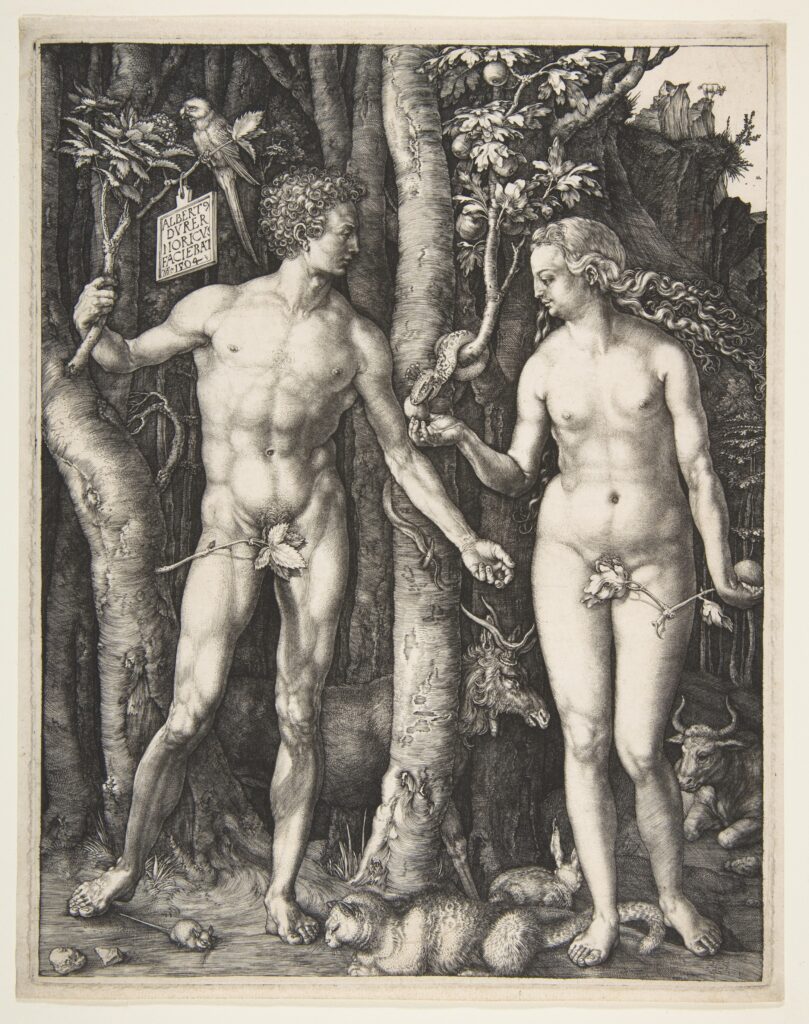
Notice, too, how little else the chapter gives you. No name for the creature. No account of where it came from, why it alone among the animals can talk, or what exactly it wants. Later readers would supply all of that: a fallen angel, a vessel for Satan, the origin of evil itself. The text of Genesis 3 offers none of it. Verse one calls it, in so many words, “more crafty than any other wild animal that the LORD God had made.” Not a god. Not a demon. Not even, in so many words, evil — only shrewd, and curious about the one tree no one has thought to warn it away from.
That restraint looks less like an oversight once you set it beside its neighbours. Serpents entwine fertility goddesses on plaques from Canaanite sites across the region; they flank sacred trees, guard springs, coil around the emblems of gods considerably older than Israel’s. A culture surrounded by serpent cults, telling a story about the origin of shame and knowledge, had every reason to know exactly what kind of creature it was invoking, and every reason to cut that creature down to size. Scholars call this demythologization: not erasure, but the deliberate reduction of a once-divine figure to an ordinary animal with an extraordinary gift for conversation.
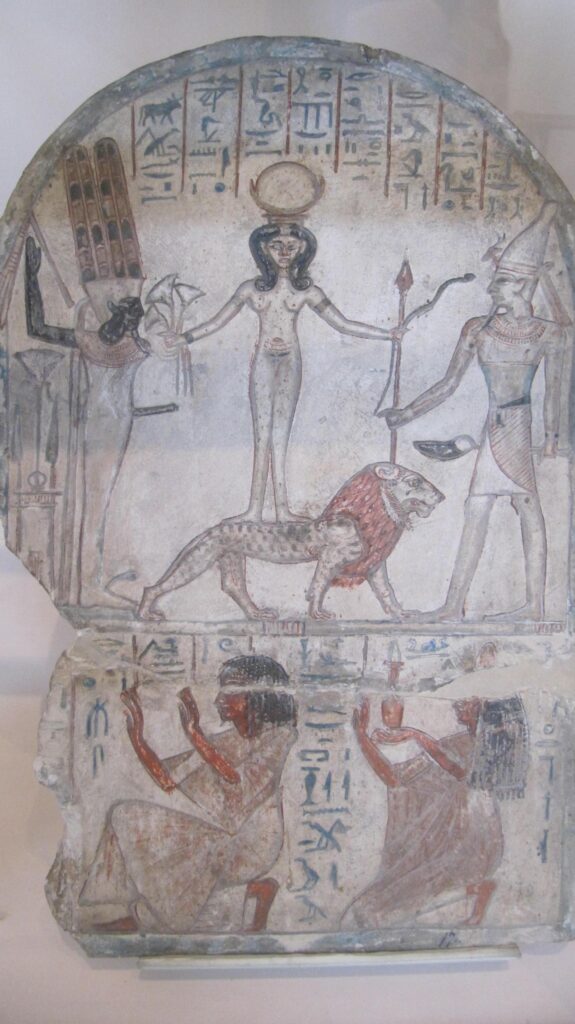
One recent reading pushes the animal’s ordinariness further still, into the register of Mesopotamian divination. The Šumma Ālu omen tablets record snake behaviour in obsessive detail — where it appears, which direction it faces, what it does next — as a working technology for reading the future. Set against that background, the serpent’s opening question to the woman starts to sound less like seduction than augury: a creature whose entire cultural association was with hidden knowledge, doing precisely what such creatures were understood to do. It is a contested reading, resting on a wordplay between nāḥāš and the root for divination that not every Semitist accepts, but it adds a texture the demythologization thesis alone doesn’t capture: even reduced to an animal, this was never a random animal to choose.
The curse, when it finally comes, is where the chapter commits to something like myth. The serpent will crawl on its belly and eat dust; there will be enmity between it and the woman, between its offspring and hers, an offspring that will crush its head while it strikes at his heel. It is the only moment in Genesis 3 that reaches past a single garden into cosmic time, an enmity built to outlast every generation that reads it. It is also, as it happens, the one detail later tradition would find hardest to leave alone.
The Quran leaves it alone almost entirely. In its account of the Garden there is no serpent at all: Iblis, condemned for refusing to bow before the newly created Adam, tempts the couple directly, through whispered suggestion, with no animal intermediary of any kind (Quran 7:20, 20:120). The absence is total, and by most readings deliberate: one more instance of the Quran narrowing a shared story to its essential moral transaction, this time between a man and the being who resents him. But the serpent does not stay away for long. Within a few generations, in the exegetical literature that grew up around the bare Quranic text, it returns by a side door. Wahb ibn Munabbih, an early eighth-century figure born in Yemen and reputed for his close knowledge of Jewish scripture, tells of Iblis disguising himself as a serpent, four-legged at the time and as beautiful as a Bactrian camel, to slip past the Garden’s guardian and reach Eve. When the curse falls, it falls on the serpent in terms that read as a near-paraphrase of Genesis: its legs withdrawn into its belly, the earth given to it as food, enmity set between it and the children of Adam, a promise of the heel bitten and the head crushed. What the Quran had refused to say, its earliest interpreters could not resist restoring.
Four centuries later, several hundred kilometres north, a bronze serpent that no one in Jerusalem seems to have found remotely sinister would stand inside Solomon’s Temple for the better part of three hundred years — venerated, burned incense to, and finally destroyed not because anyone doubted its power, but because a reforming king had decided it had too much of it.
2. The Idol Moses Made
King Hezekiah broke it into pieces. That is the whole of the verse in 2 Kings 18:4: among a list of cultic reforms — high places torn down, sacred pillars smashed, the Asherah cut down — comes the destruction of “the bronze serpent that Moses had made,” because, the text adds almost as an aside, “until those days the people of Israel had been making offerings to it.” The Israelites had a name for it by then: Nehushtan. Nobody explains what the word means, or why an object attributed to Moses himself had been standing in the Temple for the better part of three centuries before anyone thought to ask whether it belonged there.
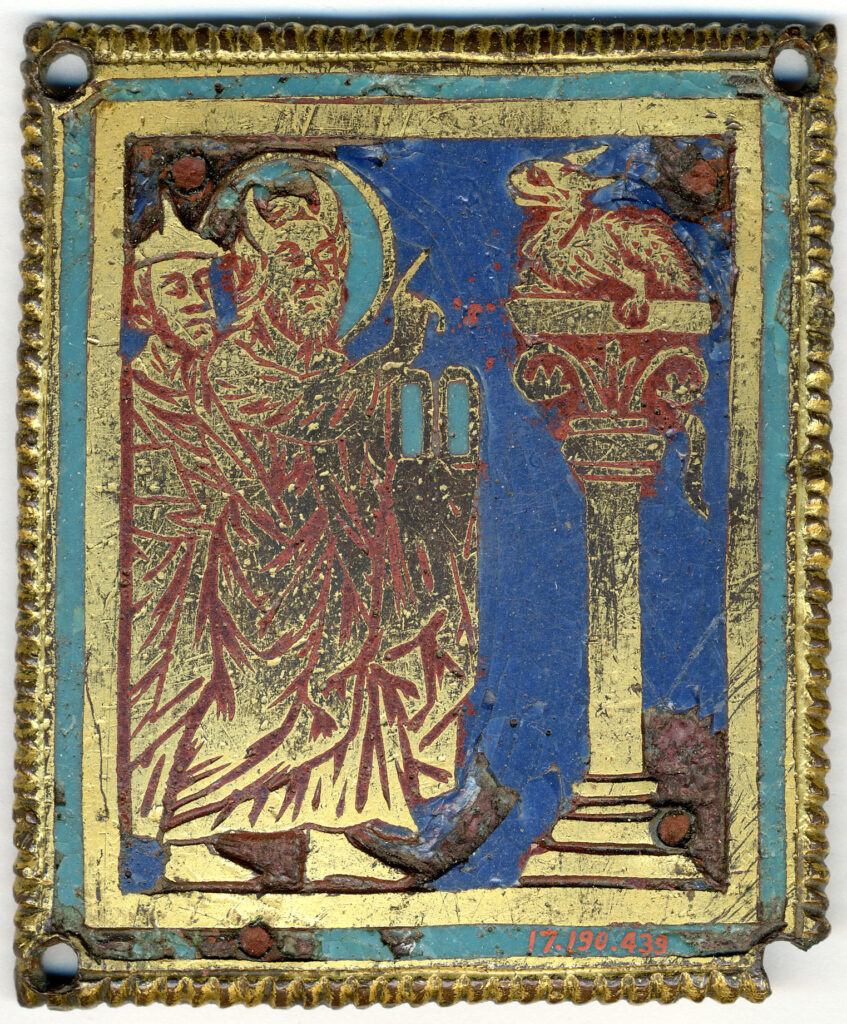
Its origin story, when the Torah gets around to telling it, is straightforward enough. In Numbers 21, the people complain against God and Moses in the wilderness; God sends venomous serpents among them as punishment; the people repent; Moses is instructed to make a bronze serpent and set it on a standard, so that anyone bitten who looks at it will live. It is a strange kind of miracle — the cure modelled on the affliction, the very shape of the danger turned into its own remedy — but it is presented as a single, contained episode, resolved in nine verses and never mentioned again until Hezekiah’s hammer four hundred years later.
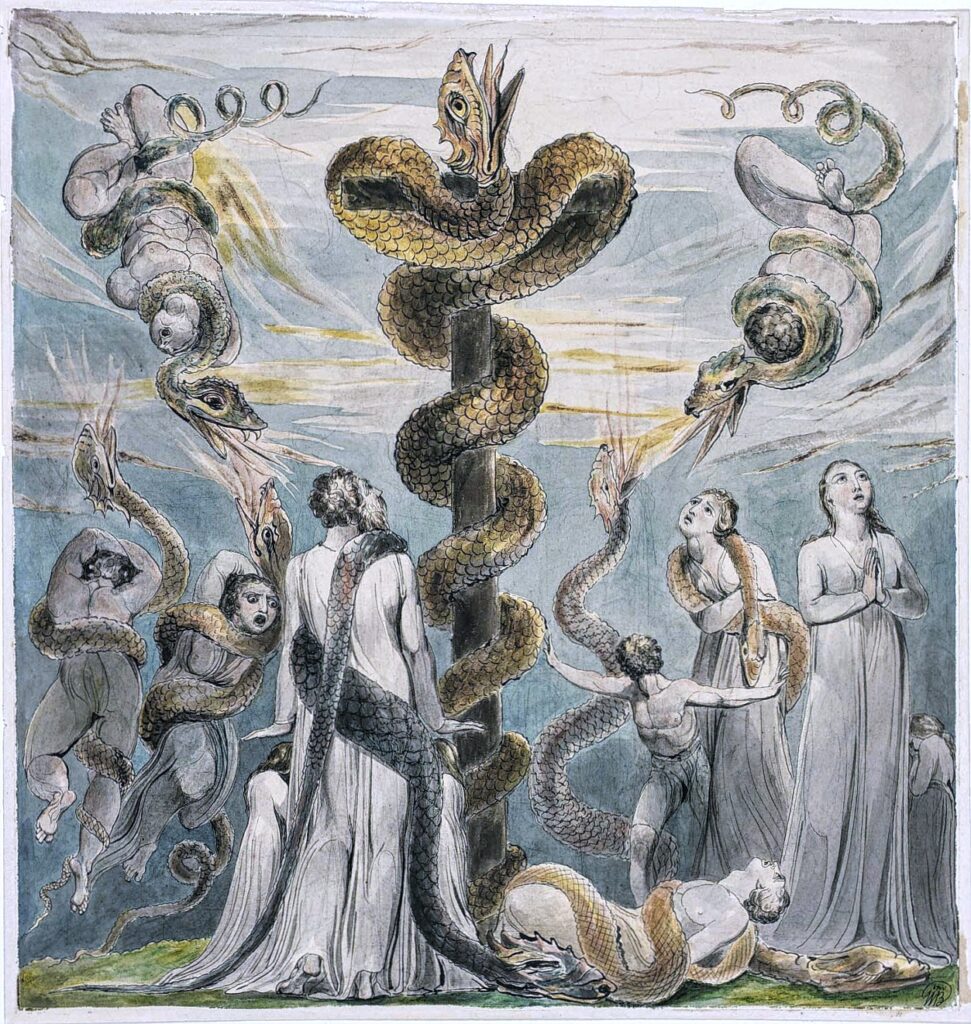
That silence is the real puzzle. An object credited with saving the nation from a plague of serpents in the wilderness, made at God’s own instruction, ought to have accumulated some history along the way: a story of how it travelled from Sinai to Jerusalem, who guarded it, why it ended up in Solomon’s Temple rather than some older, more obviously Mosaic sanctuary. No such story survives. What does survive is a stone: the “Serpent’s Stone” at the spring of En-Rogel, just outside the city, where Adonijah later held his coronation feast (1 Kings 1:9); and the “Dragon’s Well,” mentioned in passing centuries afterward by Nehemiah (2:13). Jerusalem, in other words, knew a serpent-marked landscape well before David ever took the city from its Jebusite inhabitants. One influential, if now dated, argument holds that Zadok, the priest David kept on in Jerusalem despite his conspicuously undocumented genealogy, was himself a survival of that older Jebusite priesthood, and that the bronze serpent he served was already standing in the city’s sanctuary when David arrived. On this reading, Numbers 21 is not history preserved but history supplied: a Mosaic pedigree attached, generations later, to an object whose real origin was considerably less flattering to explain.
The wider region makes the idea easy to credit. Bronze-age Canaanite sites across Palestine — Megiddo, Gezer, Hazor, Beth-shan — have produced serpent imagery bound up with fertility goddesses, sacred springs, and the ordinary business of asking the earth to keep producing. A serpent icon standing in a Jerusalem shrine before Israel’s arrival would not have been an oddity; it would have been the regional default. Even the Hebrew wordplay hints at how naturally the object sat inside its adopted tradition: nĕḥuštān shares its root with nĕḥōšet, bronze, but sounds close enough to nāḥāš, serpent, that a much later rabbinic tradition could not resist punning on the two, as though the material and the creature had always half-implied each other.
Whatever brought the object into Jerusalem’s cult, its function once there looks less like fertility and more like medicine. The healing described in Numbers 21 belongs to a recognisable and widespread logic: sympathetic magic, in which the image of the harmful creature becomes the instrument of its own cure, attested from Egyptian apotropaic amulets to, centuries later and far to the west, the god Asclepius. Ovid has him tell a petitioner: “Only look upon the serpent that twines about my staff, I shall change myself into this.” Look, and live by looking: the Greek and the Hebrew traditions, without any contact between them, arrived at the identical gesture. In the Arabah, where Israelite tradition places the wilderness wandering, that logic acquires an almost literal footnote: a small bronze serpent, excavated from a Late Bronze Age shrine at Timna, sits in exactly the copper-mining region that gives a local viper, coppery, common, and genuinely dangerous, its modern name, and where a wadi is still called, in Hebrew, the stream of Nehushtan.
None of this made the object any less dangerous to Hezekiah’s reforming eye. A cure had become, over three centuries, an idol; a piece of homeopathic medicine had turned into something people burned incense to. And whatever the bronze serpent of the Temple actually was, its family resemblance to something far larger was never in doubt. When the Bible reaches for language to describe the forces truly beyond taming — chaos itself, coiled in the sea — it does not invent a new vocabulary. It reaches for the same creature.
3. A Monster With Too Many Names
“On that day the LORD with his cruel and great and strong sword will punish Leviathan the fleeing serpent, Leviathan the twisting serpent, and he will kill the dragon that is in the sea.” Isaiah writes this as prophecy, a battle still to come, fought against an enemy who is very much still alive. Elsewhere in the same collection of texts, Leviathan is considerably less alarming. In Psalm 74, God has already crushed the monster’s heads and handed the carcass to the desert creatures as food — past tense, settled business. In Psalm 104, Leviathan is barely a monster at all: a sea-creature God formed, the poem says, simply to play in the water, one detail among the general splendour of creation. And in the long, unresolved final speeches of Job, Leviathan gets an entire chapter of description that adds up not to a threat but to a boast on God’s part, proof that some things in creation belong entirely outside human mastery.
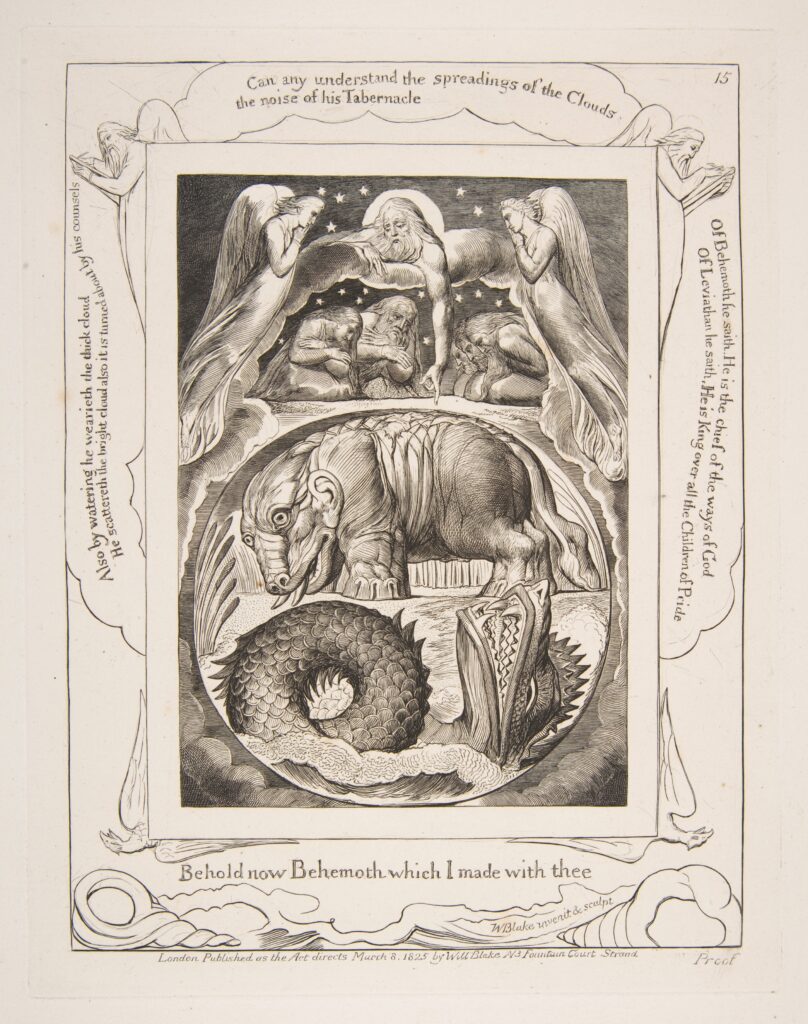
The same name, four different registers: unfinished cosmic war, ancient victory, harmless plaything, unanswerable wonder. The Hebrew Bible never settles on what Leviathan is, and the reason becomes clear the moment you look at where the figure came from.
At Ugarit, on the Syrian coast, centuries before any of these Hebrew texts were written down, the storm-god Baal receives a boast very close to a victory report: “When you struck down Litan the fleeing serpent, finished off the twisty serpent, the powerful one with seven heads.” A few tablets away, in an entirely different scene, the goddess Anat lists her own past kills to a pair of messengers, and among them is “the twisty serpent, the powerful one with seven heads” — word for word the same epithets, attached this time not to a monster named Litan but to one called Tunnan, and defeated not by Baal but by Anat. Whether Tunnan and Litan are the same creature under two names, or two closely related monsters sharing a stock vocabulary, Ugaritic myth itself never bothers to resolve; the tradition was evidently comfortable letting more than one god claim the same kind of victory over more than one version of the same enemy.
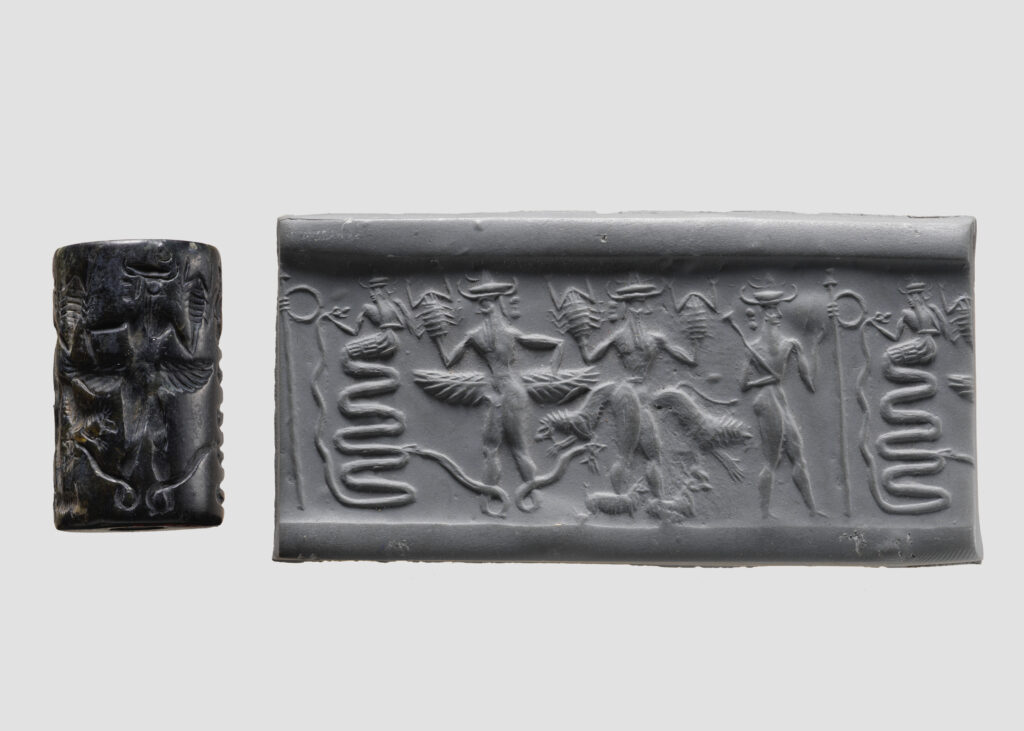
What it does not leave ambiguous is the vocabulary. Fleeing serpent, twisting serpent, seven heads: these are not loose thematic echoes but a set of formulas, and Isaiah’s Leviathan carries every one of them into Hebrew almost unchanged — nāḥāš bāriaḥ, nāḥāš ʿăqallātôn, a correspondence tight enough that “twisting serpent” in Hebrew is essentially a translation of the Ugaritic phrase, not a coincidence of imagery. Whoever composed Isaiah 27 was not inventing a monster. He was reaching for a figure whose exact description had already been fixed in the region’s mythic vocabulary for the better part of a millennium — a figure old enough, by the time it reaches Isaiah, to have already been carved with seven heads on a Mesopotamian cylinder seal the better part of a millennium before the Ugaritic tablets themselves were written, and well over a thousand years before Isaiah’s.
That is the real inheritance: not a single myth passed down intact, but a durable image — the coiling, multi-headed enemy of the sea — that different cultures kept reaching for and never quite agreed on what to do with. Ugarit let two different gods claim its death. Israel could not decide whether the death had already happened, was still to come, or had never really been in question at all. The figure would travel further still, into a text written centuries after Isaiah and in a different language entirely, where a war in heaven would finally give it seven heads, ten horns, and a name it had never carried before.
4. One Verse, Three Genealogies
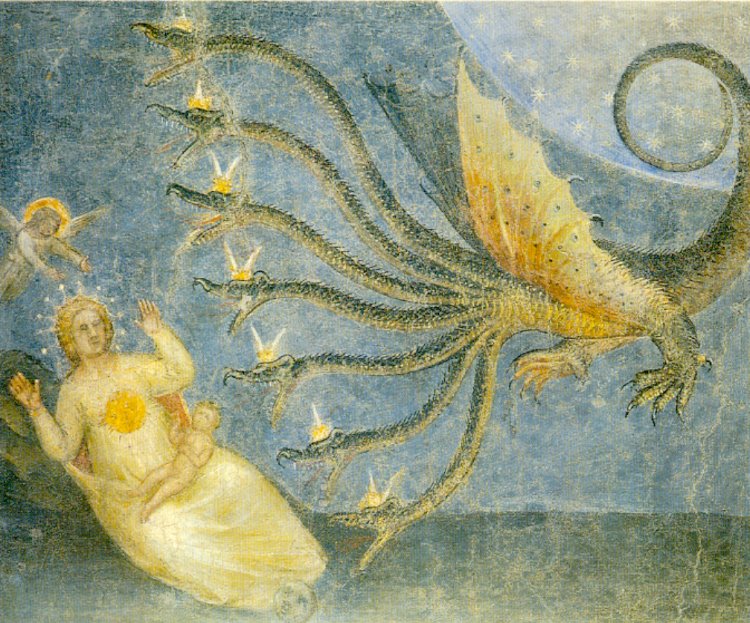
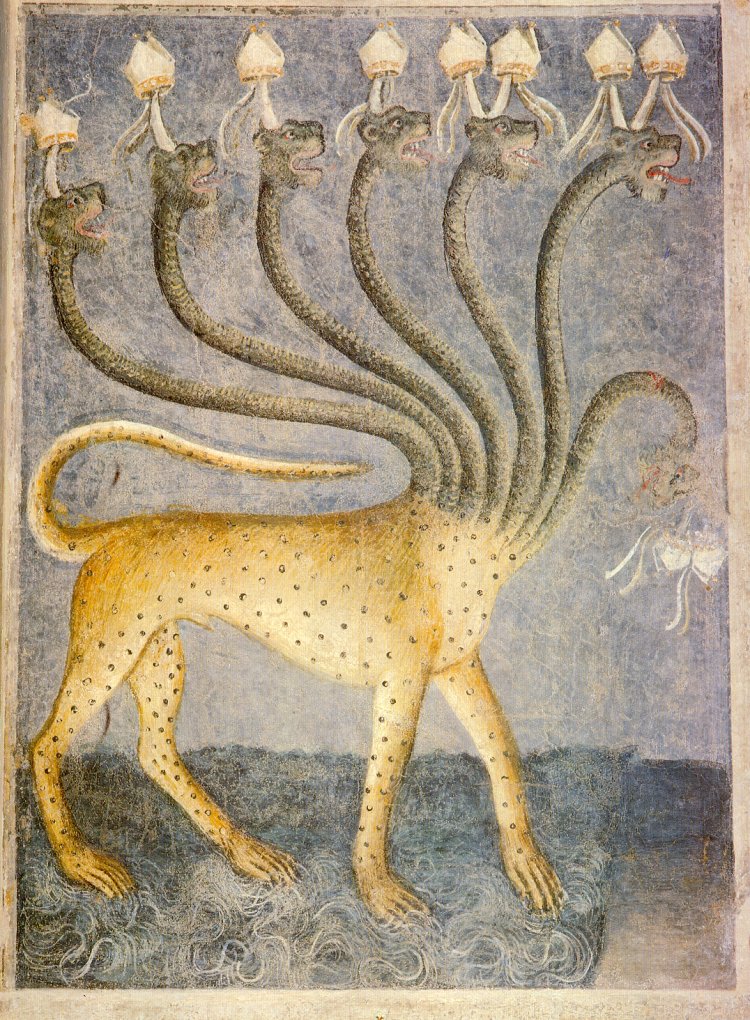
The dragon makes its entrance in Revelation 12 with the same seven heads Litan wore at Ugarit and Leviathan wore in Isaiah, and for two paragraphs it does more or less what dragons in this tradition have always done: it waits by a labouring woman, ready to devour her child the moment it is born. Then, in the space of a single verse, the text stops behaving like a combat myth and starts explaining itself: “And the great dragon was thrown down, that ancient serpent, who is called the devil and Satan, the deceiver of the whole world.” Three names, three genealogies, collapsed into one clause. The dragon is the old chaos-monster of the sea. The “ancient serpent” — ho ophis ho archaios in the Greek, a phrase that only makes sense as a deliberate pointer backward — is the unnamed creature of Genesis 3. And “the devil and Satan” is the accuser, the fallen adversary, the figure Judaism and Islam would each go on to develop into Ha-Satan and Iblis. This is the moment the three strands of this article stop running in parallel and get tied into a single knot.
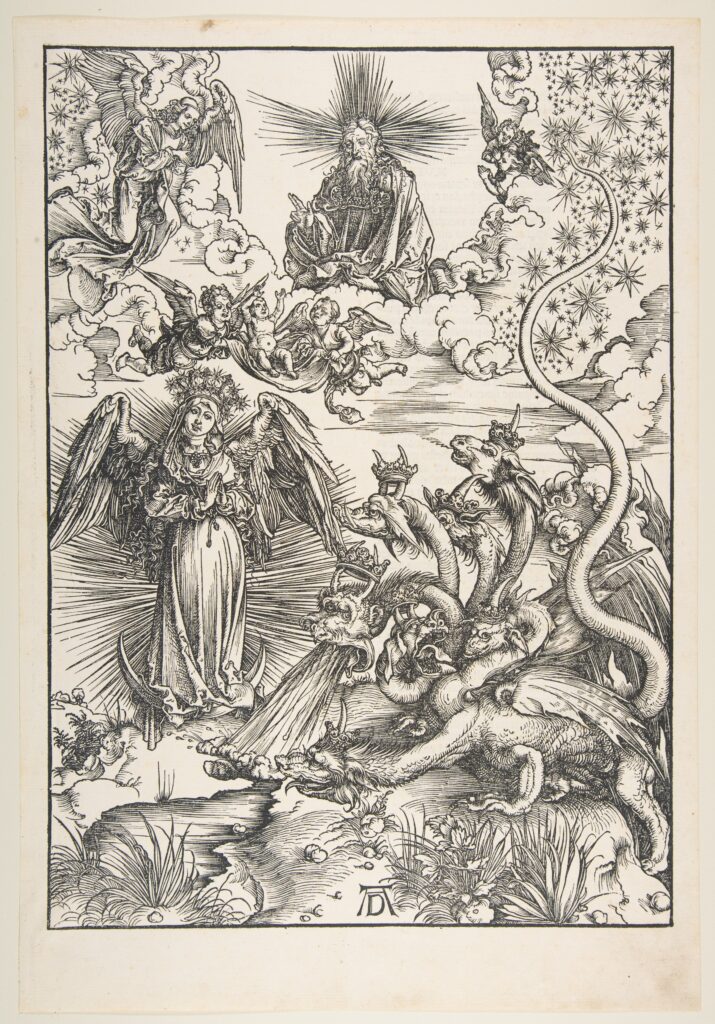
The knot was not always there. Two separate stories sit behind Revelation 12, and neither one, on its own, has anything to do with the Garden of Eden. The first follows a pregnant woman fleeing a monster that wants her child dead the instant it is born, which is not biblical material at all but a close reworking of the myth of Leto: pursued across the earth by the serpent Python at Hera’s instigation, delivering her son Apollo only once safely away from the monster’s reach. The story was not an obscure import. Leto and Python were worshipped, with inscriptions and coinage to prove it, in exactly the cities of western Asia Minor that Revelation itself addresses as its seven churches — Ephesus among them. The second story, the war in heaven in which Michael casts the dragon down, descends instead from a much older Near Eastern pattern of a rebellious lesser god cast out of the divine council, the same pattern that gives Isaiah his taunt against the king of Babylon as a fallen “Day Star, son of Dawn,” and that Jewish writers of the centuries just before and after Revelation had already elaborated into a full narrative of Satan’s primordial fall, jealous of Adam and unwilling to bow before him — the very story, transposed into Arabic some five centuries later, that gives the Quran its Iblis.
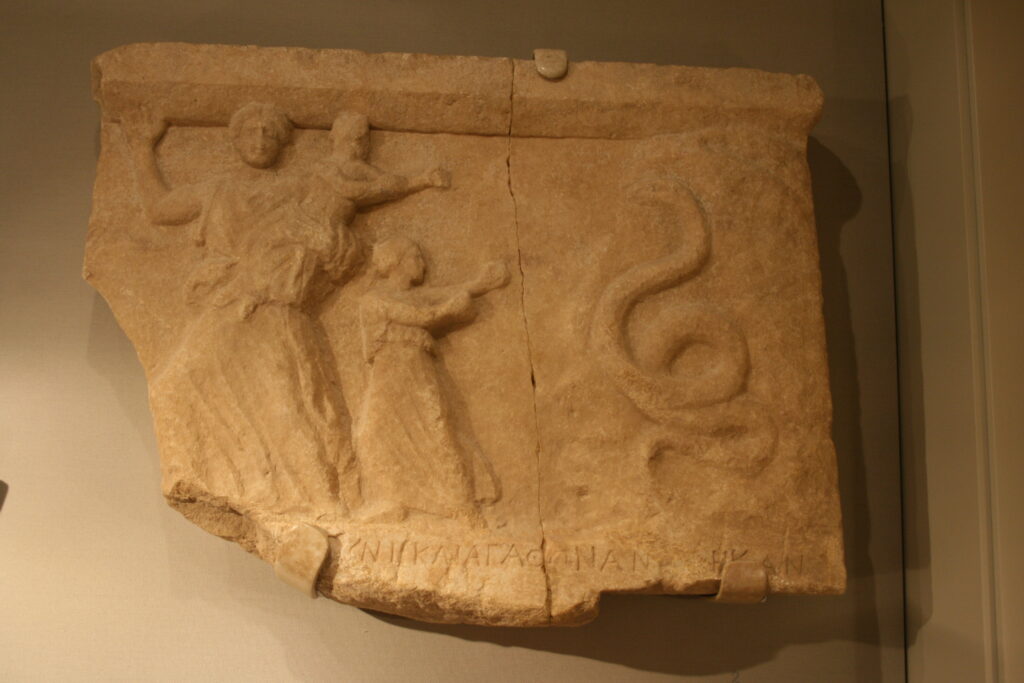
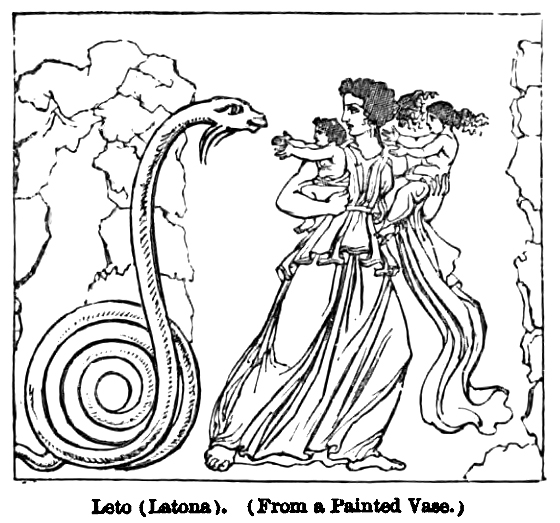
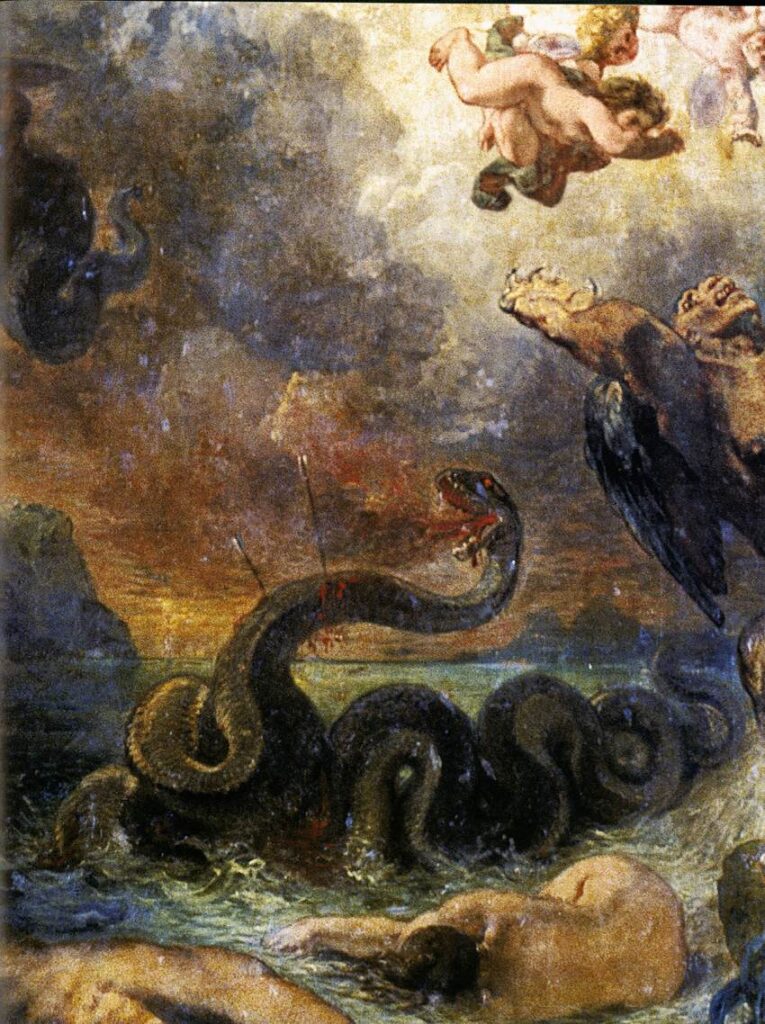
Neither source, by itself, needed Genesis 3. What let a Christian editor weld them together, and weld both of them onto the Eden story besides, was an accident of translation. The Greek word ophis serves double duty in the Septuagint: it is what the Genesis serpent is called, and it is also the word used for Leviathan in Isaiah’s Greek text. One vocabulary item, spanning two originally unrelated monsters, gave a first-century writer the linguistic room to say that they had, all along, been the same creature. The fusion is not a vague thematic resonance that later readers projected backward. It is a specific redactional decision, visible in the seams if you know where to look, made possible by a translator’s word choice centuries before Revelation was written.
What results is not a summary of the earlier material but a genuinely new claim: that the shrewd, unnamed animal of the garden, the many-headed sea monster Israel could never quite decide whether to fear, and the proud subordinate who refused to bow, whether before Adam in an Arabian retelling or before God in a Judean one, were never three figures to begin with. They were one figure, encountered three times, under three different names, by three traditions that had no reason to suspect they were describing the same thing. The Greek clause that finally says so runs on without a comma to mark where the dragon ends and the serpent begins, or where the serpent ends and the devil begins. In the manuscript, as in the history behind it, the seams were never meant to show.
A Note on Sources and Scholarly Uncertainty
The reading of Genesis 3 that opens this article rests on two layers of confidence that shouldn’t be flattened together. The demythologization of the serpent, its reduction from a once-divine Canaanite figure to an unnamed talking animal, is close to scholarly consensus, argued at length by Nahum Sarna among others. The ophiomantic reading that follows it, the suggestion that the serpent’s opening question echoes the vocabulary of Mesopotamian snake divination, is a minority position within the field. It rests on a proposed wordplay between nāḥāš and a divinatory root that not every Semitist accepts, and it is presented here as an argued possibility, not an established fact.
The Quranic paragraph draws on Wahb ibn Munabbih’s account, preserved in at-Tabari’s Taʾrīkh (ed. de Goeje, I, 106–107) and cross-referenced in his Tafsīr, in preference to the later, more elaborate composite version transmitted through ath-Thaʿlabī. Wahb’s version was chosen as the earliest attested telling of the story, not because the later version is unreliable, but because a closer paraphrase of Genesis, attached to an earlier and more precisely datable narrator, makes for a cleaner argument. Two full monographs stand behind this section: Peter Awn’s study of Iblis in Sufi psychology was read in its entirety, though only its opening chapter, on Iblis’s Quranic and pre-Islamic origins, is drawn on directly; its later chapters, on Iblis’s afterlife in Sufi mysticism, belong to a different article. Roberto Tottoli’s survey of biblical prophets in Muslim literature was likewise read in full and is the source for both the Wahb ibn Munabbih material and the broader isrāʾīliyyāt framework referenced throughout.
The Nehushtan section rests on an older and a newer source that were never in conversation with each other. H. H. Rowley’s argument for Zadok as a survival of Jerusalem’s pre-Israelite priesthood dates to 1939 and has not been checked here against scholarship published after 1980; it is presented as an influential and still-cited hypothesis, not a settled finding. Karen Joines’s 1968 article, and a 2023 study by Gillian Williams and Mariette Harcombe that extends the sympathetic-magic reading with comparative material from Timna and the cult of Asclepius, sit on firmer and more recent ground. A book-length treatment by Joines from 1974, which would likely have deepened the archaeological material further, could not be located through the sources available during research and is absent from what follows.
The Ugaritic material in the Leviathan section is drawn from a single, precisely bounded passage, CAT 1.3 III’s account of Anat’s battles and its extended scholarly commentary, in Mark Smith and Wayne Pitard’s critical edition of the Baal Cycle. The edition itself runs to several hundred pages of philological commentary on material unrelated to the serpent; only the passage in question, and the commentary attached to it, was consulted. John Day’s discussion of Leviathan and Isaiah 27:1 was read in the relevant chapter of his book, not the volume as a whole.
The redactional argument in the final section, that Revelation 12:9 fuses two Jewish sources with the Genesis serpent via the Septuagint’s double use of ophis, follows Adela Yarbro Collins’s The Combat Myth in the Book of Revelation closely; the book was read in full. The connection drawn at the end of that section, between the Jewish fallen-angel tradition behind Revelation’s war in heaven and the Quran’s account of Iblis’s refusal to bow, is this article’s own synthesis, built by placing Awn’s citation of the Vita Adae et Evae alongside Yarbro Collins’s citation of the same text, rather than a link either author makes explicitly. Three further monographs identified as directly relevant to this fusion, Neil Forsyth’s The Old Enemy, Ziony Zevit’s What Really Happened in the Garden of Eden?, and Bernard Batto’s Slaying the Dragon, could not be obtained through any free and legal channel during the research for this article and are not cited below, though their arguments, so far as they could be reconstructed from published tables of contents and reviews, appear consistent with the reading offered here.
Biblical quotations follow the New Revised Standard Version and Quranic quotations follow M. A. S. Abdel Haleem’s translation. The two direct quotations from the Hebrew Bible (Genesis 3:1 and Isaiah 27:1) have been checked and corrected against the NRSV’s exact wording; the Quranic verse citations (7:20, 20:120) are referenced by number rather than quoted directly and have not required the same check.
Bibliography
Primary Sources
At-Ṭabarī, Muḥammad ibn Jarīr. Taʾrīkh al-rusul wa’l-mulūk. Edited by M. J. de Goeje. Leiden: Brill, 1879–1901.
At-Ṭabarī, Muḥammad ibn Jarīr. Jāmiʿ al-bayān ʿan taʾwīl āy al-Qurʾān. Cairo, various editions.
The Holy Bible: New Revised Standard Version. Nashville: Abingdon Press, 1989.
The Qur’an. Translated by M. A. S. Abdel Haleem. Oxford World’s Classics. Oxford: Oxford University Press, 2004.
Smith, Mark S., and Wayne T. Pitard. The Ugaritic Baal Cycle, Volume II: Introduction with Text, Translation and Commentary of KTU/CAT 1.3–1.4. Supplements to Vetus Testamentum 114. Leiden: Brill, 2009.
Secondary Sources
Alter, Robert. Genesis: Translation and Commentary. New York: W. W. Norton, 1996. [Attribution of the arum/arummim wordplay follows a secondary citation in Zvi Ron’s article, below; not independently verified against Alter’s primary text.]
Awn, Peter J. Satan’s Tragedy and Redemption: Iblīs in Sufi Psychology. Studies in the History of Religions 44. Leiden: Brill, 1983.
Day, John. God’s Conflict with the Dragon and the Sea: Echoes of a Canaanite Myth in the Old Testament. Cambridge: Cambridge University Press, 1985.
Joines, Karen Randolph. “The Bronze Serpent in the Israelite Cult.” Journal of Biblical Literature 87, no. 3 (1968): 245–256.
Ron, Zvi. “Wordplay in Genesis 2:25–3:1.” Jewish Bible Quarterly 42, no. 1 (2014).
Rowley, H. H. “Zadok and Nehushtan.” Journal of Biblical Literature 58, no. 2 (1939): 113–141.
Sarna, Nahum M. Understanding Genesis: The Heritage of Biblical Israel. New York: Jewish Theological Seminary of America, 1966.
Smith, Duane E. “The Divining Snake: Reading Genesis 3 in Light of Mesopotamian Ophiomancy.” Journal of Biblical Literature 134, no. 1 (2015).
Tottoli, Roberto. Biblical Prophets in the Qur’an and Muslim Literature. Richmond, UK: Curzon, 2002.
Williams, Gillian, and Mariette Harcombe. “Reconsidering the Nehushtan as a Magical Healing Device within the Geographical, Cultural, and Magico-Religious Context of the Ancient Near East.” Religions 14, no. 11 (2023): 1404.
Yarbro Collins, Adela. The Combat Myth in the Book of Revelation. Harvard Dissertations in Religion 9. Missoula, MT: Scholars Press, 1976.
Sources identified as relevant but not directly consulted
Batto, Bernard F. Slaying the Dragon: Mythmaking in the Biblical Tradition. Louisville: Westminster John Knox, 1992.
Forsyth, Neil. The Old Enemy: Satan and the Combat Myth. Princeton: Princeton University Press, 1987.
Hendel, Ronald S. “Nehushtan” and “Serpent.” In Dictionary of Deities and Demons in the Bible, 2nd ed., edited by Karel van der Toorn, Bob Becking, and Pieter W. van der Horst. Leiden: Brill, 1999. [Consulted only in preview via Brill Reference Works Online; full entries not accessed.]
Joines, Karen Randolph. Serpent Symbolism in the Old Testament: A Linguistic, Archaeological, and Literary Study. Haddonfield, NJ: Haddonfield House, 1974.
Zevit, Ziony. What Really Happened in the Garden of Eden? New Haven: Yale University Press, 2013.