There is no such thing as Native American mythology.
There are the cosmologies of the Ojibwe, the Muscogee Creek, the Tewa, the Hopi, the Zuni, the Adena, the Mississippian peoples of Cahokia, and several hundred other distinct nations with their own languages, their own sacred geographies, their own ways of organizing the relationship between the human and the non-human world. What we call “Native North America” spans more cultural and linguistic diversity than the entire European continent. Any article that treats it as a unified tradition is doing something intellectually dishonest.
This article does not do that. It selects four examples — the Great Serpent Mound of Ohio, the Horned Serpent of the Eastern Woodlands and the Southeast, the Avanyu of the Pueblo Southwest, and the serpent’s cosmological function in Hopi tradition — because these are the cases where the scholarly record is substantial and the serpent’s role is documented with sufficient rigor to warrant careful analysis. Other traditions across the continent — the Pacific Northwest, the Subarctic, the Great Plains — contain their own serpentine figures and deserve their own treatment. This article makes no claim to represent them.
What it does claim is that across the examples it examines, something remarkable holds: the serpent occupies a consistent structural position. It governs water. It inhabits the world below. It connects the levels of the cosmos. These convergences, within a single continent, across nations separated by millennia and thousands of miles, are the finding.
I. The Great Serpent Mound: A Serpent Written into the Landscape
In Adams County, Ohio, someone built a serpent 411 meters long.
The body undulates across the ridge in seven coils. The tail spirals inward at one end. At the other, the mouth opens wide around an oval form — an egg, perhaps, or the sun, or a frog; scholars have not agreed. The whole structure rises roughly a meter above the surrounding terrain, carefully constructed of layered clay and ash and stone, shaped and smoothed and maintained. It has no burial chamber. It contains no artifacts that would definitively identify its builders. It is simply a serpent, traced with extraordinary care into the earth of the Ohio Valley, oriented toward the summer solstice sunset.
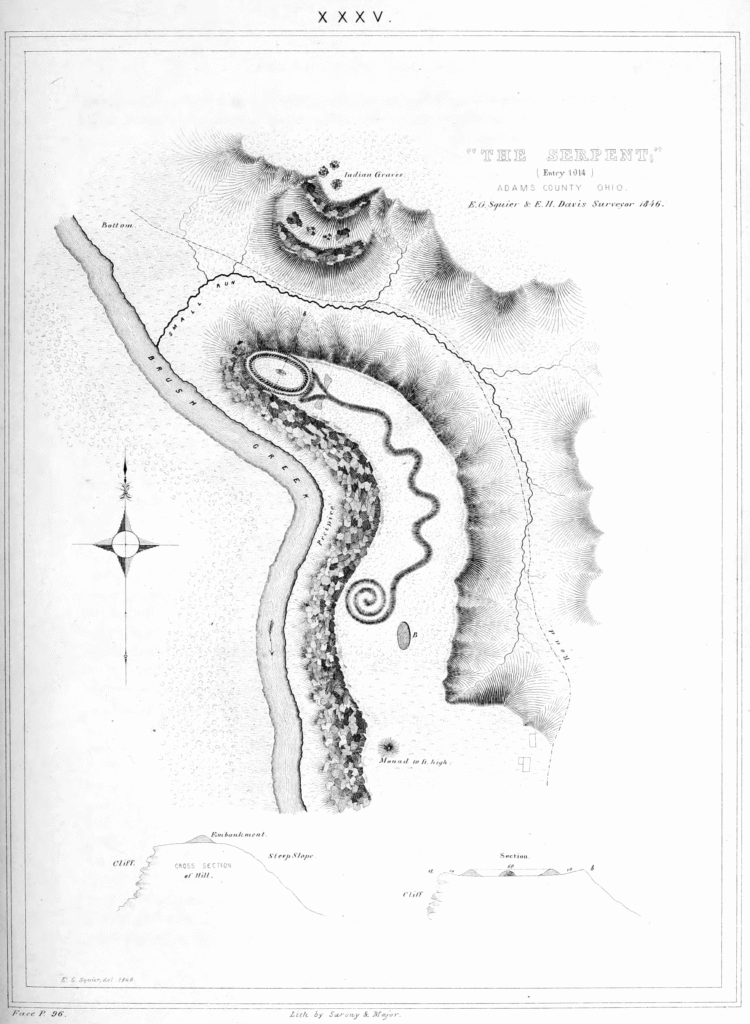
Who built it, and when, is a question that remains genuinely open. Nineteenth-century archaeologists attributed the mound to the Adena culture, whose burial mounds cluster nearby and who flourished in the Ohio Valley from approximately 800 BCE to 100 CE. Radiocarbon dating in 1991 suggested a much later date — approximately 1070 CE — pointing instead to the Fort Ancient culture. In 2014, a new team obtained dates pointing back to roughly 300 BCE, consistent with Adena construction, with evidence of later Fort Ancient repair or renovation. That 2014 dating has itself been challenged. The debate continues in peer-reviewed archaeology journals, and this article will not pretend to resolve it.
What is not contested is what the mound is, and what the serpent meant across the cultures that occupied this landscape over centuries. The Great Serpent of Native North American tradition — known by different names in different nations — is consistently associated with the world below the surface of the earth, with the passage of souls after death, and with the waters that flow beneath the ground. Archaeoastronomical analysis of the site connects the mound’s orientation to the constellation Scorpius, which in several Woodland traditions was associated with the Great Serpent and with the Milky Way as the path of the dead. Whether the builders were Adena or Fort Ancient or both, they were working within a cosmological tradition in which the serpent held a specific and serious place.
The mound’s most striking feature is its apparent purposelessness by ordinary archaeological standards. No one was buried here. No objects were deposited. The effort required to build it — thousands of person-hours of earthmoving, compacting, shaping — was not invested in securing an afterlife for the dead or in storing wealth. It was invested in making a serpent visible on the landscape, large enough to be seen only from above, oriented toward a specific moment in the astronomical calendar. Something about the serpent warranted this.
II. The Horned Serpent: Sovereign of the Waters
Beneath the surface of rivers and lakes in the traditions of many nations of the Eastern Woodlands and the Southeast, something vast and dangerous lives.
It is enormous. It is horned, or antlered, or both. It controls the water — not merely as a resident but as a sovereign. Its goodwill permits safe crossing; its anger produces floods, whirlpools, the sudden violence of water that kills. It is the being that lives where the human world ends and the world below begins, at the threshold that rivers and lakes mark between what can be seen and what cannot.
Scholars have identified the Horned Serpent as one of the central figures of what archaeologists call the Southeastern Ceremonial Complex — a network of shared iconographic and ritual elements distributed across the Mississippian cultures of eastern North America during and before the period from approximately 800 to 1600 CE. The winged and horned serpent is among the most frequently occurring motifs on Mississippian ceramics and ritual objects: at Moundville, Alabama, the single most common design on the pottery assemblage is the U-shaped serpent with horns and wings.
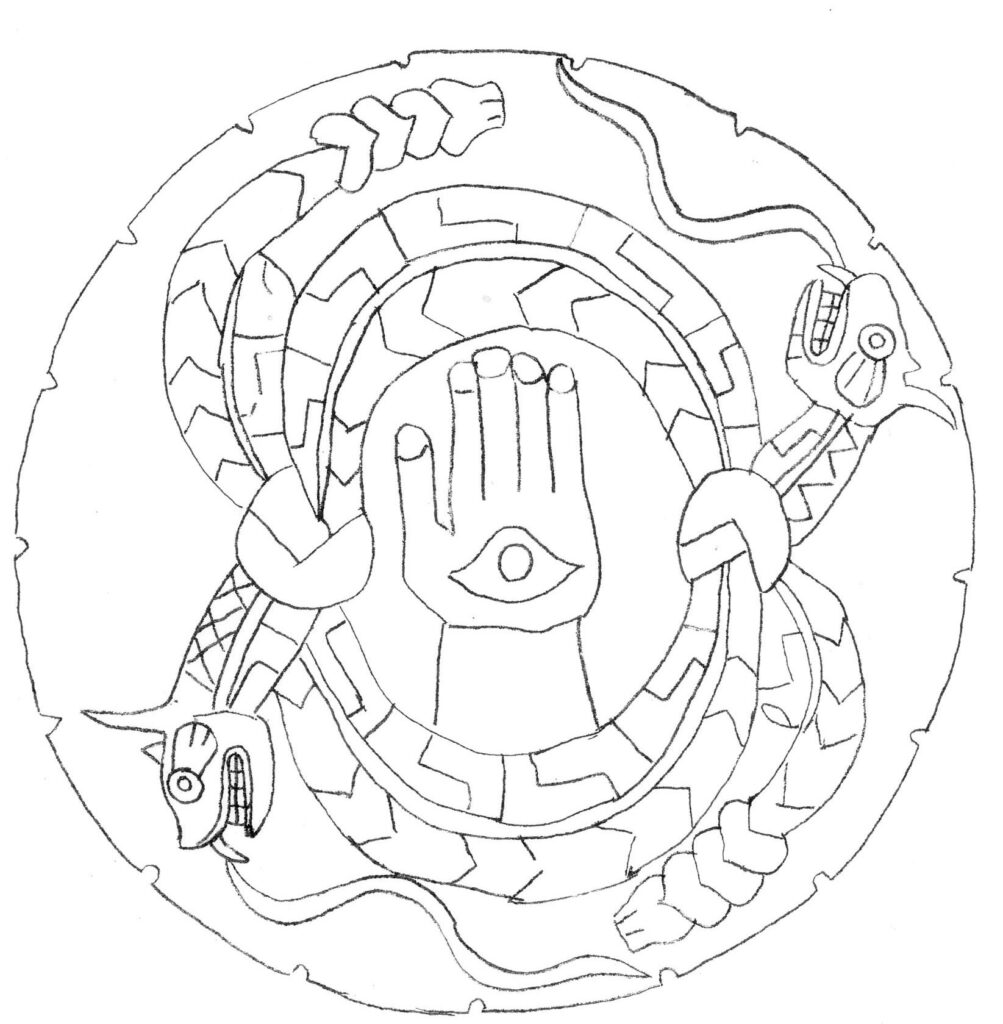
The Horned Serpent appears not only in the material record but in the oral traditions of nations whose descendants carry living relationships with these figures today. In Muscogee Creek tradition, the Horned Serpent is a being of power associated with the underwater world, whose relationship with humans is one of danger carefully managed. In Ojibwe and other Algonquian traditions, the great underwater serpent controls the water and must be negotiated with before crossing. The specific names and forms differ across nations. The structural position — the great being that governs water from below — recurs with remarkable consistency.
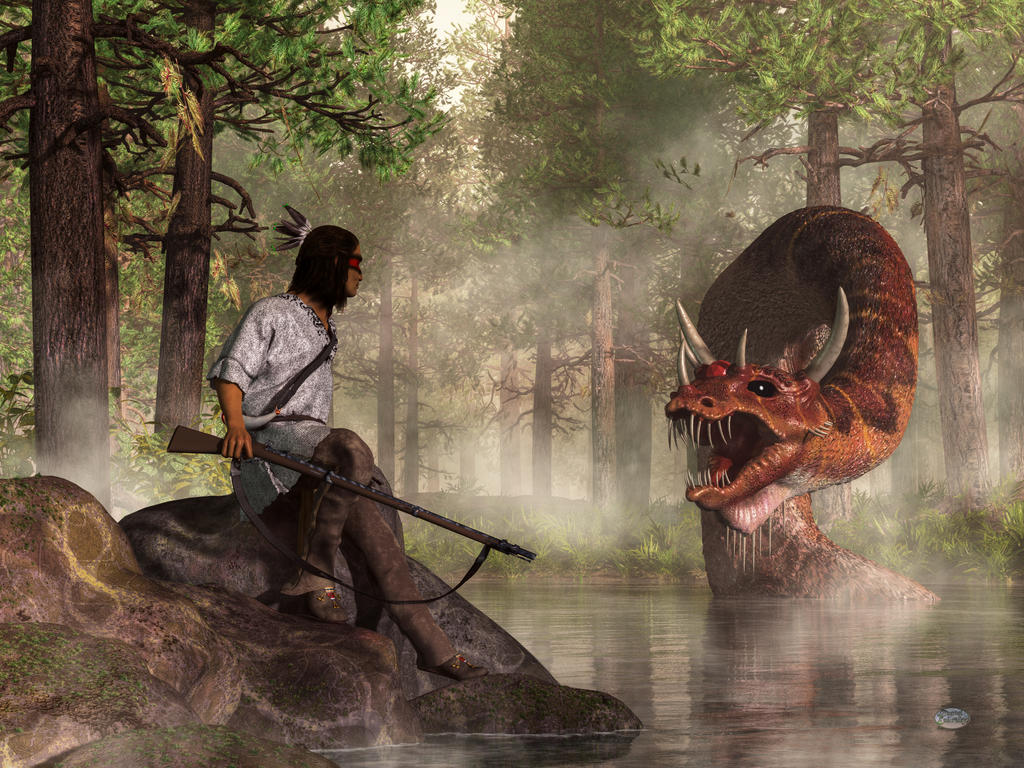
What the Horned Serpent governs is not simply water as a physical substance. It governs the boundary between the world above — the realm of the living, of sunlight, of the everyday — and the world below, which is the realm of the dead, of hidden power, of what sustains life from underneath. Rivers and lakes are not merely bodies of water in this cosmological framework. They are thresholds. The serpent is what lives at the threshold and keeps it.
III. Avanyu: The Serpent That Brings Rain
In the desert Southwest, the problem is not flooding. The problem is drought.
On the canyon walls of New Mexico, pecked into sandstone above the Rio Grande, a serpent winds through the rock. It is horned, sometimes plumed, its body curved in ways that suggest flowing water or the zigzag of lightning. It appears in locations that were, or are adjacent to, sources of water — above rivers that run seasonally, near springs, at sites where the sky and the land meet over a desert landscape whose survival depends on precipitation.
This is Avanyu — the Tewa Pueblo name for a figure that appears across multiple Pueblo nations under different names. Among the Zuni, the equivalent figure is Kolowisi. Among the Hopi, Paaloloqangw. The archaeologist Polly Schaafsma, whose decades of fieldwork on Southwestern rock art have produced the most systematic scholarly treatment of this tradition, describes the figure as a water serpent “both feared and respected,” whose home is “in springs, ponds, rivers, and ultimately the oceans, all believed to be connected under the earth’s surface.” The earliest known representations of Avanyu appear on Mimbres pottery dating to approximately 1000–1150 CE, though the figure’s roots likely extend deeper. By the period of the Rio Grande Style — roughly 1300–1700 CE — the horned and plumed serpent is ubiquitous in the rock art of the region.
The body of the serpent is the movement of water. Its zigzag form is the lightning that precedes rain. Its presence on the rock marks the site as a place where the relationship between the human community and water — its arrival, its abundance, its withholding — is addressed and negotiated.
The connections Schaafsma draws between Avanyu and Quetzalcoatl, the feathered serpent of Mesoamerica, are suggestive and academically serious: there is iconographic and archaeological evidence for exchange of imagery between the Pueblo Southwest and Mesoamerica, particularly through the Casas Grandes corridor in northwestern Mexico. The horned and plumed serpent may be an instance not of independent convergence but of documented cultural transmission — which would make it a case study, within this continent alone, for how serpent symbolism travels and transforms across cultural boundaries.
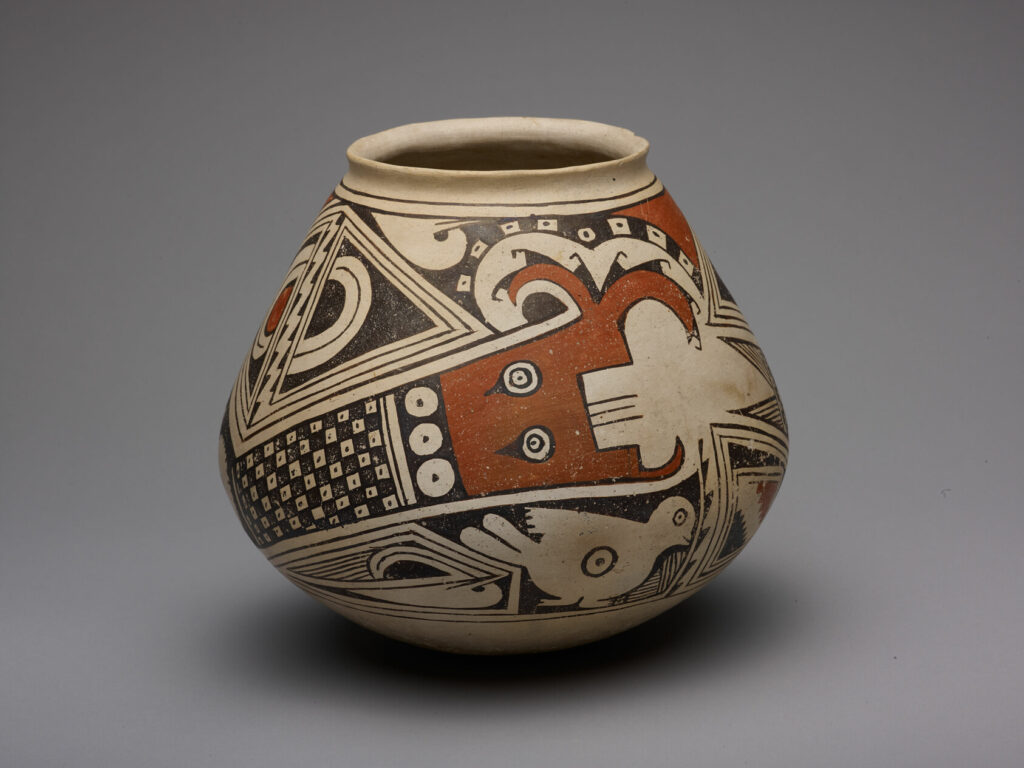
Avanyu is still present on the pottery of Santa Clara Pueblo and San Ildefonso Pueblo today. It is not an extinct symbol or an archaeological relic. The serpent that the Tewa have marked on canyon walls for a thousand years continues to wind across the surfaces of vessels made by living artists who carry that relationship with the figure into the present.
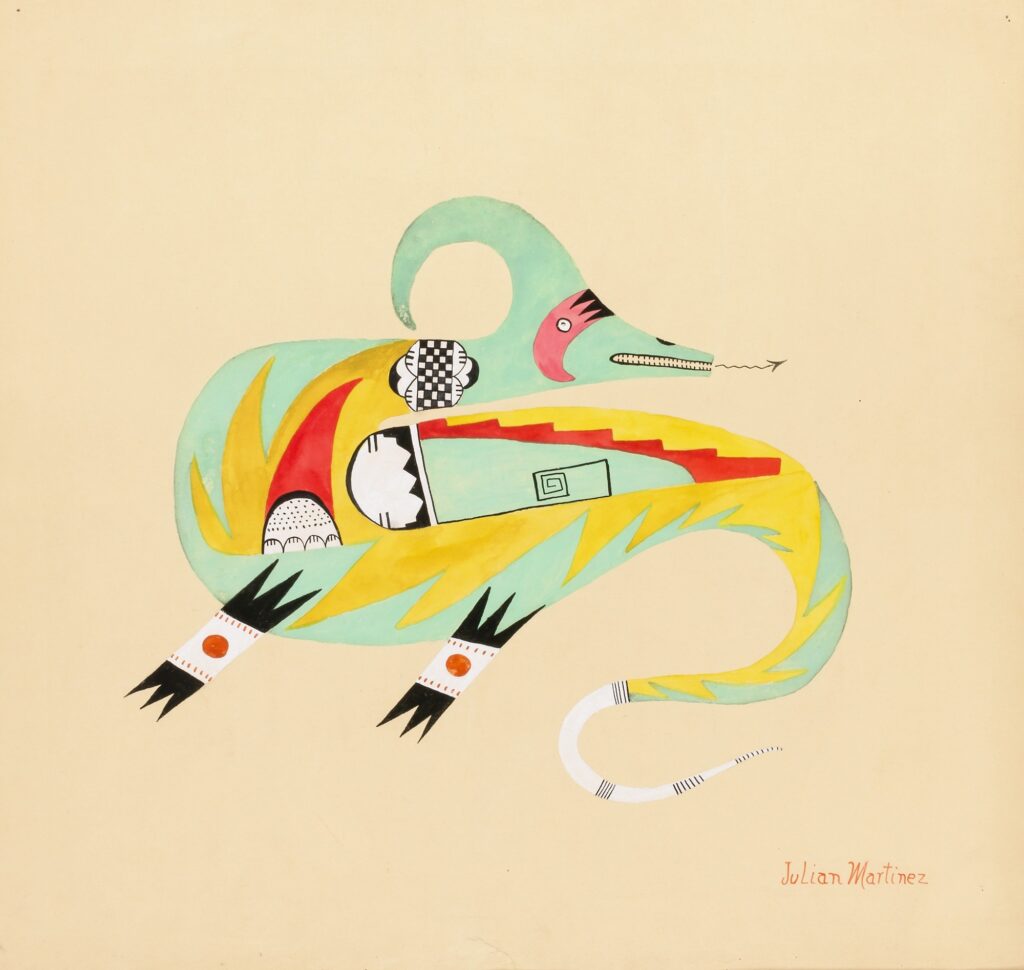
IV. The Hopi and the Serpent: What Can Be Said
The Hopi people of the Arizona mesas have, for centuries, maintained a ceremonial relationship with the serpent that is among the most discussed in the anthropological literature on Native North America — and one of the most restricted.
Since the 1990s, the Hopi have significantly limited outside access to their ceremonial life. Photography is prohibited. Observation by non-Hopi has been restricted at many ceremonies. Hopi spokespeople have been explicit that this restriction reflects a considered decision about cultural sovereignty and the protection of sacred practice from exploitation and misrepresentation. This article respects that decision. What follows concerns the cosmological function of the serpent in Hopi thought as documented in older ethnographic sources — not the details of ceremony, which belong to the Hopi.
In Hopi cosmology, the serpent is understood as a messenger between the world of the living and the world below, where the gods and the spirits of the ancestors reside. Rain comes from below, drawn upward through the intercession of these powers. The serpent, as a being that lives in springs and underground waters, mediates this relationship. It is, in the Hopi understanding documented in the ethnographic record, kin — a being with whom the human community stands in a relationship of mutual obligation rather than simple dominion.
The serpent’s association with rain in the desert Southwest is not metaphorical. Rain is the condition of survival for an agricultural people living in an arid environment. The serpent that governs water governs life. The relationship that Hopi ceremonial practice maintains with the serpent — whatever form that relationship takes in the specific details that are not ours to discuss — is a relationship with the force on which everything depends.
The older ethnographic literature on this subject is substantial, beginning with accounts from the 1880s and extending through the mid-twentieth century. It must be read with awareness that much of it was produced without the full consent of the communities it documented, in a period when the concept of indigenous cultural sovereignty had no place in anthropological practice. That history is part of the scholarly record. Any serious engagement with this tradition must acknowledge it.
The Convergence, Provisionally
Four examples, from four different regions, representing traditions separated by centuries and in some cases millennia.
The serpent that was traced into the Ohio earth at a scale visible only from above. The horned sovereign beneath the surface of the rivers of the Eastern Woodlands. The lightning-bodied water deity whose form is still pecked into the canyon walls of the Southwest. The underground messenger of the desert mesa whose relationship with rain determines whether crops survive.
None of these is the same figure. None of these traditions is the same tradition. The differences are as important as the similarities, and the articles dedicated to specific nations on this site will be the place to treat them properly.
What these four examples share — in the absence of any documented line of transmission that would connect an Ohio earthwork to a Pueblo petroglyph to an Ojibwe underwater spirit — is a structural position. The serpent governs water. The serpent inhabits the world below the living. The serpent connects what is visible to what sustains visibility from underneath.
Across the continent, in traditions that did not speak to one another, the same figure was assigned the same work.
A Note on Sources, Methodology, and Scholarly Limitations
On the diversity of Native North American traditions. This article covers four examples from a continent of extraordinary cultural diversity. The Southeastern Ceremonial Complex, the Pueblo Southwest, and the Hopi tradition represent three distinct cultural and geographic regions; the Great Serpent Mound belongs to a fourth. Dozens of traditions with significant serpentine figures — including those of the Pacific Northwest Coast, the Subarctic, the Great Plains, and California — are not represented here. Their absence reflects the limits of this article, not the limits of their significance.
On the Serpent Mound attribution. The cultural attribution of the Great Serpent Mound remains disputed. Radiocarbon dating published in 2014 and corroborated in 2019 suggests Adena construction ca. 300 BCE, with Fort Ancient repair ca. 1100 CE. Brad Lepper and colleagues have challenged the quality of the 2014 dates, arguing that the best available evidence supports Fort Ancient construction ca. 1070 CE. The debate is ongoing in the peer-reviewed literature — specifically in the Midcontinental Journal of Archaeology and related venues. The cosmological interpretation offered here draws on the broader Woodland tradition rather than claiming certainty about specific builders. For archaeoastronomical analysis connecting the mound’s orientation to Scorpius and the path of souls, see William F. Romain’s work, including “Adena-Hopewell Earthworks and the Milky Way Path of Souls,” in Tracing the Relational: The Archaeology of Worlds, Spirits, and Temporalities, University of Utah Press, 2015.
On the Southeastern Ceremonial Complex and the Horned Serpent. The standard scholarly references are F. Kent Reilly III and James F. Garber (eds.), Ancient Objects and Sacred Realms: Interpretations of Mississippian Iconography (University of Texas Press, 2007), and Susan Power, Early Art of the Southeastern Indians: Feathered Serpents and Winged Beings (University of Georgia Press, 2004). Timothy R. Pauketat, Ancient Cahokia and the Mississippians (Cambridge University Press, 2004) provides essential context for Mississippian cosmology more broadly. For the Muscogee Creek and Ojibwe traditions specifically, tradition-dedicated articles on this site will engage the relevant specialist sources in greater depth.
On Avanyu and the Pueblo horned serpent. The key scholarly reference is Polly Schaafsma, “Quetzalcoatl and the Horned and Feathered Serpent of the Southwest,” in Virginia M. Fields and Victor Zamudio-Taylor (eds.), The Road to Aztlan: Art From A Mythic Homeland (Los Angeles County Museum of Art / University of Texas Press, 2001). Schaafsma’s Indian Rock Art of the Southwest (University of New Mexico Press, 1980, with multiple subsequent editions) provides the essential survey of the iconographic tradition across the region. For the Casas Grandes/Paquimé tradition and the horned serpent’s role as the central deity of that ceremonial world, see Todd L. VanPool and Christine S. VanPool, “Visiting the Horned Serpent’s Home: A Relational Analysis of Paquimé as a Pilgrimage Site in the North American Southwest,” Journal of Archaeological Method and Theory 26 (2019).
On the Hopi and ethnographic sources. The older ethnographic literature on Hopi ceremonial life — including accounts published from the 1880s onward — was produced in a period before the concept of indigenous informed consent existed in anthropological practice. It should be read with that context explicitly in mind. The Hopi Tribe has published statements about their expectations for the use of documentation of their ceremonial life; these should be consulted before any further engagement with this tradition in published form.
Bibliography — The Serpent in Native North America
The Great Serpent Mound and Ohio Valley Earthworks
Romain, William F. “Adena-Hopewell Earthworks and the Milky Way Path of Souls.” In Tracing the Relational: The Archaeology of Worlds, Spirits, and Temporalities, edited by [editor names to verify]. Salt Lake City: University of Utah Press, 2015.
The Southeastern Ceremonial Complex and the Horned Serpent
Pauketat, Timothy R. Ancient Cahokia and the Mississippians. Cambridge: Cambridge University Press, 2004.
Power, Susan. Early Art of the Southeastern Indians: Feathered Serpents and Winged Beings. Athens: University of Georgia Press, 2004.
Reilly, F. Kent III, and James F. Garber, eds. Ancient Objects and Sacred Realms: Interpretations of Mississippian Iconography. Austin: University of Texas Press, 2007.
The Pueblo Southwest and Avanyu
Fields, Virginia M., and Victor Zamudio-Taylor, eds. The Road to Aztlan: Art From A Mythic Homeland. Los Angeles: Los Angeles County Museum of Art, 2001.
Schaafsma, Polly. Indian Rock Art of the Southwest. Santa Fe and Albuquerque: School of American Research and University of New Mexico Press, 1980.
Schaafsma, Polly. “Quetzalcoatl and the Horned and Feathered Serpent of the Southwest.” In The Road to Aztlan: Art From A Mythic Homeland, edited by Virginia M. Fields and Victor Zamudio-Taylor. Los Angeles: Los Angeles County Museum of Art, 2001.
VanPool, Todd L., and Christine S. VanPool. “Visiting the Horned Serpent’s Home: A Relational Analysis of Paquimé as a Pilgrimage Site in the North American Southwest.” Journal of Archaeological Method and Theory 26 (2019).
Ethnographic Sources
Dilworth, Leah. “Representing the Hopi Snake Dance.” Journal of the Southwest.