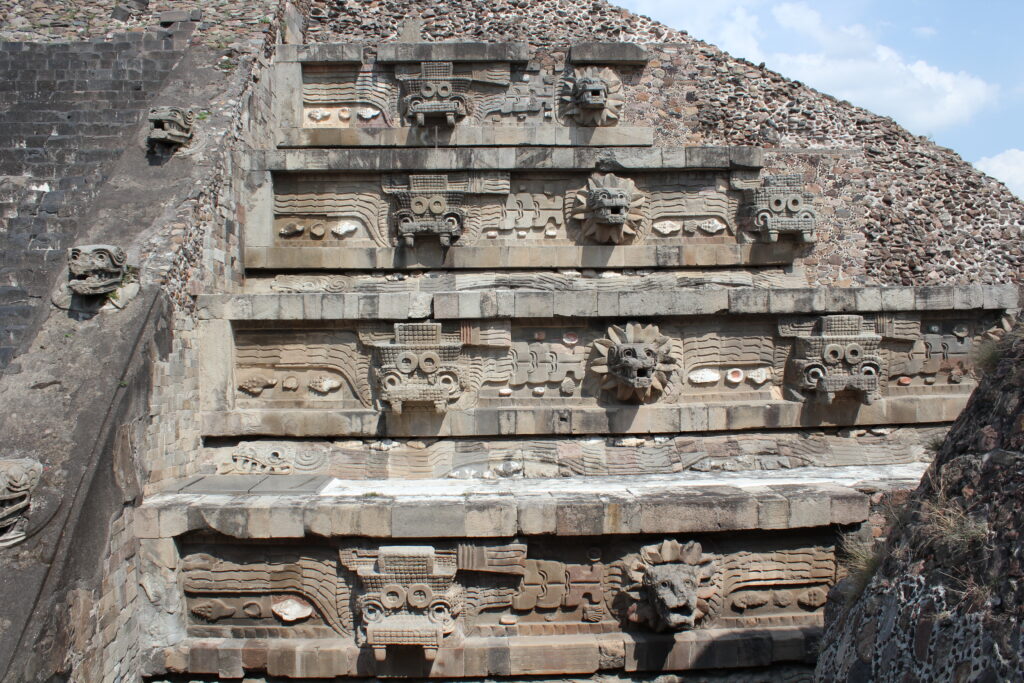
There is a building at Teotihuacan that most visitors walk past too quickly. They come for the Pyramid of the Sun, for the Pyramid of the Moon, for the long axis of the Avenue of the Dead running north under the open sky. The smaller structure at the southern end of the complex — enclosed within the great sunken plaza called the Ciudadela — tends to get less attention. This is a mistake.
The Temple of the Feathered Serpent, dated to around 150 CE, is covered on its façade with carved stone heads emerging directly from the wall. They come in two types, alternating in rows: a serpent head surrounded by feathers, and a second, more geometric reptilian head whose identity remains debated among scholars. Beneath the structure, excavations in the 1980s uncovered around two hundred sacrificial victims buried at the time of its consecration. Saburo Sugiyama, whose decades-long excavation of the pyramid produced the most detailed analysis of these deposits, has argued that the placement and number of the burials encode the 260-day ritual calendar — that the pyramid is not merely a monument but a material argument about the relationship between sacrifice, creation, and time. The building was not just a temple. It was a statement, carved in stone and sealed in blood, about what the feathered serpent was and what it demanded.
The Aztecs who would later raise Tenochtitlan in the lake basin four hundred kilometers to the south did not invent the feathered serpent. They inherited it — from the Toltecs, who inherited it from Teotihuacan, which had in turn drawn on something older still. The image had been moving through Mesoamerica for centuries by the time the Aztecs gave it its most famous name: Quetzalcoatl. Understanding the serpent in Mesoamerica means understanding that name not as a fixed theological entity but as the latest crystallization of a very long visual and religious argument about what the serpent was, and what it connected.
I. Before Heaven and Earth: The Serpent Body of the World
The world, in Aztec cosmology, is made of a body. Specifically, it is made of the body of Cipactli — a primordial creature that existed before the earth existed, swimming alone in the dark waters of chaos.
The Histoyre du Mechique — a sixteenth-century French manuscript compiled after 1547 by the cosmographer André Thévet, based on indigenous sources — preserves one of the fullest Nahuatl accounts of what happened before the world existed. In it, Tezcatlipoca and Quetzalcoatl descend toward the primordial sea, where Cipactli swims in darkness. The creature must be subdued before creation can begin. Tezcatlipoca lowers his foot into the water as bait; Cipactli seizes it. The gods overcome the monster, and from her body they fashion the earth and sky. Tezcatlipoca loses his foot permanently — which is why, in Aztec iconography, he is depicted with a missing limb replaced by a smoking mirror or obsidian blade.
The Historia de los Mexicanos por sus Pinturas (c. 1535), another colonial-era source drawing on earlier pictorial manuscripts, records that the gods decreed all the fruits of the earth would flow from Cipactli’s body as recompense for what had been done to her — the land feeds the living because a debt is owed to the creature destroyed to create it. Cipactli is described in the codices as a being of insatiable hunger, her body bristling with mouths — the Codex Borgia depicts her as a spiny aquatic form dense with teeth. Whether this specific iconographic detail of mouths located at every joint derives from a consistent pre-Columbian tradition or represents a later accretion is difficult to establish with certainty from surviving sources.
Cipactli is not a serpent in the narrow sense. She is described in the codices as a hybrid — crocodile, fish, toad, monster — though the boundaries between these categories were not fixed in Aztec symbolic thought. What matters is the logic she embodies: the world is not created out of nothing, or out of light, or out of divine will alone. It is created out of a primordial body, violent and already full of appetite. Cipactli also holds a place in the Aztec calendar. She is the first of the twenty day signs in the tonalpohualli, the 260-day ritual cycle — the creature that was torn apart to start the world also started the count of time. The monster is not gone. It is the ground underfoot.
This same structural logic — the serpent or serpentine being as the substance out of which the livable world is fashioned — appears in a completely different tradition, several hundred kilometers to the south. The Popol Vuh, the creation epic of the K’iche’ Maya of highland Guatemala and by scholarly consensus the most important surviving text of pre-Columbian American literature, opens in darkness. Nothing yet existed, only the sea at rest under the sky. On that dark sea float the creator deities: Tepeu and Q’uq’umatz — whose name means “feathered serpent” in K’iche’ and who is described, in Allen Christenson’s translation, as covered in quetzal feathers, brilliant green. Together with Tepeu and the triune storm deity Huracán, Q’uq’umatz contemplates creation. Then the gods speak: they call the word “Earth,” and from that speech the earth forms as if from a mist; they call forth the mountains, and the mountains rise at their command.
The contrast with Cipactli is worth pausing over. The Aztec earth is torn from a resisting body; creation is violent, sacrificial, transactional. The Maya earth in the Popol Vuh emerges from speech — from collective divine thought articulated into being. Q’uq’umatz is not a weapon or a victim. He is a deliberating mind. Yet in both cases, what stands at the origin is a serpentine being, present before there is a world to inhabit, giving the world its shape.
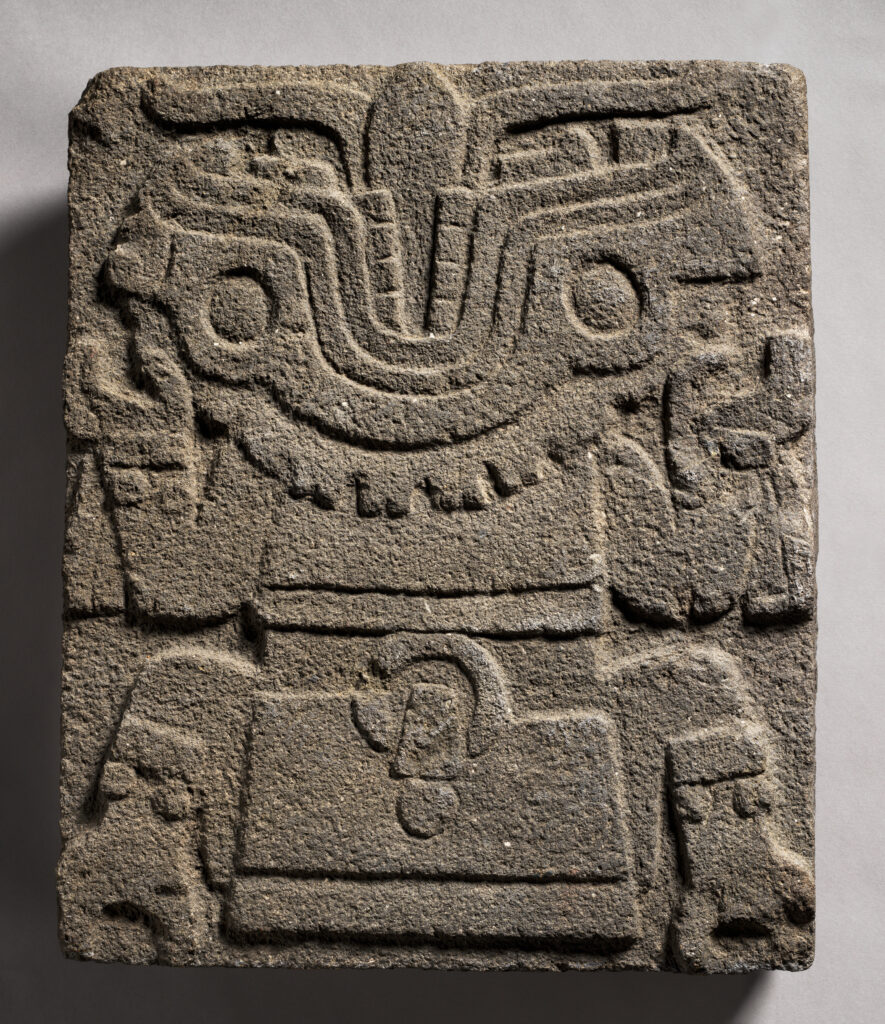
Tlaloc — one of the oldest and most continuously worshipped deities in all of Mesoamerica — belongs to this same cosmological stratum. His cult is attested at Teotihuacan from the earliest phases of the city’s monumental construction, where his image appears alongside that of the feathered serpent across multiple architectural contexts. The art historian Enrique Florescano, analyzing the iconography of Teotihuacan, has argued that the feathered serpent functioned there as part of a triad of agricultural deities: Tlaloc, god of rain and thunder; a goddess of the cave representing motherhood and fertility; and the feathered serpent itself, associated with vegetational renewal. The serpent that runs through Tlaloc’s iconography is not an independent deity but an expression of water itself — lightning as serpent, rain as serpent, the living world made possible by the serpentine force that connects sky to earth to ground.
II. The Name and the Problem: Quetzalcoatl between God, Title, and History
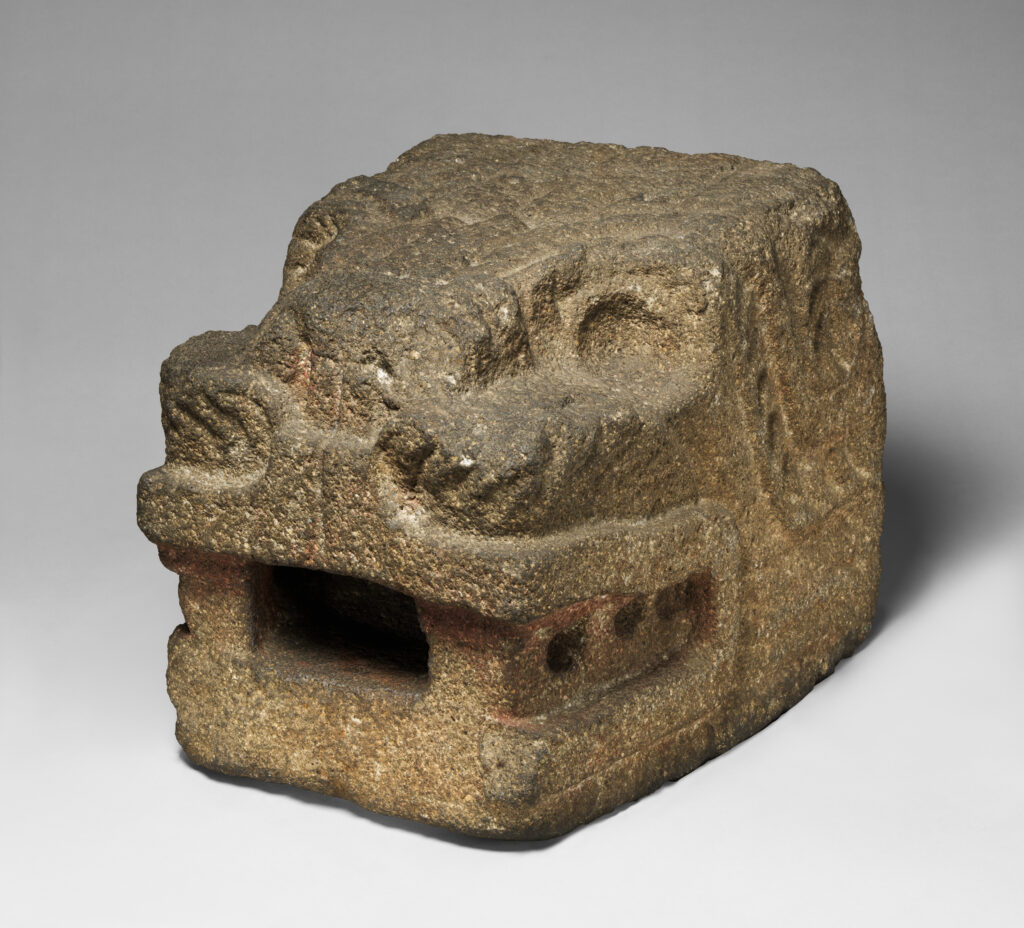
Quetzalcoatl means, in Nahuatl, something like “quetzal-feathered serpent” — the quetzal being the resplendent bird of the highland cloud forests, whose iridescent green tail feathers were among the most prized objects in Mesoamerica. The name joins two things that should not go together: the earth-bound serpent and the sky-bound bird. That is precisely the point. The archaeologist Karl Taube, analyzing Teotihuacan iconography, has argued that the feathered serpent there functioned primarily as a symbol of fertility and internal political legitimacy, in contrast with a separate “War Serpent” motif associated with external military expansion. By the time the Toltecs came to power at Tula in the ninth through twelfth centuries, the feathered serpent had accumulated a celestial dimension, becoming closely associated with the planet Venus and its cycles — a connection documented across multiple Postclassic sources. Among the Aztecs, the deity took the form of Ehecatl, the wind god, and accumulated further domains: Sahagún’s Florentine Codex records Quetzalcoatl as related to wind, Venus, merchants, arts, crafts, knowledge, and learning, and as the patron deity of the Aztec priesthood.
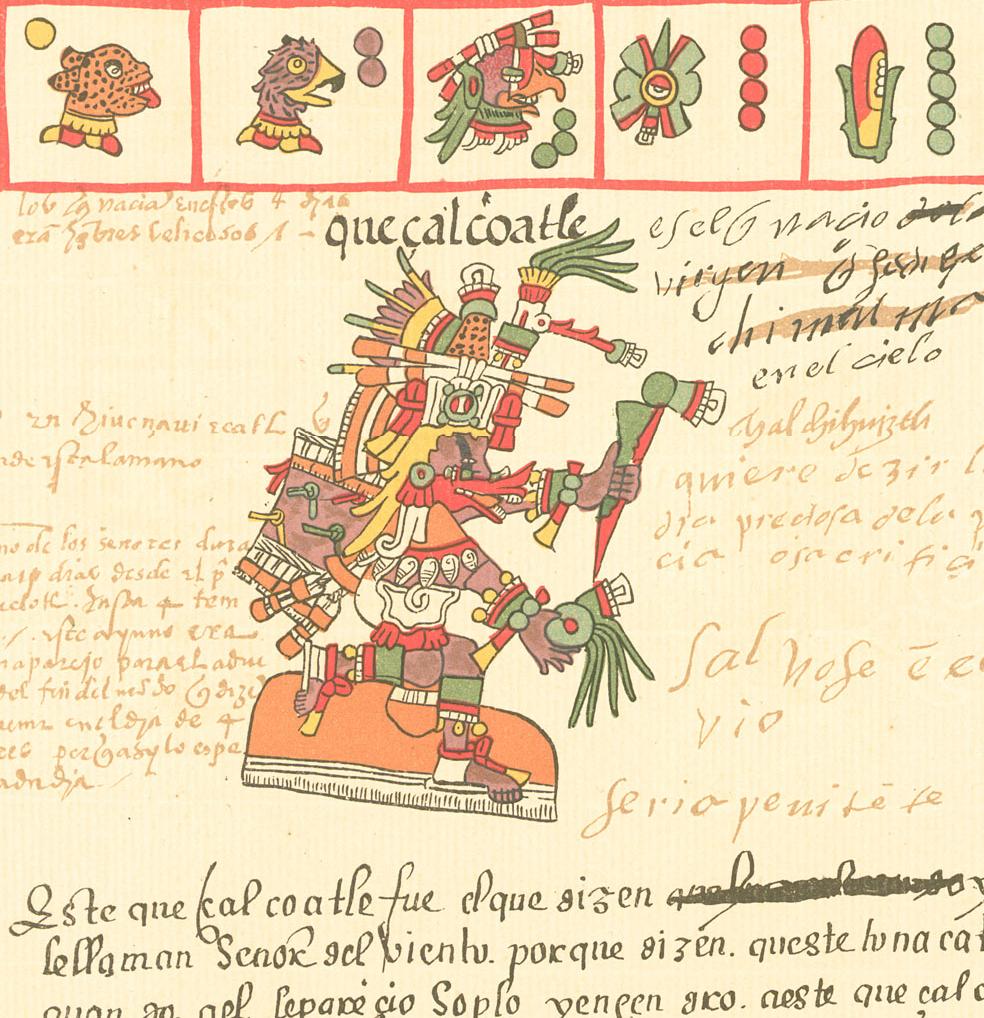
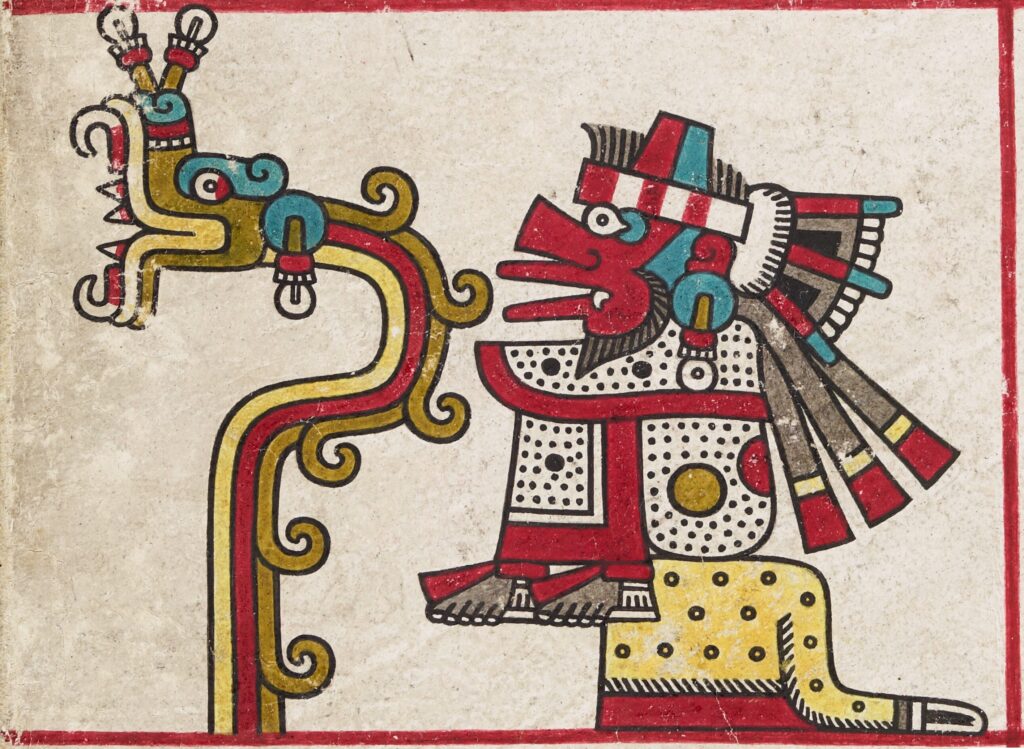
This expansion is not theological confusion. It is what happens when an image proves durable enough to absorb new functions across successive civilizations. Quetzalcoatl does not mean one thing. He is the site where a very long conversation about the serpent’s relationship to sky, water, knowledge, and power accumulates its layers.
The layering grows more complicated still when the god intersects with history — or what has been claimed as history. There was a ruler of Tula, probably in the tenth century CE, who bore the name or title Ce Acatl Topiltzin Quetzalcoatl. This historical figure, or semi-historical figure, was remembered in later Aztec sources as a priest-king who established civilization, rejected human sacrifice, and was eventually driven from his kingdom — departing eastward across the sea with a promise, or a prophecy, of return. When Hernán Cortés arrived on the coast of Mexico in 1519, the story goes, the Aztec emperor Moctezuma II believed he was witnessing the fulfillment of that prophecy.
This story has been enormously influential and, in its standard form, is almost certainly wrong. Matthew Restall’s work, particularly Seven Myths of the Spanish Conquest (Oxford University Press, 2003), has been decisive here: the legend of Moctezuma greeting Cortés as a returning god was constructed after the fact, primarily by indigenous scribes working within colonial institutions shaped by Franciscan friars who had every reason to make the Spanish arrival seem providential. Camilla Townsend’s Fifth Sun (Oxford University Press, 2019) corroborates and deepens this picture: the sources that describe Moctezuma prostrating himself before Cortés date from well after the Conquest and show clear signs of colonial reworking. The point is not that Quetzalcoatl was unimportant to the Aztecs — he was central. The point is that the specific legend of his return as a providential template for the Spanish arrival is a post-Conquest construction, not a pre-Conquest prophecy.
What remains, when this layer is carefully set aside, is something more interesting: a deity whose name could also be a royal title, a human figure whose biography absorbed divine attributes, and a story of exile and return that the Aztec political imagination had already been using long before the Spaniards arrived. The serpent, here, is not merely a god. It is a claim about legitimacy.
The Xiuhcoatl — the “turquoise serpent” or “fire serpent” — makes this claim most nakedly. In Aztec belief, the Xiuhcoatl was the nahual, or spirit form, of Xiuhtecuhtli, the fire deity, and the weapon with which Huitzilopochtli slew his sister Coyolxauhqui at the moment of his birth, driving back the stars and enacting the daily victory of the sun over darkness. Karl Taube has argued that Xiuhtecuhtli was explicitly evoked in Aztec rites of imperial coronation, and the scholar Molly Bassett, drawing on Taube’s analysis, notes that it was not only the god but the turquoise he embodied that mattered in these ceremonies — specifically in ornaments such as the xiuhuitzolli, the royal diadem whose shape scholars widely interpret as derived from the fire serpent’s tail. To wear the xiuhuitzolli was to claim the solar fire as a source of legitimate authority. The fire serpent is the sun’s weapon. To hold it, even in imagery, was to claim alignment with the solar order that kept the world alive.
Coatlicue, “she of the serpent skirt,” and Cihuacoatl, “serpent woman,” extend the serpentine into the register of the earth itself. Coatlicue is the mother of Huitzilopochtli — the earth goddess whose body is a mass of writhing serpents, whose necklace is made of hearts and hands, who represents what the earth is before it is cultivated and pacified. Cihuacoatl is the goddess of childbirth and warfare, patron of the cihuateteo, women who died in childbirth and were honored as warriors. The Nahua cosmos is saturated with the feminine-serpentine: the earth, the mother, the origin, the danger, all figured through the serpent’s body. The serpent is not one thing among many in this symbolic world. It is the substance of the world’s most fundamental category — the ground on which everything else stands.
III. Kukulkan and Q’uq’umatz: The Feathered Serpent among the Maya
Twice a year, at the spring and autumn equinoxes, something happens at the northern staircase of El Castillo, the great stepped pyramid at Chichen Itza. As the afternoon sun descends, a series of triangular shadows forms along the pyramid’s northwest balustrade, connecting at the base to the carved stone serpent head. The effect creates the impression of a serpent descending the staircase — what observers today call the “descent of Kukulkán.”
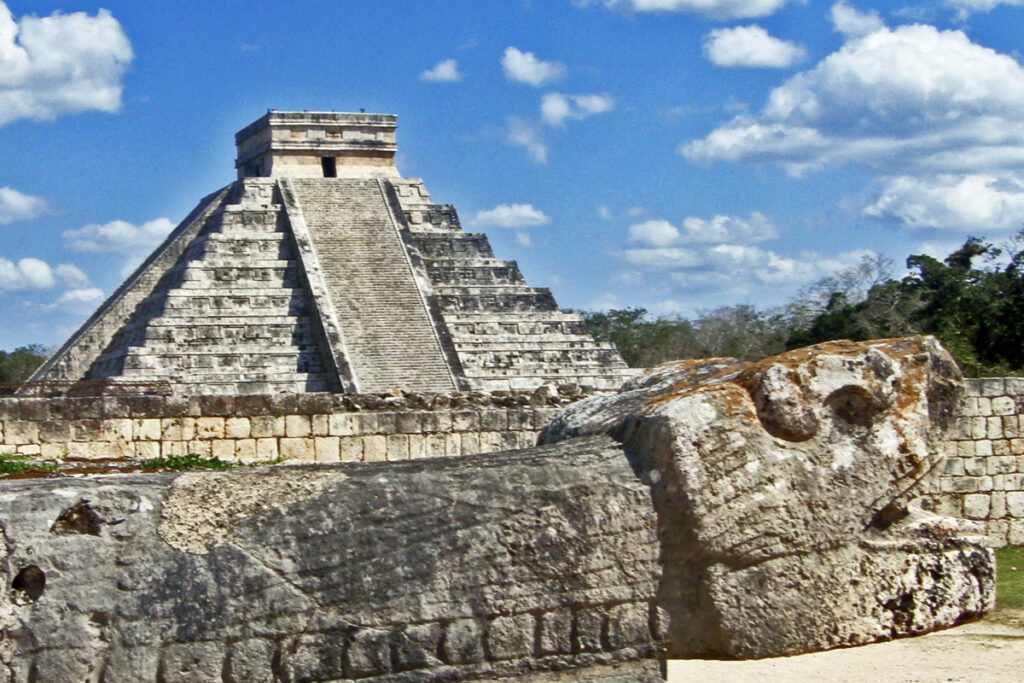
Whether this effect was deliberately engineered by the Maya builders or encountered in practice and subsequently incorporated into the temple’s ceremonial life remains genuinely contested. The archaeoastronomers Ivan Sprajc and Pedro Francisco Sánchez Nava have argued explicitly that the phenomenon was not intentionally designed, noting that a similar light effect is observable for several weeks around each equinox and therefore could not have served to identify any specific date. The debate is ongoing, and “current scholarly consensus” would be too strong a phrase — this is an open question. What is not contested is that the effect is real and that the pyramid’s orientation reflects deliberate astronomical thinking, since El Castillo’s four stairways align with the cardinal directions and the site contains other structures — including the observatory El Caracol — that clearly encode celestial observations. A study presented in 2026 in Arqueología Mexicana by four Mexican archaeoastronomers has proposed that the pyramid’s shadow patterns encode the complete Maya solar calendar across the year, not merely the equinox phenomenon; this is a recent and interesting claim that awaits independent verification.
What is not debated is Kukulkan’s identity among the Yucatec Maya: the feathered serpent, cognate with Q’uq’umatz of the K’iche’ and with Quetzalcoatl of the Nahua-speaking peoples of central Mexico. The K’iche’ Maya knew him, as we have seen, as Q’uq’umatz — the creator who floated on the primordial sea in quetzal feathers before the world existed. The Yucatec Maya who built El Castillo and the great city of Chichen Itza around it knew him as Kukulkan, and built for him a pyramid that, twice a year, becomes the god’s own body descending to earth.
The relationship among these figures — Quetzalcoatl, Kukulkan, Q’uq’umatz — is one of the central questions in Mesoamerican studies, and it does not have a settled answer. Enrique Florescano, surveying the spread of feathered serpent symbolism across Mesoamerica, has argued for sustained cultural transmission among the traditions that developed it — that the shared figure reflects genuine intellectual and religious exchange rather than independent parallel invention. Some scholars have pushed the origin further back, toward the Olmec civilization of the Gulf Coast lowlands (c. 1500–400 BCE); certain Olmec artworks show serpentine figures with what may be avian attributes, but the direct genealogical connection to the later Quetzalcoatl tradition is difficult to establish firmly on current archaeological evidence. The earliest unambiguous documentation of the feathered serpent cult occurs at Teotihuacan — which places the Temple of the Feathered Serpent close to the beginning of the attested record, not at its end.
What can be said with confidence is that the feathered serpent, in all its named forms, was shared across Mesoamerica in a way that indicates sustained cultural exchange rather than independent parallel invention. When the Maya at Chichen Itza and the K’iche’ of highland Guatemala and the Nahua-speaking peoples of the central plateau all developed versions of a deity who unites serpent and bird, earth and sky, water and wind, they were drawing on a common symbolic inheritance that crossed linguistic and political boundaries. The serpent that unites opposites — the creature that is both below and above, both flesh and feather — was not the property of any single tradition. It was the common currency of Mesoamerican religious thought.
IV. The Image Persists
The Temple of the Feathered Serpent at Teotihuacan was, at some point, partially occluded. A later platform — the Adosada — was built directly in front of the pyramid’s western façade, blocking the main sculptural face from view. The reason for this intervention is not established. Scholars have proposed various explanations: a shift in political authority, a change in the ideological program of the ruling elite, or a deliberate repudiation of the serpent-pyramid’s symbolic claims. The monument was not destroyed — it was buried, and in being buried, preserved. The heads that were meant to be seen from a distance are still there, beneath.
This has happened, in various forms, across the entire length of Mesoamerican history. The Spanish Conquest of the sixteenth century brought systematic destruction of indigenous religious culture: temples demolished, codices burned, priests executed, ceremonies suppressed. The feathered serpent’s iconography was dismantled wherever it could be identified and reached. And yet the image survived — in the codices that escaped the fires, in the stone carvings too massive to remove, in the oral traditions that continued underground, and eventually in the syncretic forms that emerged as indigenous peoples negotiated the new colonial religious landscape. Quetzalcoatl has been found by some scholars echoing in certain colonial-era depictions of the Archangel Michael, the serpent-slayer now standing in for the serpent god. The image adapts.



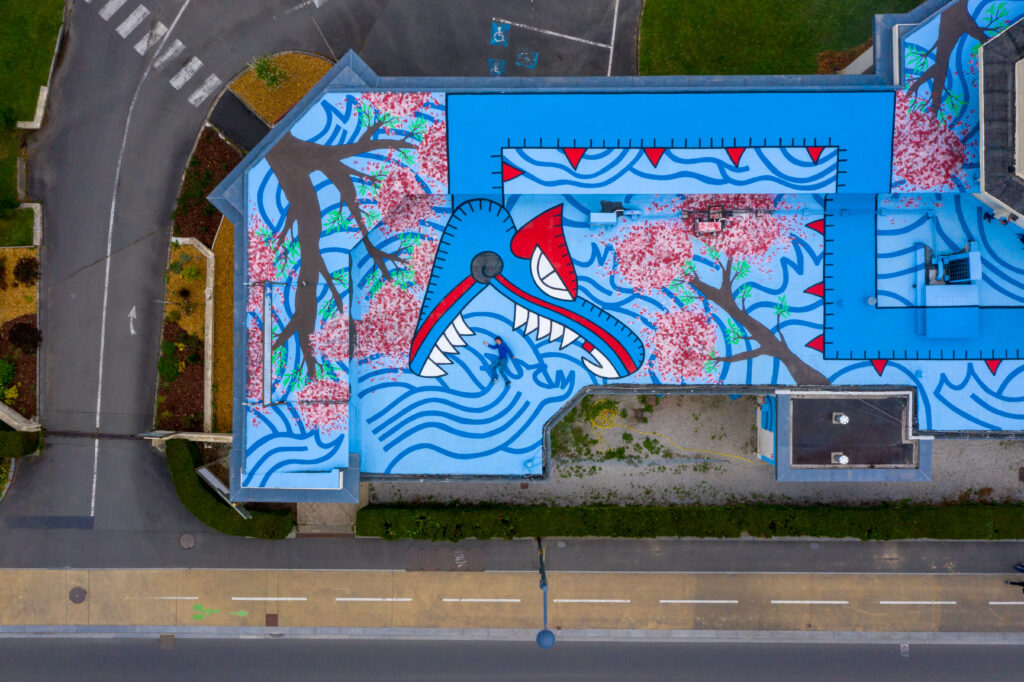
Oré, Quetzalcoatl, Normandie, 2022. Monumental roof mural on the Pavillon des Fleurs, B’O Resort thermal spa, Bagnoles-de-l’Orne, France. Over 800 m². Photographs courtesy of the artist. © Oré / artore.org / @ore_urban_art
What the full span of serpent symbolism in Mesoamerica reveals is an imagination that found in the serpent not one meaning but a structure — a way of thinking about the relationship between opposites. Earth and sky. Creation and destruction. The body of the world and the word that summons it into being. The fire that kills and the rain that feeds. A primordial monster dismembered into a habitable earth, and a feathered intelligence that spoke the mountains into existence. These are not the same story. But they are the same insistence: that the serpent, in Mesoamerica, was what you found when you looked for the origin of things.
A Note on Sources and Scholarly Uncertainty
The primary sources for Aztec mythology are almost all colonial-era documents produced after the Spanish Conquest of 1519–21 and often mediated by Franciscan friars, indigenous scribes working within colonial institutions, or both. The most important of these is Fray Bernardino de Sahagún’s Florentine Codex (compiled c. 1545–1590, in twelve books), which provides the most comprehensive account of Nahuatl religion and remains indispensable despite its complex production context. The Histoyre du Mechique, a French manuscript compiled after 1547 by the cosmographer André Thévet from indigenous sources, provides a version of the Cipactli cosmogony drawn upon in this article; it was first published critically by E. de Jonghe in the Journal de la Société des Américanistes de Paris (1905). The Historia de los Mexicanos por sus Pinturas (c. 1535) offers additional cosmogonic material. Readers should be aware that what we know of Aztec mythology is substantially filtered through this colonial layer.
For the Maya, the Popol Vuh is the central primary source for K’iche’ Maya cosmology. The standard scholarly translations are Dennis Tedlock’s (Simon & Schuster, 1996) and Allen Christenson’s (Mesoweb, 2007); both are reliable, with Christenson providing more literal rendering and extensive annotation.
The claim that Moctezuma II greeted Cortés as the returning Quetzalcoatl is treated here as a post-Conquest construction, following Matthew Restall (Seven Myths of the Spanish Conquest, Oxford University Press, 2003; updated edition 2021) and Camilla Townsend (Fifth Sun: A New History of the Aztecs, Oxford University Press, 2019). This is now the dominant position among historians of the Conquest, though not universally accepted.
For the feathered serpent at Teotihuacan, the foundational works are Saburo Sugiyama’s Human Sacrifice, Militarism, and Rulership: Materialization of State Ideology at the Feathered Serpent Pyramid, Teotihuacan (Cambridge University Press, 2005) and Karl Taube’s “The Temple of Quetzalcoatl and the Cult of Sacred War at Teotihuacan” (RES: Anthropology and Aesthetics 21, 1992). Enrique Florescano’s The Myth of Quetzalcoatl (Johns Hopkins University Press, 1999; translated by Lysa Hochroth) traces the deity’s spread across Mesoamerica and addresses the agricultural-deity triad discussed in Section I. Davíd Carrasco’s Quetzalcoatl and the Irony of Empire (University of Chicago Press, 1982; revised edition 1992) remains the key study of Quetzalcoatl’s role in Aztec political theology.
For Xiuhcoatl and the xiuhuitzolli, the analytical framework used here draws on Molly Bassett, The Fate of Earthly Things: Aztec Gods and God-Bodies (University of Texas Press, 2015), which synthesizes Taube’s iconographic work on the fire deity complex.
On the Olmec origins of the feathered serpent: the hypothesis is widely discussed but archaeologically contested. I have treated it as an open question rather than a settled conclusion.
The debate over the intentionality of the El Castillo equinox effect involves Ivan Sprajc and Pedro Francisco Sánchez Nava on the skeptical side (position presented at the eighth Mesa Redonda de Palenque) and those who argue for deliberate design. A study presented in 2026 in Arqueología Mexicana by four Mexican archaeoastronomers proposes a year-round solar encoding in the pyramid’s design; this is recent and awaits independent scholarly verification.
Bibliography
Primary Sources — Not Directly Consulted
The following primary sources are referenced in this article via secondary scholarship or in translation. They are listed here for the reader’s benefit.
Sahagún, Fray Bernardino de. Florentine Codex: General History of the Things of New Spain. Compiled c. 1545–1590. Translated and edited by Arthur J. O. Anderson and Charles E. Dibble. 13 vols. Santa Fe and Salt Lake City: School of American Research and University of Utah Press, 1950–1982.
Historia de los Mexicanos por sus Pinturas. c. 1535. In Teogonía e historia de los mexicanos: Tres opúsculos del siglo XVI, edited by Ángel María Garibay K. Mexico City: Editorial Porrúa, 1965.
Histoyre du Mechique. Compiled after 1547 by André Thévet from indigenous sources. First published critically by E. de Jonghe in Journal de la Société des Américanistes de Paris 2 (1905): 1–41.
Codex Borgia. Pre-Columbian. Vatican Apostolic Library, Rome. Facsimile edition with commentary by Eduard Seler. Berlin: Gebr. Unger, 1904–1909.
Christenson, Allen J., trans. Popol Vuh: The Sacred Book of the Maya. Norman: University of Oklahoma Press, 2007. Originally published Mesoweb, 2003–2007.
Tedlock, Dennis, trans. Popol Vuh: The Definitive Edition of the Mayan Book of the Dawn of Life and the Glories of Gods and Kings. New York: Simon & Schuster, 1996.
The Feathered Serpent at Teotihuacan
Sugiyama, Saburo. Human Sacrifice, Militarism, and Rulership: Materialization of State Ideology at the Feathered Serpent Pyramid, Teotihuacan. Cambridge: Cambridge University Press, 2005.
Taube, Karl A. “The Temple of Quetzalcoatl and the Cult of Sacred War at Teotihuacan.” RES: Anthropology and Aesthetics 21 (1992): 53–87.
Quetzalcoatl, Kukulkan, and the Feathered Serpent Tradition
Carrasco, Davíd. Quetzalcoatl and the Irony of Empire: Myths and Prophecies in the Aztec Tradition. Chicago: University of Chicago Press, 1982. Revised edition, 1992.
Florescano, Enrique. The Myth of Quetzalcoatl. Translated by Lysa Hochroth. Baltimore: Johns Hopkins University Press, 1999.
Aztec Religion and Political Theology
Bassett, Molly. The Fate of Earthly Things: Aztec Gods and God-Bodies. Austin: University of Texas Press, 2015.
The Spanish Conquest and Its Historiography
Restall, Matthew. Seven Myths of the Spanish Conquest. Oxford: Oxford University Press, 2003. Updated edition, 2021.
Townsend, Camilla. Fifth Sun: A New History of the Aztecs. Oxford: Oxford University Press, 2019.
Archaeoastronomy at Chichen Itza
Sprajc, Ivan, and Pedro Francisco Sánchez Nava. Position on the non-intentional nature of the El Castillo equinox shadow effect. Presented at the eighth Mesa Redonda de Palenque. Publication details not confirmed; cited here from conference reports.