A man sits enthroned. From the base of his neck, at the shoulders, two black serpents have grown — not painted on, not worn as ornament, but living flesh, sprung from a stranger’s kiss. He will spend the rest of his reign feeding them daily on human brains, because that is the only thing that keeps them quiet. His name, in the version everyone in Iran still knows, is Zahhāk. Ferdowsi wrote him into the Shahnameh around the year 1010, and by the time he did, the serpents on the tyrant’s shoulders had already been travelling through Iranian storytelling for the better part of two thousand years.
Fifteen centuries before Ferdowsi, an Avestan hymn described something similar but not identical: not a man who grew serpents, but a serpent-thing to begin with — three mouths, three heads, six eyes, a thousand tricks, called simply the Lie. Its name was Aži Dahāka, and it belonged to no royal genealogy. It was a cosmic adversary, defeated — though never quite killed — by a mortal hero named Thraētaona, in a story with no more historical pretension than the myth of any storm-god’s battle against chaos.
Between the hymn and the epic, something happened to this figure that did not happen, in quite the same way, to the serpent of the Bible, the dragon of the Norse sagas, or the Mesopotamian mušḫuššu. It became historical. Dj. Khaleghi-Motlagh, the modern editor of the critical Shahnameh text, has put the mechanism plainly: in the Avesta, Thraētaona is Iran’s great dragon-slayer; in the national legend that descends from it, he loses that title, because his adversary has, by then, turned into something close to a historical person — a bad king in a chronicle of bad kings, rather than a demon in a cosmology of demons. What survives of the old serpent is little more than its memory: two snakes on a shoulder, recalling a shape the character no longer fully has. This article follows that migration — from the three-headed thing in the Avesta to the crowned tyrant on Mount Damavand — and asks what gets kept, and what gets lost, when a myth turns into history.
1. Three Mouths, Three Heads, Six Eyes
The fullest description of the creature comes from the Zamyād Yašt, the nineteenth hymn of the Avesta, in a stock epithet repeated with only minor variation wherever the story is told: three-mouthed, three-headed, six-eyed, possessed of a thousand skills, the very mighty, deceitful Druj — the personification of the Lie itself, sent by the Hostile Spirit against the material world. The same formula recurs, almost word for word, in the older Yasna 9 and in a third, independent hymn to Verethragna, the god of victory, and it appears once more, in the geographical catalogue that opens the Videvdad, which names Varena, among Iran’s lands, specifically as the place where Thraētaona — the dragon’s future smasher — was born. Three separate genres, hymn, praise-poem, and priestly law-book, carry the same story as settled background knowledge, which is usually a sign that a myth is already old by the time any of its surviving texts were composed.
What the name itself means is not settled, and probably shouldn’t be treated as though it were. “Dahāka” has been read two ways by philologists who each have a claim to authority on the question. Martin Schwartz derives it from an old pejorative suffix attached to a word for manhood or virility, arriving at something close to a snake-man. It’s a reading that fits the creature’s later, humanoid Shahnameh incarnation almost too neatly. The older and more traditional line ties dahāka- instead to the dāsa/dasyu of the Rigveda, the generic enemy peoples of the Indo-Aryan tradition, so that the name would originally have tied the monster to those hostile tribes rather than to anything reptilian. P. O. Skjærvø, surveying both proposals in the standard reference article on the subject, declines to adjudicate between them, and there is no obvious reason to be more confident than he is.
There is, however, one point of vocabulary the tradition does settle, and settles explicitly, in its own words rather than through modern reconstruction. Aži simply means “serpent.” It is the exact cognate of the Vedic áhi-, the ordinary word for snake, and originally carried no implication of anything monstrous at all. Aždahā, the word that eventually gives Modern Persian its ordinary term for “dragon,” is a narrower, later category folded inside the first. The Bundahišn, the great Zoroastrian cosmological compilation, is unambiguous about the hierarchy: among the earth’s noxious creatures, it says, the many-headed dragon is the worst of its earthbound kind, and it adds that the serpent, the dragon, and the two- and seven-headed azdahāk are all of the serpent species. A dragon, in other words, is a kind of serpent, not a separate order of being — a distinction the tradition draws with more precision than some of its modern interpreters. Even careful archaeologists working on the pre-Zoroastrian iconography of this figure have occasionally glossed aži as simply meaning “dragon,” collapsing a distinction the Bundahišn itself insists on keeping.
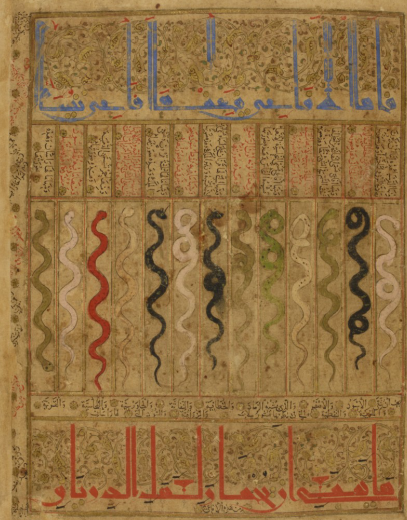
The clearest evidence that this is not a story invented for Aži Dahāka alone comes from outside the Iranian tradition entirely, from the sister tradition preserved in the Vedas. A Vedic hero, Trita Āptya, kills a three-headed, six-eyed monster named Viśvarūpa with the aid of the war-god Indra — the same plot, the same numbers, run through a related but distinct language. Calvert Watkins has shown that the resemblance goes well past theme: the Avestan formula for the killing, yō janat āzīm, “who slew the serpent,” is an exact grammatical cognate of the Vedic ahann áhim, down to the marked word order that both languages preserve. This is not two cultures independently landing on a good story. It is one story, carried by one poetic diction, splitting into two languages that still, thousands of years later, encode the same act — a hero slaying a serpent — in matching word order. Whatever else changes about Aži Dahāka between the Avesta and Ferdowsi, this much is inherited rather than invented: a monster with three heads and six eyes, killed — or rather, not quite killed — by a hero whose name and whose grammar both go back to a common Indo-Iranian source.
Killed is, in fact, the wrong word, and the Avesta itself signals as much. Thraētaona does not destroy Aži Dahāka; he binds him. The full weight of why he stops there, and what it costs him not to finish the job, belongs to a later stratum of the tradition — but the seed of the deferral is already visible in the Zamyād Yašt itself, where the same weapon Thraētaona once swung against the monster reappears centuries later, in the hands of the world’s final saviour, at the very end of time.
2. The King Who Became a Monster
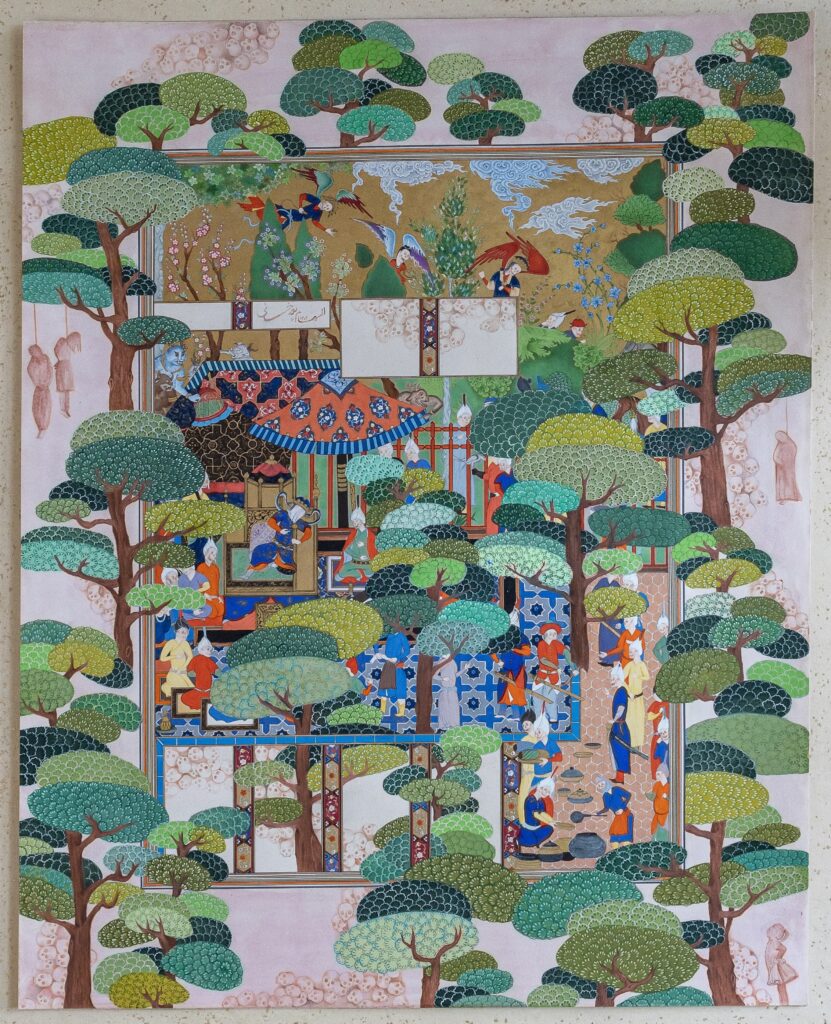
Merdās was, by every account, a good king: an Arab ruler, pious, just, beloved by his subjects. His son Bivārāsp was not born a monster. He became one in stages, and Ferdowsi’s version of how it happened is worth following closely, because the sequence matters more than the outcome. Eblis, the tempter, works on the young prince the way tempters generally do in this kind of story — not with a single overwhelming horror, but with a series of small, deniable steps. First he talks Bivārāsp into killing his own father. Then, disguised as a gifted cook, he wins the new king’s trust by introducing him to the pleasure of meat. His final request is modest: a kiss, one on each shoulder, as a reward for his cooking. Where his lips touch, two black serpents sprout from the flesh, and no physician can remove them; cut them off and they grow back overnight. Bivārāsp is horrified — and that horror, the scholar Laurie Pierce has pointed out, is the last distinctly human reaction the character has in the entire poem. Once Eblis tells him, disguised now as a doctor, that the only way to quiet the serpents is to feed them a human brain each day, the transformation is complete. He has become, in every particular that matters, the three-mouthed, three-headed, six-eyed thing of the old hymns, wearing a human face over it.
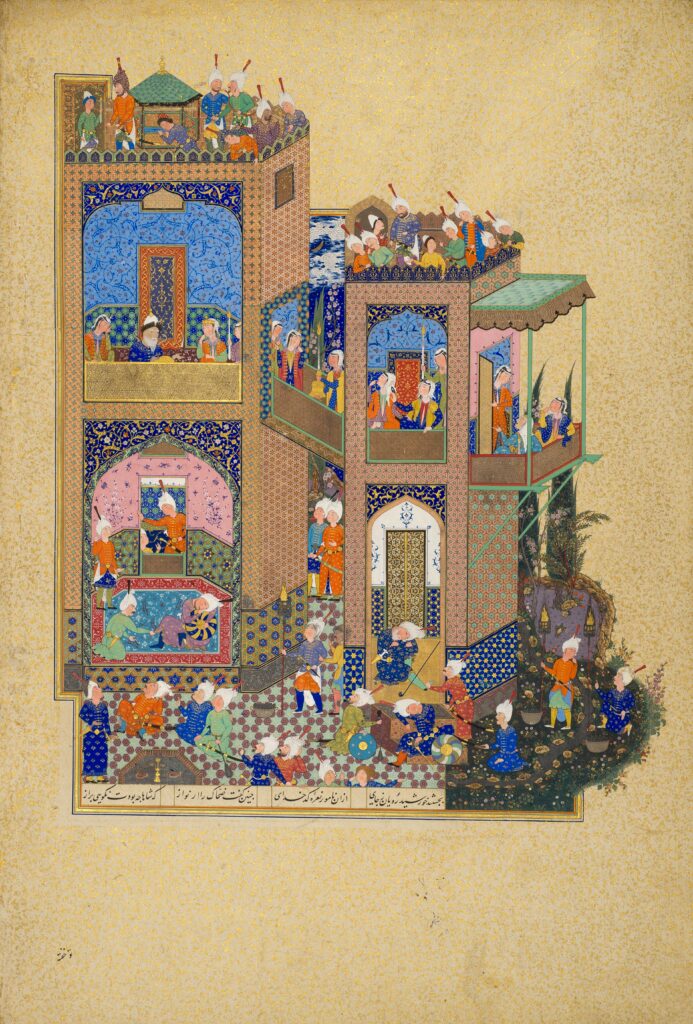
This is the migration Khaleghi-Motlagh identified with more precision than anyone before him. In the Avesta, Thraētaona is unambiguously Iran’s chief dragon-slayer. In the national legend that Ferdowsi eventually put into verse, he loses that role — not because a better dragon-slayer replaced him, but because his opponent stopped, functionally, being a dragon. Zahhāk has a genealogy, a father, a court, a chronology of misrule; he belongs to the same kind of narrative as any other bad king in the Shahnameh’s long dynastic sequence, and a king, however monstrous, is not defeated the way a cosmic adversary is defeated. The old body survives only as an echo: two serpents on the shoulders, a shape the king no longer fully occupies.
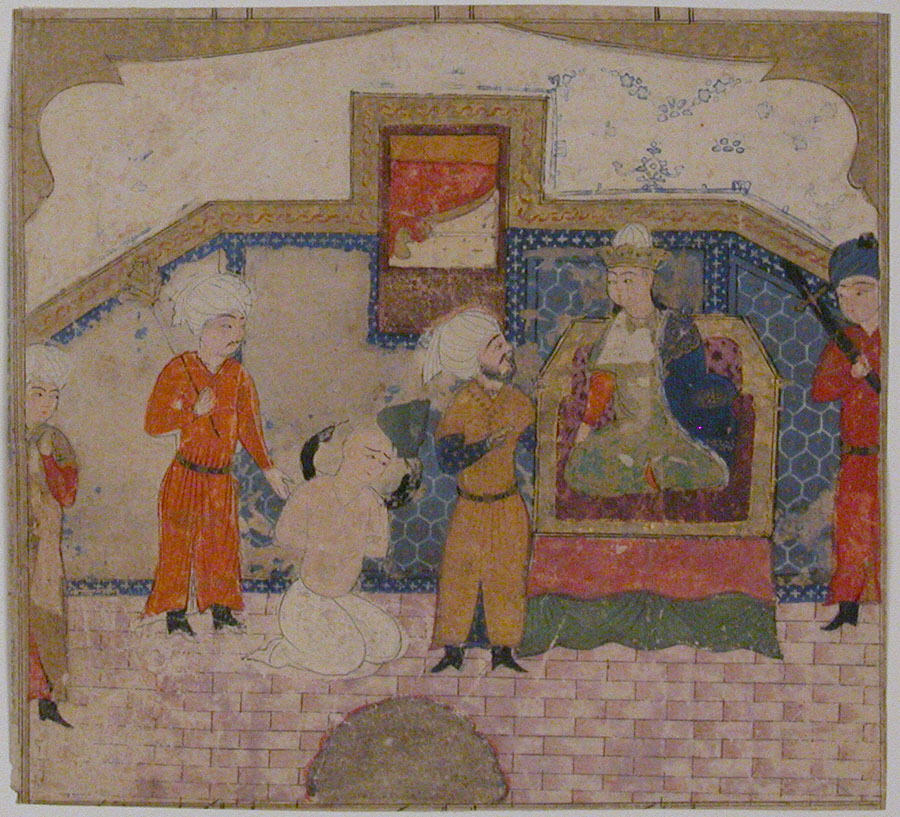
The rest of the story plays out as history rather than cosmology. Zahhāk’s tyranny — famously, the daily sacrifice of two young men’s brains — provokes the revolt of Kaveh, a blacksmith whose leather apron becomes the royal standard of the uprising he starts. Fereydun, born in secret and raised in hiding from the tyrant who fears his birth, grows into the war that ends Zahhāk’s reign: the crossing of the Tigris, the fall of the palace, the rescue of Jamshid’s two sisters, Shahrnaz and Arnavaz, whom Zahhāk had kept as consorts. When Fereydun finally has the tyrant at his mercy, he moves to kill him outright — and is stopped by the angel Sorush, who intervenes specifically to prevent it. Zahhāk is bound instead, with a cord of lion-hide, and led to Mount Damavand to be chained there. Why binding rather than killing was necessary is a question the epic itself does not fully answer; the fuller explanation belongs to the cosmological tradition running alongside it, and that tradition earns its own hearing.
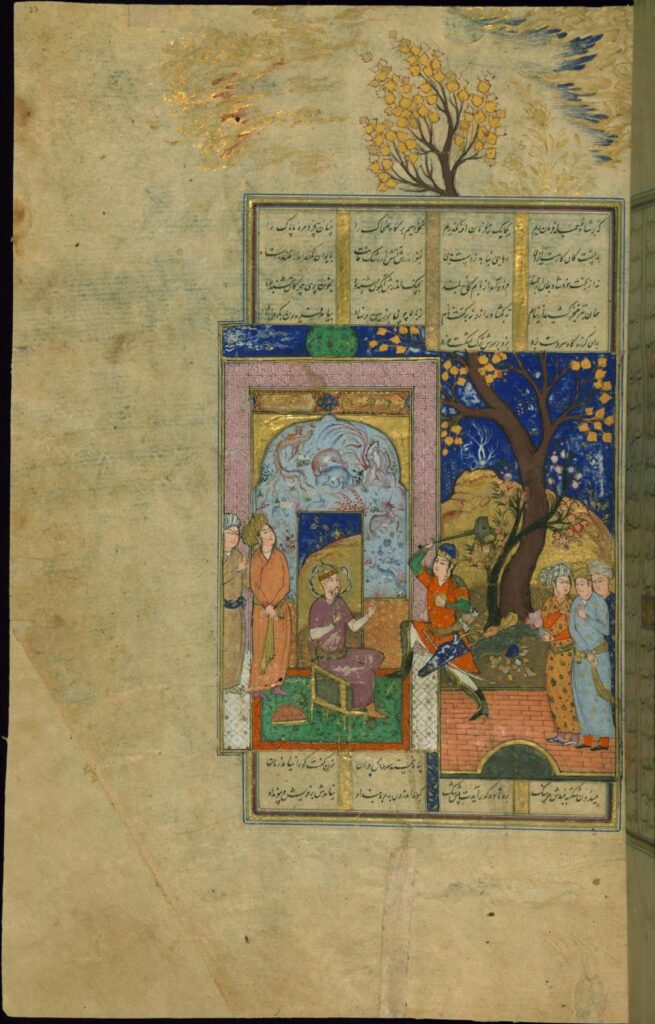
What Fereydun does with his victory says as much about the tradition as the victory itself. Later in the epic, preparing to divide his kingdom among his three sons, he tests them by transforming himself into a dragon and attacking each in turn — a deliberate, almost ironic echo of the very creature he spent his youth fighting, now worn as a costume rather than suffered as an affliction. Dragon-slaying, by this point in the Shahnameh, has become less a cosmic office than a recurring proof of royal fitness, a test any sufficiently legitimate ruler is expected to pass: Sam, Rostam, Bahram Gor, and Bahram Chobin — acclaimed king on the spot after killing his dragon — all take their turn at it. Ardashir slays a monstrous Worm to justify the dynasty he has just founded on the ruins of the Parthians. The gesture has detached itself almost entirely from the theology that once gave it meaning.
It has not, however, become morally neutral. Laurie Pierce notes that where the serpent elsewhere in Near Eastern tradition can carry positive as well as negative associations, the Shahnameh allows the serpent no such ambiguity: it is uniformly bad, and the sorcery associated with it follows a strict and gendered logic. Men in the poem can practice a redemptive, “white” version of magic; women largely cannot. Even Shahrnaz, who eventually turns Zahhāk’s own arts against him, remains tainted by the association and passes the taint to her sons, Salm and Tur, whose fratricidal ambitions drive much of the epic’s later tragedy. Arnavaz, less closely bound to the tyrant, becomes instead the mother of blameless Iraj. Historicization doesn’t just simplify the monster. It reorganizes the whole moral field around him.
3. Bound Until the End of Time
The Bundahišn does not so much narrate Zahhāk’s reign as catalogue its consequences, in a register closer to inventory than story. When the Evil Spirit lets loose his noxious creatures across the earth, the text says, he leaves nothing on it untouched, down to the smallest measurable spot: serpents, scorpions, lizards, frogs, and, chief among the earthbound kind, the many-headed dragon. This is not narrative in the way Ferdowsi’s Shahnameh is narrative; it behaves more like a ledger of catastrophe, and the catastrophe it is keeping the books on is, in large part, the reign of the figure it calls Dahāg, or Bevarasp — Bivārāsp, in the spelling the Shahnameh tradition prefers.
Where the Avesta is content to let Aži Dahāka exist without a family tree, the Bundahišn supplies one, and it is worth taking seriously as a piece of theological argument rather than mere ornament. On his father’s side, Dahāg descends through six named generations to Siyāmak, one of the earliest men. On his mother’s side, the line runs nine generations back — to Ganag Mēnōy, the Evil Spirit himself. The genealogy is not incidental detail; it is a claim about where evil in the created world actually originates, traced with the same care a court chronicler would give a king’s descent from a legitimate founder, except that the founder here is the source of all corruption. The text is equally precise about geography. Dahāg’s dominion stretches across Babylon, Shambaran, and Hindustan, and, in a detail with no obvious narrative payoff attached to it, the river Spet in Atropatene, where he once begged a favor of Ahriman and the demons. None of these places do anything in the text beyond being named as his. The effect, cumulatively, is of a geography organized entirely around where the monster has been.
One passage in this catalogue does more than organize; it explains, in a way that unsettles rather than reassures. Among the peoples the Bundahišn accounts for by origin, it attributes the existence of dark-skinned people to a monstrous coupling engineered by Dahāg during his reign, between a demon and a young woman on one side and a young man and a parīg on the other — an origin story sitting inside a longer catalogue, in the same chapter, of some two dozen other human and semi-human peoples the text derives from similarly strange unions. This isn’t an isolated slur; it’s an instance of a much larger pattern: by the time the Bundahišn was compiled, Dahāg’s rule had become the tradition’s default explanation for disorder of every kind — cosmic, social, and, here, ethnic — as though a single tyrant’s thousand-year misrule were sufficient cause for everything the world had subsequently gotten wrong with it. The passage is documented, not marginal, and any account of how totalizing this figure became in the later tradition has to reckon with it rather than look past it.
The eschatology answers a question the epic leaves open: why doesn’t Fereydun simply kill him? The Bundahišn is direct about the reason. Dahāg’s body, once fully unleashed, would flood the world with the very kind of noxious creature it already was — the text elsewhere makes clear that the dragon is one species among the serpent kind, and killing the source outright risks scattering its kind rather than ending it. So he is bound at Mount Damavand instead, for the length of Fereydun’s remaining rule, and there he stays through the whole of human history that follows, until the final millennium, that of Ušēdarmāh, when the fetters give way. What kills him then is not Fereydun, and not Fereydun’s line at all: it is Kirsāsp, the sleeping hero, raised from the dead specifically for the purpose, who strikes Dahāg down with his mace as the world’s last age closes. The mortal who bound the monster and the mortal who finishes him are, deliberately, not the same person — a detail the epic tradition, focused on Fereydun’s own triumph, has no particular reason to preserve, but the cosmology insists on.
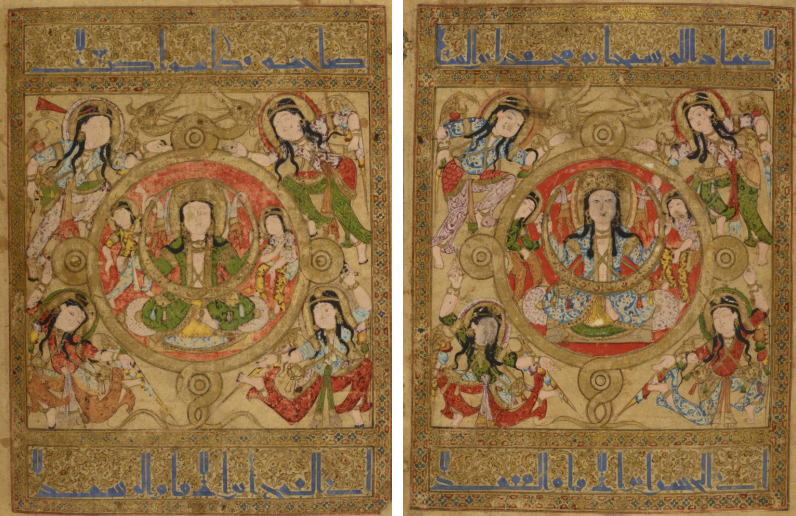
Running alongside this timeline, and easy to confuse with Dahāg if the two aren’t kept separate, is Gōčihr — a genuinely distinct entity, a serpent-shaped constellation rather than a serpent-shaped king, its head fixed in Gemini and its tail in Sagittarius, moving backward through the sky and switching position with itself every ten years. Gōčihr belongs to the demonic order that will assault creation in the final age, and the Bundahišn eventually gives it its own ending, distinct from Dahāg’s: at the last purification, when all humanity passes through molten metal, the dragon of the sky is consumed in that same metal, the last of its corruption burned away with everything else the age still owed to darkness. Two serpentine antagonists, bound to the same eschatology, meeting two different ends — one struck down by a resurrected hero’s mace, the other simply, finally, melted.
4. Two Serpents on the Shoulders
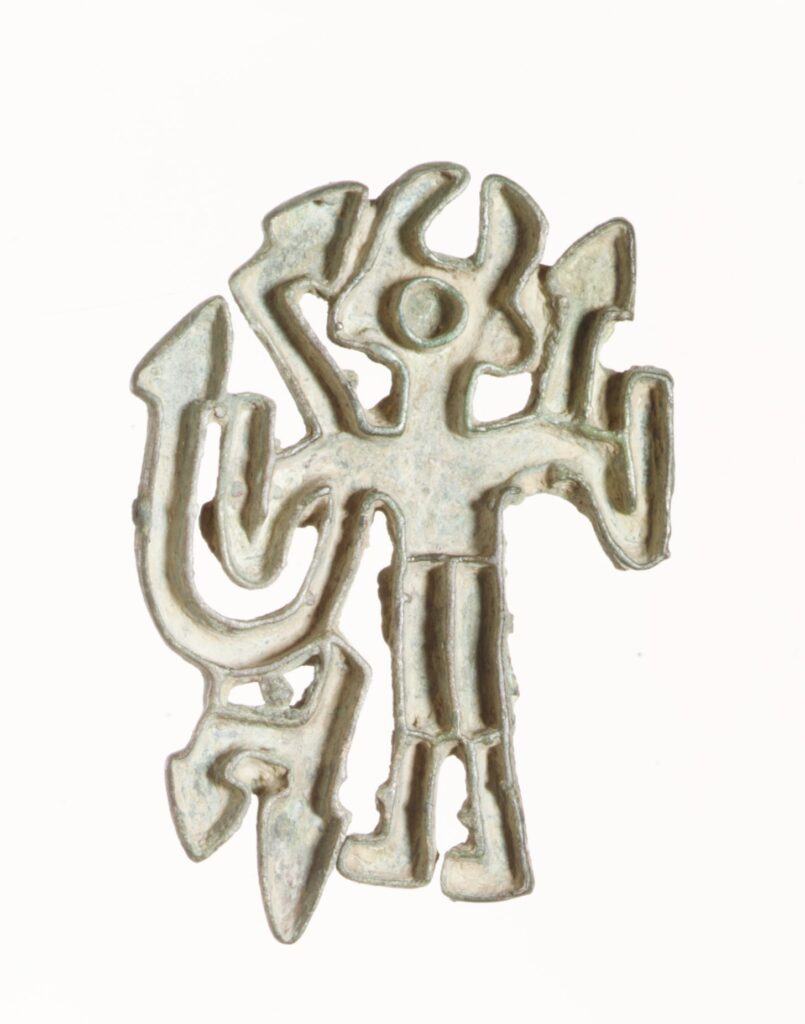
The oldest of these witnesses is a pin. Bronze-age, roughly two hundred millimetres long, of silver or a copper alloy — the sources aren’t fully certain which — and weighing about twenty grams, pulled from the cemetery at Shahdad in Kerman province during Ali Hakemi’s 1971–72 survey and now catalogued at Iran’s National Museum. Its head shows a horned, seated figure, crowned, with two serpents rearing heraldically from his arms or shoulders — the same basic composition that will still be recognizable, in outline, well over three thousand years later, on the shoulders of Ferdowsi’s Zahhāk. David Meier and Massimo Vidale, who published the most recent study of the object, date it to somewhere between the end of the Early Dynastic II period and the fall of the Third Dynasty of Ur — the third millennium BCE, in round terms — and note that it does not stand alone. Related images turn up across a surprisingly wide arc of the Bronze Age Near East and Central Asia: the so-called Cincinnati Man, a bronze basin now in Berlin, a cylinder seal from Tepe Yahya, sealstones from Gonur in the Bactria–Margiana Archaeological Complex, and the chlorite corpus associated with the site of Jiroft. Closest of all, and closest to home for this site specifically, is the stele of Gudea, ruler of Lagash in the twenty-first century BCE, showing the Mesopotamian god Ningišzida with two serpents springing directly from his shoulders — a figure already examined, on its own terms, in this site’s article on ancient Mesopotamia, and cited by Meier and Vidale themselves as the closest and best-known comparandum to their Iranian pin.
A second witness, roughly a thousand years younger, comes from the Bactria–Margiana culture as well: a cylinder seal now in the Louvre, discussed by Touraj Daryaee, showing the same seated figure with the same pair of serpents erupting from the shoulders, dated to the late second millennium BCE. And a third, far later than either, closes the gap almost entirely: a small terracotta figurine, probably Sogdian, seventh or eighth century CE, now in the Hermitage — a man enthroned, crowned with inset stones, two serpents rising from the base of his neck. J. R. Russell, who identified it, situates it as an iconographic missing link between the Bronze Age pins and Ferdowsi’s poem, closer in time to the Shahnameh than to Shahdad, but still recognizably part of the same visual lineage. Three witnesses, three thousand years, one shape.
None of these objects can tell us, on its own, whether the figure they depict was ever meant to be read as evil. Meier and Vidale argue that it probably wasn’t — that the “man with serpents” began as a neutral or even benevolent image, and that its negative charge is a comparatively late overlay, arriving with the rise of newer, more totalizing religious systems in the second and first millennia BCE, systems with every incentive to turn the old supernatural order into a gallery of villains. It is a claim that finds independent support elsewhere in the Zoroastrian corpus. Domenico Agostini has traced a near-identical trajectory for several other monstrous races in Pahlavi literature — the dog-headed, the leather-shanked, those with eyes and ears set into their chests — which appear as peaceable, pastoral peoples in the earlier Draxt ī āsūrīg and only later, in texts like the Ayādgār ī Jāmāspīg, become cannibal servants of the Evil Spirit, likely under pressure from the Alexander Romance tradition circulating through the region in the sixth and seventh centuries CE. Neither Meier and Vidale nor Agostini is describing the same figure as the other, but they are describing the same mechanism: an old, morally unmarked image absorbed and re-signed by a religious tradition that needed its monsters unambiguous.
Discussing the pin from Shahdad, even Meier and Vidale gloss aži simply as dragon — a shorthand that the Bundahišn itself would not allow, since the text is explicit that the dragon is one kind of thing the word aži covers, not the word’s meaning outright. It is an understandable simplification for archaeologists working primarily with objects rather than texts, but it says something about how thoroughly the later, narrower sense has come to stand in for the older, broader one — even among people whose job is to look past a thousand years of accumulated assumption and describe only what the object in front of them actually shows. On the Hermitage figurine, that older, broader word is still, quite literally, wrapped around a king’s neck.
A Note on Sources and Scholarly Uncertainty
Two points in this article rest on genuinely unsettled scholarship, and I want to be direct about both rather than let the prose imply more certainty than the field currently has.
The etymology of Dahāka is not resolved, and I don’t think it’s my place to resolve it. Martin Schwartz reads it as an old compound meaning roughly “snake-man.” The more traditional line ties it instead to the Rigvedic dāsa/dasyu, the generic name for the peoples the Indo-Aryans considered enemies. P. Oktor Skjærvø, surveying both in the standard reference article on the subject, doesn’t choose between them, and I’ve followed his lead rather than pick a winner myself.
The detail that Thraētaona was born in Varena — the region named as his birthplace in the Videvdad’s geographical catalogue — reached me through an unpublished set of course materials by Skjærvø, explicitly marked “please do not cite without permission.” I’ve relied on it, in paraphrase, because I’m confident it’s accurate to the text, but it isn’t properly sourced yet: before this detail can stand on its own, it needs to be traced to a publishable edition of the Videvdad — James Darmesteter’s translation is the obvious public-domain candidate — rather than left resting on a private teaching document.
Calvert Watkins’s How to Kill a Dragon is a 640-page monograph, and I worked from a targeted set of chapters rather than the whole book — enough to establish the Indo-Iranian formula connecting Thraētaona to the Vedic Trita Āptya, which I’m confident stands on solid philological ground. Watkins extends the same comparison tentatively toward Herakles and the theft of Geryon’s cattle, by his own admission on much thinner evidence — a handful of papyrus fragments from Stesichorus’s Geryoneis and a scholiast’s note. I’ve left that extension out of this article on purpose. It belongs, if anywhere, in a future piece comparing how different traditions build the same story from shared or independent material, not folded into an argument about one tradition’s own internal history.
The archaeological argument in the final section — that the “man with serpents” image predates its later demonization — leans partly on Meier and Vidale’s 2013 study of the Shahdad pin, which I read in an author’s-proof PDF; the pagination may not match the final published version, and should be checked against it before this bibliography is considered locked.
Two dates in this piece are rounded rather than pinned to a specific citation from the sources I read for this article. Ferdowsi’s completion of the Shahnameh “around the year 1010” is the broadly accepted date in Persian literary history, but I haven’t traced it to a source within this article’s own reading list, only to general convention. “Fifteen centuries before Ferdowsi” for the Younger Avestan material is looser still — Avestan dating is a genuinely contested question, complicated by centuries of oral transmission before anything was written down, and the figure I’ve used is an approximation, not a scholarly consensus figure.
One passage deserves a direct word rather than a silent pass. The Bundahišn’s catalogue of the origins of different peoples — cited in the third section — includes an account that attributes the existence of dark-skinned people to a monstrous coupling engineered by Dahāg. I’ve included it because it’s genuinely part of the text and genuinely part of how totalizing this figure’s reign became in later tradition, not because it needs airing for its own sake. It sits inside a longer Bundahišn catalogue of some two dozen peoples derived from similarly strange unions, and I’ve tried to present it with that context intact rather than isolate it.
Finally, a small methodological note on vocabulary. Philologists working directly with the Avestan and Pahlavi texts — Skjærvø, Schwartz, and the Bundahišn itself — are careful to keep aži (“serpent,” the broad category) distinct from aždahā (“dragon,” the narrower one it contains). Archaeologists working from objects rather than texts don’t always preserve that distinction; Meier and Vidale, discussing the Shahdad pin, gloss aži simply as “dragon.” I don’t think this is a mistake so much as a difference in disciplinary habit, and I’ve kept the more precise, text-based distinction throughout this article rather than the looser one.
Bibliography
Primary Sources
Anklesaria, Behramgore Tehmuras, trans. Zand-Ākāsīh: Iranian or Greater Bundahišn. Transliteration and Translation in English. Bombay: Rahnumae Mazdayasnan Sabha, 1956. Digital edition by Joseph H. Peterson, 2002. https://www.avesta.org/mp/grb.htm.
Ferdowsi, Abolqasem. Shahnameh: The Persian Book of Kings. Translated by Dick Davis. New York: Viking Penguin, 2006. Revised and expanded edition, Penguin Classics, 2016.
Hintze, Almut, trans. Zamyād Yašt: Introduction, Avestan Text, Translation, Glossary. Iranische Texte, Heft 7. Wiesbaden: Ludwig Reichert Verlag, 1994.
Warner, Arthur George, and Edmond Warner, trans. The Shahnama of Firdausi. 9 vols. London: Kegan Paul, Trench, Trübner & Co., 1905–1925.
Primary Sources — Not Directly Consulted
Vidēvdād, Fargard 1.17, on Thraētaona’s birth in Varena. Known to us only via P. Oktor Skjærvø, “Zoroastrian Texts,” unpublished course materials, Harvard Divinity School, 2007 — marked “please do not cite without permission” and therefore not citable here. This detail must be re-sourced to a published, citable edition (James Darmesteter’s translation, or Almut Hintze) before it can stand in the final text. Flagged for resolution before publication.
Scholarship
Agostini, Domenico. “Half-human and Monstrous Races in Zoroastrian Tradition.” Journal of the American Oriental Society 139, no. 4 (2019): 805–817.
Daryaee, Touraj. “The Serpentine Man in Iranian Myth.” In Zaraθuštrōtəma: Zoroastrian and Iranian Studies in Honour of Philip G. Kreyenbroek, edited by Shervin Farridnejad, 107–113. Ancient Iranian Series 10. Irvine: University of California, 2020.
Khaleghi-Motlagh, Djalal. “Aždahā ii. In Persian Literature.” Encyclopaedia Iranica III/2 (1989): 199–202. Online edition, 2011. http://www.iranicaonline.org/articles/azdaha-ii-in-persian-literature/.
Meier, David M. P., and Massimo Vidale. “The ‘Man with Serpents’ Revisited. On a Figurated Pin from the Bronze Age Site of Shahdad (Kerman, Iran).” Iranian Journal of Archaeological Studies 3, no. 1 (2013): 1–9.
Pierce, Laurie. “Serpents and Sorcery: Humanity, Gender, and the Demonic in Ferdowsi’s Shahnameh.” Iranian Studies 48, no. 3 (2015): 349–367.
Russell, James R. “Aždahā iv. Armenian Aždahak.” Encyclopaedia Iranica III/2 (1989): 203–205. Online edition, 2011. http://www.iranicaonline.org/articles/azdaha-iv-armenian-azdahak/.
Schwartz, Martin. “Transformations of the Indo-Iranian Snake-man: Myth, Language, Ethnoarcheology, and Iranian Identity.” Iranian Studies 45, no. 2 (2012): 275–279.
Skjærvø, P. Oktor. “Aždahā i. In Old and Middle Iranian.” Encyclopaedia Iranica III/2 (1987): 191–197. Online edition, 2011. http://www.iranicaonline.org/articles/azdaha-i-in-old-and-middle-iranian/.
Watkins, Calvert. How to Kill a Dragon: Aspects of Indo-European Poetics. New York: Oxford University Press, 1995.