Dan and the Architecture of the World
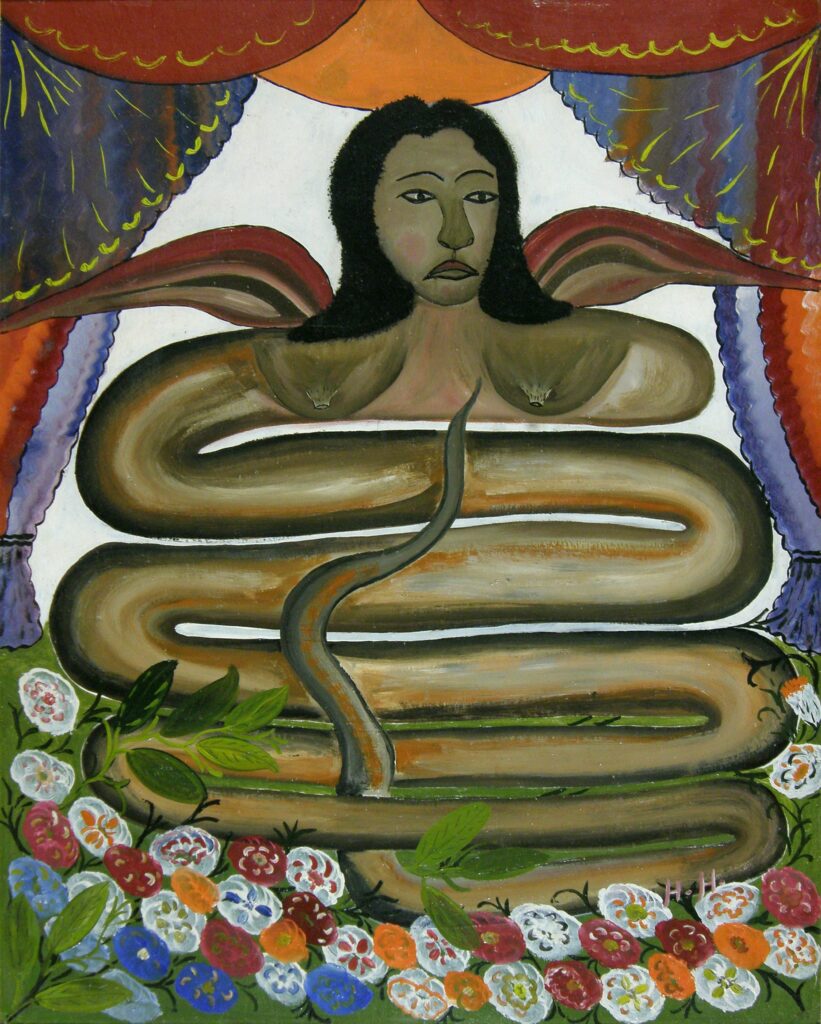
There is a building in Ouidah, in what is now the Republic of Benin, where pythons are kept. Not displayed, not housed as curiosities — kept, as one keeps something sacred. The snakes move freely through the interior space of the temple and are let out periodically into the town. When a python is found by local inhabitants, it is carried back. When one dies, it receives funerary rites. This has been documented by European observers since at least the end of the seventeenth century, when the Dutch merchant Willem Bosman described the “House of the Serpent” at Ouidah, its offerings, and the annual pilgrimages made there by the kings of the region. The python was, in his account, a “superior and excellent Divinity” to whom people appealed for rain, for health, for the outcome of wars, for harvests, for marriages. The serpent was consulted on everything, and about everything it was believed to know.
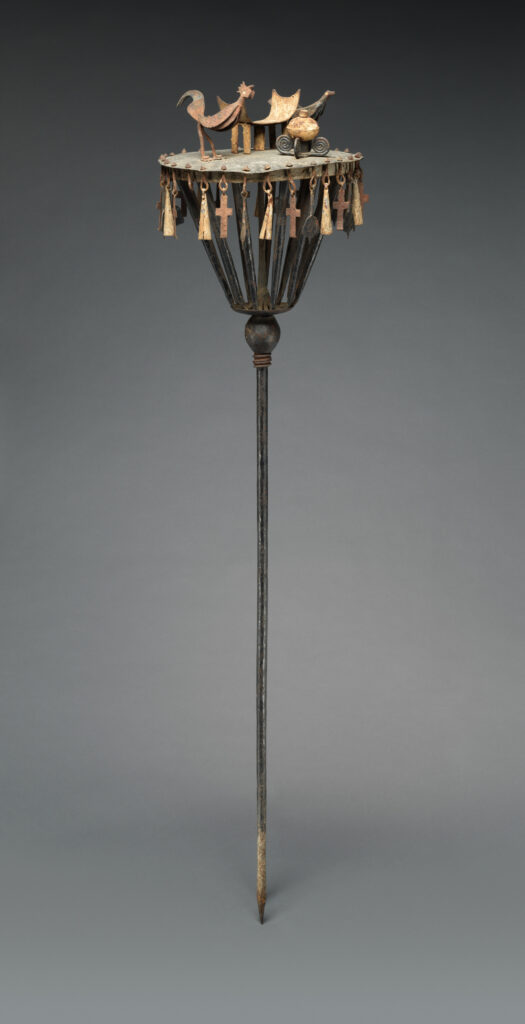
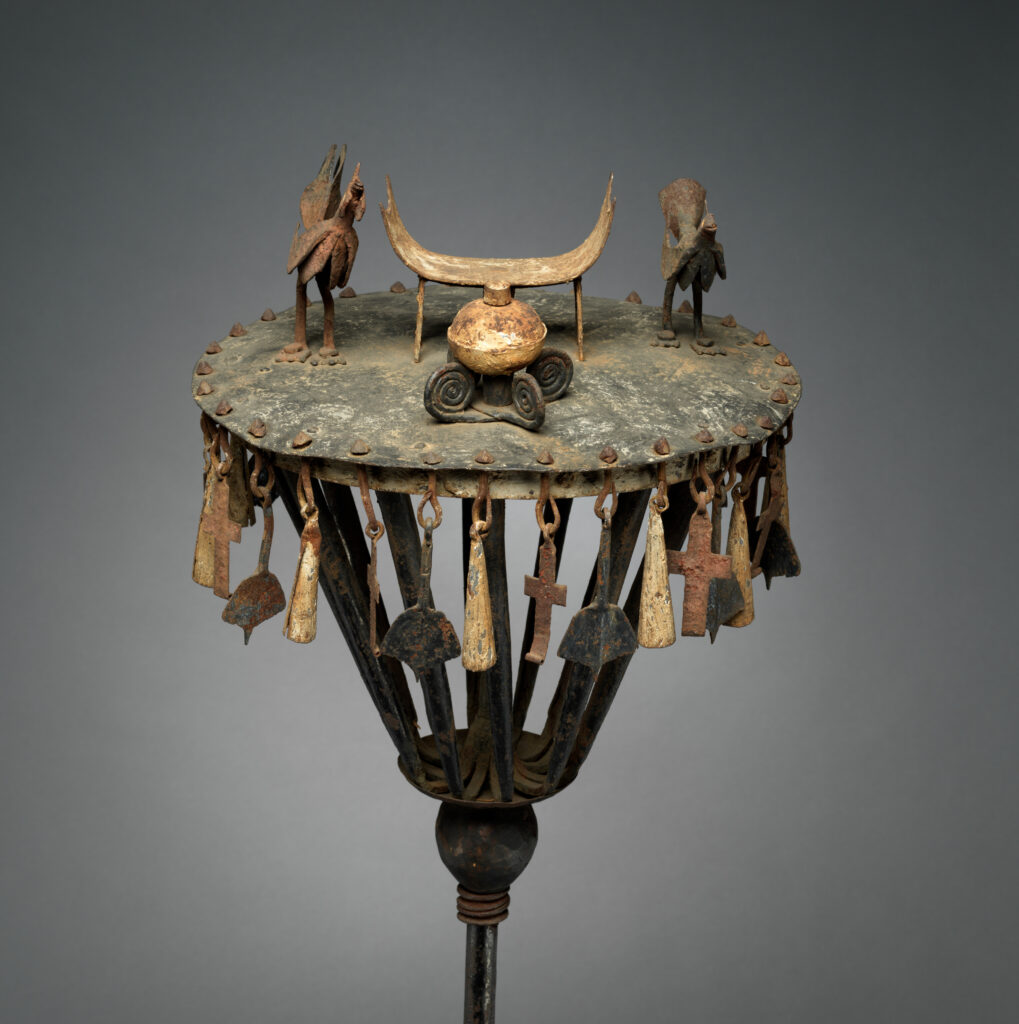
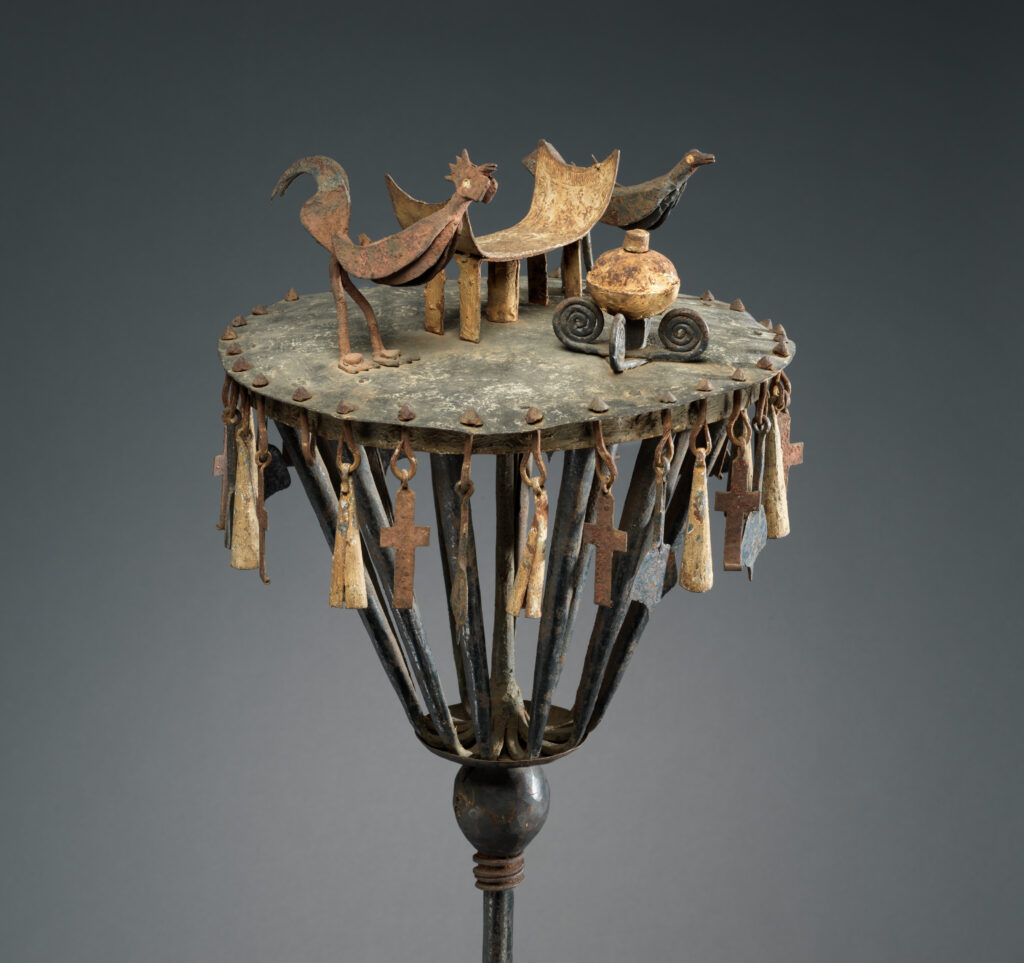
This is not allegory. This is not a serpent used as a symbol for something else. In Ouidah, the snake is the god — or rather, the snake is one form in which the god is present in the world. To understand what that means requires going further back than Bosman’s seventeenth-century account, into the cosmological structure from which the python cult grows. That structure belongs primarily to the Fon people of Dahomey, and at its center stands a figure called Dan.
Dan is the primordial serpent of Fon cosmology. He is not a trickster, not a monster, not a creature to be vanquished. He is, in the most literal sense available to cosmological language, the structure of things. According to traditions documented by Melville and Frances Herskovits in their foundational studies of Dahomean religion, Dan’s coils encircle the universe — thousands of loops beneath the earth, thousands above — and it is this encirclement that holds the world in place. Without Dan, the earth would collapse. His movement is what sustains the cosmos; his rest, if it ever came, would be its undoing. The Herskovitses recorded a belief that Dan carries the earth on his coils the way one might carry an object on one’s back: the earth is not free-floating but supported, actively held up by the body of the serpent.
This cosmological function is not unique to the Fon in the global record — one thinks of the Norse Jörmungandr encircling Midgard, or of the nāga Shesha upon whose body the universe rests in Hindu tradition. But what distinguishes the Fon conception is its particular insistence on Dan as a benign, almost impersonal force of coherence. He is not threatening; he does not test heroes or pursue the sun. He simply is, and in being, holds everything together. The Fon theologian who described Dan to Melville Herskovits spoke of the serpent less as a personality than as a condition — the condition of the world’s continued existence.
Dan has a counterpart, or a complement: Ayido Hwedo, the rainbow serpent, typically conceived as feminine. Where Dan sustains the earth below, Ayido Hwedo arches through the sky above, her body the arc of the rainbow. Together they form a vertical and celestial pair — the serpent of the depths and the serpent of the heights — enclosing the world between them. Some accounts merge the two figures; others treat Ayido Hwedo as Dan’s companion or feminine aspect. What remains consistent is the structural logic: the serpent is not incidentally present in the cosmos. The serpent is the cosmos’s frame.
The Python in the Temple
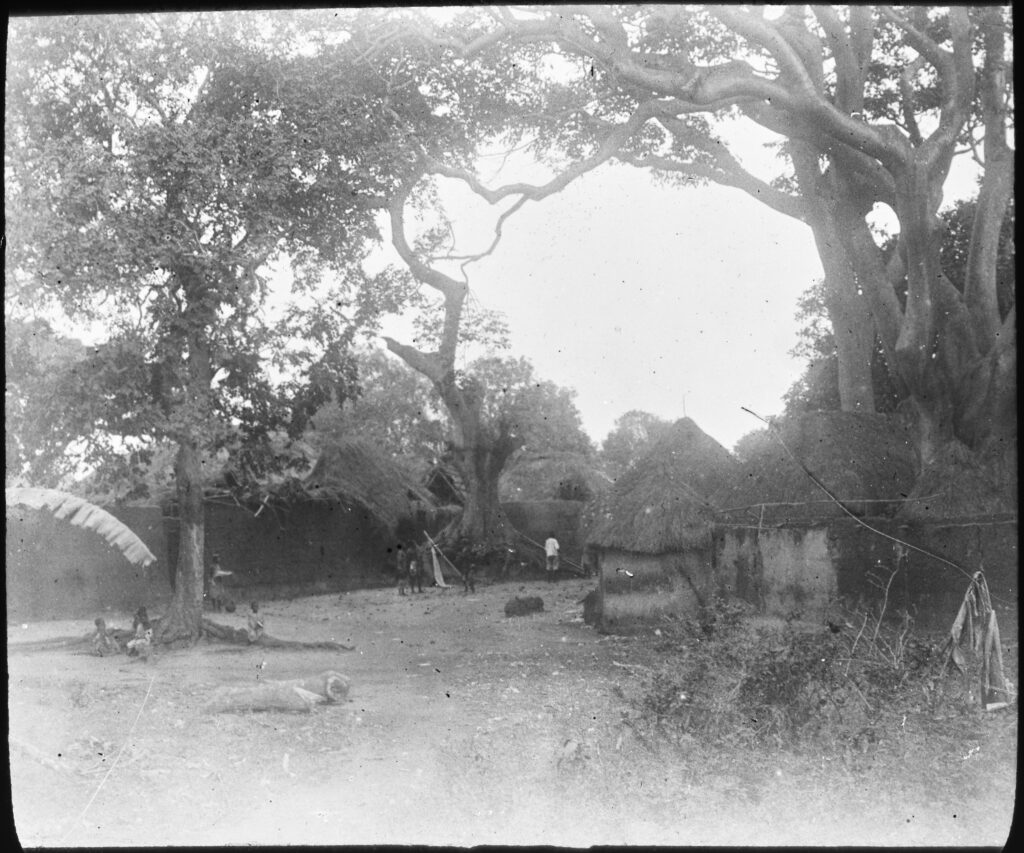
The temple at Ouidah is where this cosmological framework makes contact with an animal. The python worshipped there — Dangbé, “the Good Serpent,” as Pierre Verger called him in his study of the Dahomean python cult — is a royal python (Python regius), a species known for its docility and its striking, color-banded skin. It does not bite. It does not threaten. Bosman noted in 1705 that the animal was “extremely patient and never attacks people,” and that it was large, its skin “marked by wavy stripes in which yellow, blue and brown combine in a most agreeable way.” He was describing a real snake, observed in a real place, treated as divine.
The origin legend attached to the Ouidah python cult, as recorded in various historical accounts and discussed by Christian Merlo and Pierre Vidaud in their study published in Diogenes, involves a king of Ouidah named Kpassè who was saved from capture during a war when pythons emerged from the forest to protect him. In honor of this intervention, shrines were established. The historical tradition, documented from at least the early eighteenth century, locates the formalization of the cult around 1717 to 1725 — though the Houéda people’s reverence for the python appears older, and the Dahomey kings who conquered the region eventually adopted and institutionalized the cult rather than suppressing it. By the late seventeenth century, when European traders and missionaries began leaving written records, the python cult was already established enough to attract systematic description.
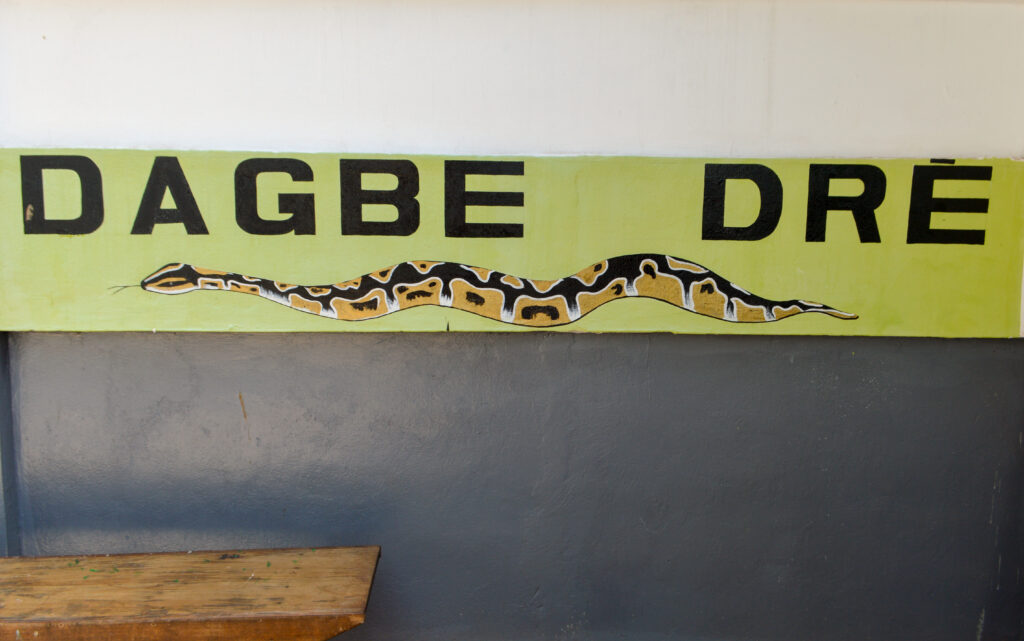
What the Ouidah cult represents is something unusual in the global history of serpent religion: not a symbolic serpent, not a mythological serpent, but a living serpent venerated as divine. Killing a python, even accidentally, was treated as a serious offense. The snakes moved through the town under the protection of the community. This is not zoolatry in any dismissive sense — it is the logical consequence of a theology in which the cosmic serpent Dan is understood to be present in the world, accessible, capable of interceding in human affairs. The python in the temple is not merely a symbol of Dangbé. He is Dangbé, in some sense that European observers consistently found difficult to articulate but could not deny.
The cultic continuity documented from the seventeenth century through the twentieth is itself remarkable. The python temple still exists. The royal pythons are still kept there. Scholars of West African religion, including Suzanne Preston Blier in her study of vodun arts in southern Benin and Togo, have documented the persistence of the tradition within living vodun practice. This is not a reconstructed or revived tradition — it is an unbroken one, surviving colonization, missionary pressure, and the political upheavals of the twentieth century.
Damballah and the Great White Serpent
Sometime between the late seventeenth and early nineteenth centuries, enslaved people from the Fon-speaking regions of Dahomey — along with many others from the Ewe, Yoruba, and Kongo cultural zones — were transported across the Atlantic to the Caribbean island of Saint-Domingue, the French colony that became Haiti after the revolution of 1804. They carried with them, under conditions of extreme violence and cultural suppression, the religions of their homelands. Dan traveled across the ocean.

In Haiti, he became Damballah Wedo.
Damballah is one of the most senior lwa in the Haitian vodou pantheon — the lwa are the divine beings who serve as intermediaries between humans and Bondye, the supreme creator too remote to be directly approached. He is represented as a great white serpent, associated with purity, with primordial wisdom, with water and rain, and with the sky. He speaks in no human language; when he possesses a devotee during ceremony, the person moves sinuously on the ground, hisses, and may climb to high places. He is very ancient, very calm, and very powerful. Leslie Desmangles, in his study of vodou and Roman Catholicism in Haiti, describes Damballah as among the most beloved and invoked of all the lwa, associated with beginnings and with the ground of existence itself.
His companion in the Haitian pantheon is Ayizan Wedo — or in another pairing, Ayida Wedo, the rainbow lwa. The correspondence with the Dahomean Dan and Ayido Hwedo is not accidental. It is direct. Scholars of Afro-Atlantic religion, from the Herskovitses onward, have traced this continuity with care. The names changed during the crossing — corrupted by the phonetics of Haitian Creole, syncretized under French Catholicism with Saint Patrick (who is depicted with serpents in his iconographic tradition), recontextualized within a new social and political reality. But the structure persisted. The great serpent who holds the world, the rainbow serpent who arches above it, the veneration of the python as a form of divine presence: these survived the Middle Passage in the memories and practices of the enslaved.
The survival was not passive. Vodou in Haiti was, as Desmangles argues at length, a religion of resistance as much as of worship. It was under vodou rites that the revolution of 1791 was organized; it was in the name of the lwa that enslaved people found the collective identity that colonial brutality sought to destroy. Damballah’s primordial calm — his association with the origins of things, with wisdom older than the violence that had been done — gave to Haitian vodou a ground of stability that no colonial power could entirely reach. The serpent that held the Dahomean cosmos together held the Haitian community together by analogous means.
There is a theological detail worth pausing on. In Dahomey, Dan is associated with wealth — the circulation of cowrie shells, the flow of goods and prosperity. The blue glass beads called segi in Yoruba are called danmi (“serpent excrement”) in Fon, and are said to be brought to the surface by snakes. This association between the serpent and material wealth, between the cosmic body of Dan and the flow of resources through the human world, persists in Damballah. He governs abundance as well as purity. The serpent that holds the earth together is also the one that keeps things moving through it.
Oxumaré: The Rainbow That Returns
The transport of West African religion across the Atlantic produced more than one diaspora. The Fon carried Dan to Haiti. The Yoruba-speaking peoples — from what is now southwestern Nigeria and the Republic of Benin, culturally and geographically close to but distinct from the Fon — carried their own traditions to Brazil, where they coalesced, primarily in the state of Bahia, into the religion known as Candomblé. The Yoruba divine beings, the orixás, found new forms in the Brazilian terreiros, the ceremonial houses where Candomblé is practiced. Among them is Oxumaré.
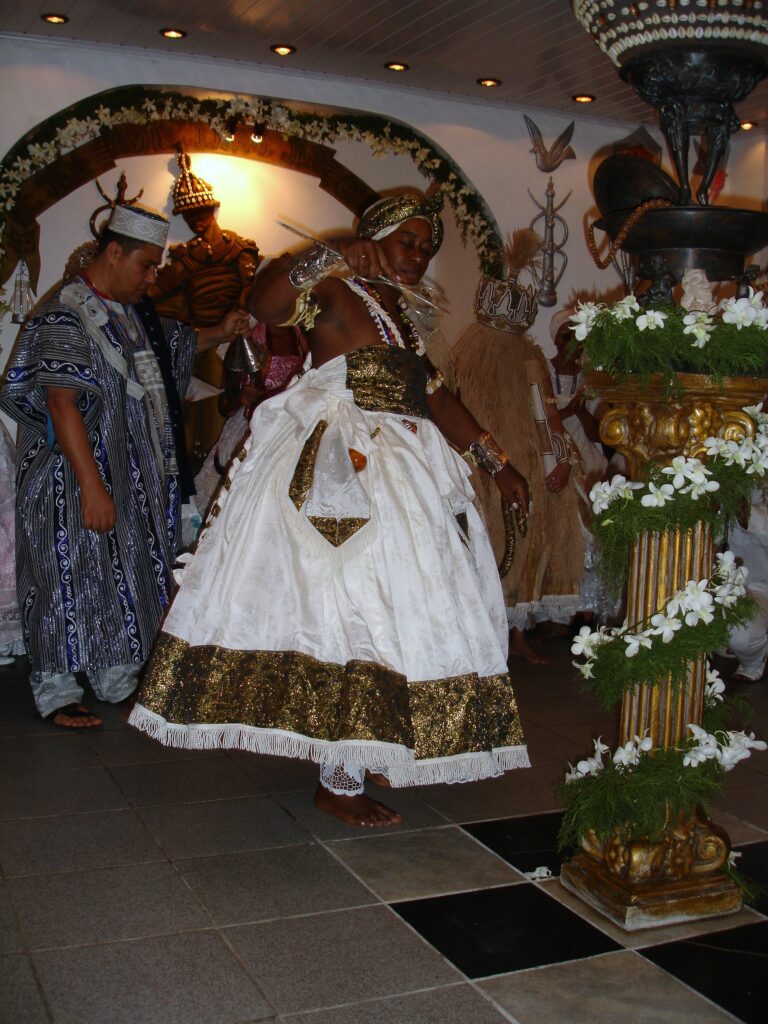
Oxumaré is the orixá of the rainbow and the serpent. The two are not separate — he embodies both, alternating between them. According to Pierre Verger, the French ethnographer who spent much of his life documenting Yoruba religious practice in both West Africa and Brazil, Oxumaré’s function includes gathering the rain that falls to earth and carrying it back to the sky: he is the water cycle made divine, the arc of the rainbow that closes the circuit between heaven and earth. He is described as androgynous, or as alternately male and female — in some traditions, a serpent for six months of the year and a rainbow for the other six, a biannual transformation that embodies the rhythms of season and weather.
The correspondences with Dan and with the Australian Rainbow Serpent are striking enough to have attracted comparative attention, though the mechanisms of connection — if any exist beyond structural parallel — remain a subject of scholarly debate. What Verger specifically notes is that the place of origin for Oxumaré among the Yoruba is the same region where the Fon Dan is paramount: the area around the former Kingdom of Dahomey, among peoples called the Mahi. The Yoruba Oxumaré and the Fon Dan share a geographical root and almost certainly a historical connection, though exactly how deep that connection runs and through what channels it passed are questions not yet fully resolved.
In the Brazilian Candomblé tradition, Oxumaré has become a figure of particular cultural significance beyond his religious function. As an androgynous or gender-fluid orixá, he has been embraced by communities whose identities refuse binary categories — the terreiros of Bahia have historically offered a social space more hospitable to gender variance than the surrounding Catholic culture. This is not incidental to his mythology: the serpent who is both male and female, both earthly and celestial, both serpent and rainbow, embodies a refusal of fixed categories that extends naturally into social life.
Reginaldo Prandi, the Brazilian sociologist who has documented Candomblé mythology in depth, records the myths in which Oxumaré participates in the very creation of the world — wrapping himself around the earth, forming valleys and rivers with the movement of his body through the primordial landscape. This is another version of the same figure: the serpent whose body is the shape of the world.
Water and Ancestor: Dogon and Kongo Traditions
Two other traditions in the African corpus contain serpent figures of real mythological importance, though the scholarly documentation of both presents complications that must be named directly.
Among the Dogon people of the Bandiagara Escarpment in Mali, there is a figure called Lébé. Lébé is a primordial ancestor — an old man, in the oldest traditions, the eighth ancestor of the Dogon lineage — whose body was buried in the primordial field. When the seventh ancestor, sacrificed to restore cosmic order, returned in the form of a spirit called the Nummo, he swallowed the buried body of Lébé and transformed it: the ancestor was reborn as a serpent. This Lébé-serpent then guided the Dogon people from their original homeland in the region of Mandé toward the Bandiagara Escarpment, where they live today. He is associated with the land’s fertility; his representative among the Dogon, the priest called the hogon, is believed to be visited and licked clean each night by the serpent — an act that transfers vital force and keeps the community alive.
The source for this and much else in Dogon cosmology is Marcel Griaule’s famous Dieu d’eau (1948), based on conversations with the elder Ogotemmêli. Griaule spent decades working with the Dogon, and his work introduced their cosmological system — extraordinarily rich and complex — to the international scholarly world. However, the reliability of Griaule’s account has been seriously contested. Walter van Beek, an anthropologist who conducted independent fieldwork with the Dogon in the late 1980s and early 1990s, published a critique in American Ethnologist (1991) arguing that many of the mythological elements Griaule documented were either unknown to the Dogon he spoke with or reconstructed through a dialogic process in which Griaule and his interlocutors co-created material rather than simply transmitting it. The debate remains unresolved, and Griaule’s defenders — including his own daughter, the anthropologist Geneviève Calame-Griaule — have challenged van Beek’s methodology in turn. What can be said with caution is that a serpent ancestor named Lébé does appear in Dogon tradition, and that the figure’s function as a guide, a fertility force, and a nocturnal visitor to the hogon is attested in multiple sources. The precise cosmological system in which Lébé is embedded should be treated as Griaule’s reconstruction rather than transparent ethnographic fact.
The Kongo situation is different in character. Among the Bakongo people of Central Africa — in what is now the Democratic Republic of Congo, the Republic of Congo, and Angola — spirits called bisimbi (singular simbi) are water spirits associated with rivers, springs, and other bodies of fresh water. They are shapeshifters, appearing in human form, in the form of snakes, as fire, or as gourds. They are understood as guardians of the boundary between the living and the dead — the Kongo cosmological model places life and death on two sides of a liminal threshold associated with water, called kalunga, and the bisimbi inhabit and govern this threshold. Their serpentine form is one expression of their liminal nature: the snake that moves between water and land, between the world seen and the world beneath.
The work of Robert Farris Thompson, particularly Flash of the Spirit (1983), has traced the persistence of Kongo religious concepts across the Atlantic diaspora: into Haitian vodou (where the simbi lwa appear as a category of water spirits), into Louisiana Voodoo, into Cuban Palo, and into the folklore of the Gullah-Geechee communities of the Carolina Lowcountry. The serpentine water spirit did not remain in Central Africa. It crossed, transformed, and resurfaced in new contexts, always keeping its association with fresh water and liminal space.
The Kongo material is less well documented than the Fon material in terms of serpent-specific mythology; what exists tends to be embedded in broader studies of nkisi (sacred objects and forces) and of the diaspora’s transformations. For readers wishing to pursue the Kongo tradition specifically, Thompson’s work and that of Wyatt MacGaffey — particularly Religion and Society in Central Africa (1986) — provide the most rigorous starting points in English.
A Note on Sources and Scholarly Uncertainty
The scholarship on African religious traditions and the African diaspora is substantial, but it is not evenly distributed, and the conditions under which much of it was produced deserve acknowledgment.
The foundational work on Fon/Dahomean religion remains that of Melville J. Herskovits and Frances S. Herskovits, whose fieldwork in Dahomey in the 1930s produced Dahomey, an Ancient West African Kingdom (1938) and the closely related An Outline of Dahomean Religious Belief (1933). These texts established the scholarly framework through which Dan, Ayido Hwedo, and the Dahomean vodun system became legible to Western academic audiences. They have been criticized — as was virtually all mid-twentieth-century ethnography of Africa — for the inevitable limitations of external observation and for frameworks shaped more by comparative religion than by indigenous categories. They remain, nonetheless, the essential primary sources for this material, and their descriptions of Dan’s cosmological function are consistent with what later scholars have confirmed from different angles. Suzanne Preston Blier’s African Vodun: Art, Psychology, and Power (University of Chicago Press, 1995) is the most important more recent study and treats both the Benin and Togo vodun traditions and their diaspora connections with considerable sophistication.
For Haitian vodou, Leslie Desmangles’s The Faces of the Gods: Vodou and Roman Catholicism in Haiti (University of North Carolina Press, 1992) is the standard reference for the theological analysis of the lwa system. Karen McCarthy Brown’s Mama Lola: A Vodou Priestess in Brooklyn (University of California Press, 1991) provides an ethnographic account grounded in extended participant observation and is valuable for its attention to Damballah’s role in lived practice.
For Candomblé, Pierre Verger’s Orixás: Deuses Iorubás na África e no Novo Mundo (1957; Brazilian edition 1981) is the foundational comparative text, and Reginaldo Prandi’s Mitologia dos Orixás (Companhia das Letras, 2001) provides the most comprehensive collection of Candomblé mythological narratives in Portuguese. Both Verger and Prandi document Oxumaré in detail. J. Lorand Matory’s Black Atlantic Religion: Tradition, Transnationalism, and Matriarchy in the Afro-Brazilian Candomblé (Princeton University Press, 2005) offers a more critical and theoretically sophisticated perspective on the construction of “African tradition” in the diaspora.
The Griaule controversy regarding the Dogon material is discussed in Walter E.A. van Beek, “Dogon Restudied: A Field Evaluation of the Work of Marcel Griaule,” Current Anthropology 32, no. 2 (1991): 139–167, with responses from multiple scholars. Readers should consult this alongside Griaule’s own Dieu d’eau (1948; English translation Conversations with Ogotemmêli, Oxford University Press, 1965) and Griaule and Germaine Dieterlen’s Le Renard pâle (Institut d’Ethnologie, 1965).
A word on North Africa: the Amazigh/Berber traditions of the Maghreb do contain serpent figures — a flying serpent called Aherman appears in several folkloric sources — but the academic literature on specifically Amazigh serpent mythology is thin in English and French, and I have not been able to identify peer-reviewed monographs or articles that would allow this material to be treated with the rigor applied elsewhere in this article. For this reason, North Africa has been excluded from the main text rather than handled superficially.
The article on the Ouidah python cult by Christian Merlo and Pierre Vidaud, “The Black Serpent Who Opened the Eyes of Man,” Diogenes 14, no. 55 (1966): 61–88, is an important primary study and mobilizes an extensive series of seventeenth- through nineteenth-century eyewitness accounts of the serpent cult, from Bosman (1705) through Richard Burton’s mission to Gelele (1893). It is the best available synthesis of the historical documentation of Dangbé and remains valuable despite its age.
Bibliography
Primary and Historical Sources — Directly Consulted or Cited via Academic Intermediaries
Bosman, Willem. Voyage en Guinée. Utrecht, 1705. [Cited via Merlo and Vidaud, 1966.]
Griaule, Marcel. Dieu d’eau: Entretiens avec Ogotemmêli. Paris: Éditions du Chêne, 1948. English translation: Conversations with Ogotemmêli: An Introduction to Dogon Religious Ideas. London: Oxford University Press for the International African Institute, 1965.
Griaule, Marcel, and Germaine Dieterlen. Le Renard pâle. Vol. 1. Paris: Institut d’Ethnologie, 1965.
Scholarly Monographs and Articles
Blier, Suzanne Preston. African Vodun: Art, Psychology, and Power. Chicago: University of Chicago Press, 1995.
Brown, Karen McCarthy. Mama Lola: A Vodou Priestess in Brooklyn. Berkeley: University of California Press, 1991.
Desmangles, Leslie G. The Faces of the Gods: Vodou and Roman Catholicism in Haiti. Chapel Hill: University of North Carolina Press, 1992.
Herskovits, Melville J. Dahomey, an Ancient West African Kingdom. 2 vols. New York: J. J. Augustin, 1938.
Herskovits, Melville J., and Frances S. Herskovits. An Outline of Dahomean Religious Belief. Memoirs of the American Anthropological Association, no. 41. Menasha, WI: American Anthropological Association, 1933.
Herskovits, Melville J., and Frances S. Herskovits. Dahomean Narrative: A Cross-Cultural Analysis. Evanston, IL: Northwestern University Press, 1958.
MacGaffey, Wyatt. Religion and Society in Central Africa: The BaKongo of Lower Zaire. Chicago: University of Chicago Press, 1986.
Matory, J. Lorand. Black Atlantic Religion: Tradition, Transnationalism, and Matriarchy in the Afro-Brazilian Candomblé. Princeton: Princeton University Press, 2005.
Merlo, Christian, and Pierre Vidaud. “The Black Serpent Who Opened the Eyes of Man.” Diogenes 14, no. 55 (1966): 61–88.
Prandi, Reginaldo. Mitologia dos Orixás. São Paulo: Companhia das Letras, 2001.
Thompson, Robert Farris. Flash of the Spirit: African and Afro-American Art and Philosophy. New York: Random House, 1983.
van Beek, Walter E. A. “Dogon Restudied: A Field Evaluation of the Work of Marcel Griaule.” Current Anthropology 32, no. 2 (1991): 139–167.
Verger, Pierre Fatumbi. Notes sur le culte des Orisa et Vodun à Bahia la Baie de tous les Saints, au Brésil et à l’ancienne Côte des Esclaves en Afrique. Mémoires de l’Institut français d’Afrique noire, no. 51. Dakar: IFAN, 1957.
Verger, Pierre Fatumbi. Orixás: Deuses Iorubás na África e no Novo Mundo. Salvador: Corrupio, 1981.
Primary Sources — Not Directly Consulted
Hambly, Wilfrid D. “Serpent Worship in Africa.” Field Museum of Natural History, Anthropological Series 21, no. 1. Chicago: Field Museum, 1931.
Hazoumé, Paul. “L’âme du Dahoméen animiste révélée par sa religion.” Présence Africaine, numéro spécial, 1957.
Parrinder, Geoffrey. La religion en Afrique occidentale. Paris: Payot, 1950.