I. Water and Stone
Chavín de Huántar sits at 3,177 metres in a narrow valley at the confluence of two rivers, the Mosna and the Wacheqsa, in the Peruvian highlands. The site is approximately 3,000 years old — old enough to predate the Inca empire by two and a half millennia, old enough that the Incas who eventually came to dominate the Andes had no clearer idea of who built it than we do. What they left behind is a temple complex of galleries and passageways carved into the earth, a system of underground channels extending more than a thousand metres, stone sculptures of extraordinary technical precision, and no written language at all. What the site means must be reconstructed from what the stones show and what the architecture does.
What the architecture does, in large part, is manipulate water. Archaeologist John Rick, who has directed excavations at Chavín de Huántar for decades at Stanford, has documented a hydraulic system far exceeding any practical drainage function: canals designed to route water beneath the ceremonial plazas and amplify its sound, creating a roaring backdrop during ritual. The priests who administered the site appear to have used water — along with darkness, psychoactive substances, and controlled acoustics — as instruments of authority, staging encounters that demonstrated their access to forces beyond ordinary human reach. Among the animals whose images recur across the site’s stone carvings — jaguar, caiman, raptor — the serpent is a constant. It appears on portable objects carried far beyond the valley, in the iconography of the Lanzón monolith deep in the temple’s innermost gallery, on ceremonial nose ornaments worn by elites throughout Peru. At Chavín, the serpent and water are not merely associated. They are bound together in a ritual apparatus designed to overwhelm the senses.
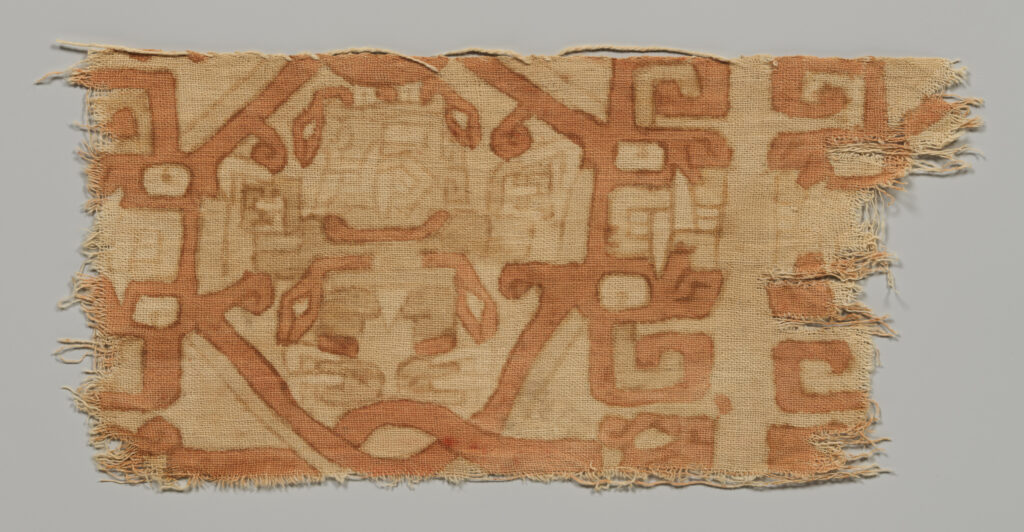
This conjunction — serpent and water, serpent and the earth’s hidden depths — runs through the entire subsequent history of Andean religion. It does not require a direct line of transmission between Chavín and the Incas, who came two thousand years later and several hundred kilometres to the south. What it requires is attention to a landscape in which water emerges from underground, where rivers are the arteries of life, where the high lakes of the altiplano hold their reflections of the sky, and where earthquakes remind anyone living there that forces of enormous power move beneath the surface. Into that landscape, the serpent fits with the precision of a key into a lock.
II. The Amaru and the Andean Cosmos
The Amaru is a double-headed serpent. In Inca and broader Andean cosmology it inhabits the underworld — ukhu pacha, the realm beneath — emerging at springs, rivers, and lakes, connecting the subterranean to the terrestrial. Its symbolism is not reducible to a single attribute: colonial-era chroniclers who documented Andean beliefs recorded its association with water, the rainbow, earthquakes, lightning, wisdom, and the Milky Way. Bernabé Cobo in his seventeenth-century Historia del Nuevo Mundo, and Felipe Guamán Poma de Ayala in his Nueva Corónica y Buen Gobierno (c. 1615), both note the Amaru as an object of veneration — a huaca, a sacred power — particularly associated with the eastern Andean region of the Antisuyu, the tropical lowlands where serpents of considerable size were actually present and where highland and forest traditions met. Cobo’s account is especially concrete: he describes Andeans keeping live serpents in large jars, feeding them the blood of guinea pigs and herbs, and making festivals and sacrifices for them.
The Amaru’s composite appearance — documented sources give it variously a puma head, condor features, a fish’s tail, the body of a serpent — is not decorative eclecticism. In Andean cosmological logic, the most powerful beings combine elements of the three realms: sky, earth, and underground. The condor governs the sky, the puma the terrestrial world, the serpent the subterranean. An Amaru that encompasses all three is not a monster but a map of the cosmos made flesh.
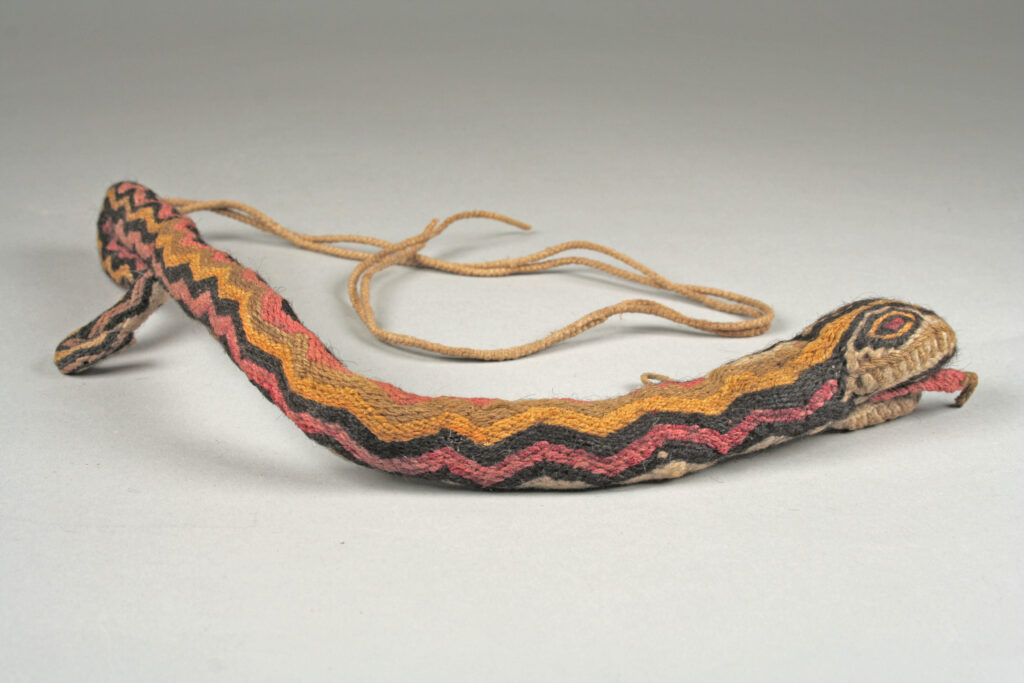
The name itself carried political weight. According to the colonial chronicle of Joan de Santa Cruz Pachacuti Yamqui Salcamaygua, when Pachacuti Inca Yupanqui — the fifteenth-century ruler credited with dramatically expanding Inca power — named his son Amaru Tupa Yupanqui, the occasion coincided with a major earthquake: the movement of the earth beneath Cusco interpreted as the amaru stirring in its underground home. The serpent’s body and seismic event were, in the Andean conception, manifestations of the same force. Margarita Gentile’s detailed study of colonial-period documentation, published in El Futuro del Pasado (2017), traces instances of amaru veneration across several regions, noting how the creature appears in Huarochirí accounts as a being capable of being petrified at moments of intense sacred power — the stone then remaining as a presence in the landscape.
The Amaru is pan-Andean in a way that exceeds the Inca empire’s own geographical reach. At Tiwanaku, the Bolivian altiplano site that flourished between roughly 400 and 1000 CE — predating the Inca and two thousand kilometres from Chavín — the central figure of the famous Gateway of the Sun is the Staff God, a frontally positioned deity holding vertical attributes in each hand. Scholarly debate continues about this figure’s identity and the precise nature of its attributes, but what is clear is that serpentine forms appear throughout Tiwanaku iconography, woven through the site’s ceramic, textile, and stone programs. The Staff God motif, with variants including serpentine staffs, travelled across Andean cultures from at least the Chavín horizon onward, and its persistence across millennia and vast distances points to a shared symbolic vocabulary for which the serpent was a central term.
III. The River Is a Serpent
The anaconda is the largest snake in the world by mass. It lives in the rivers and flooded forests of the Amazon basin. In much of the Amazon, it is not possible to think about water without thinking about the anaconda, and not possible to think about the anaconda without confronting questions about the origin of rivers, the nature of power, and the relationship between the human community and the forces that could destroy it. The mythological elaboration of the anaconda across dozens of Amazonian traditions is enormous and internally diverse; any summary risks flattening distinctions that matter enormously to the communities involved. With that caveat stated, certain patterns recur.
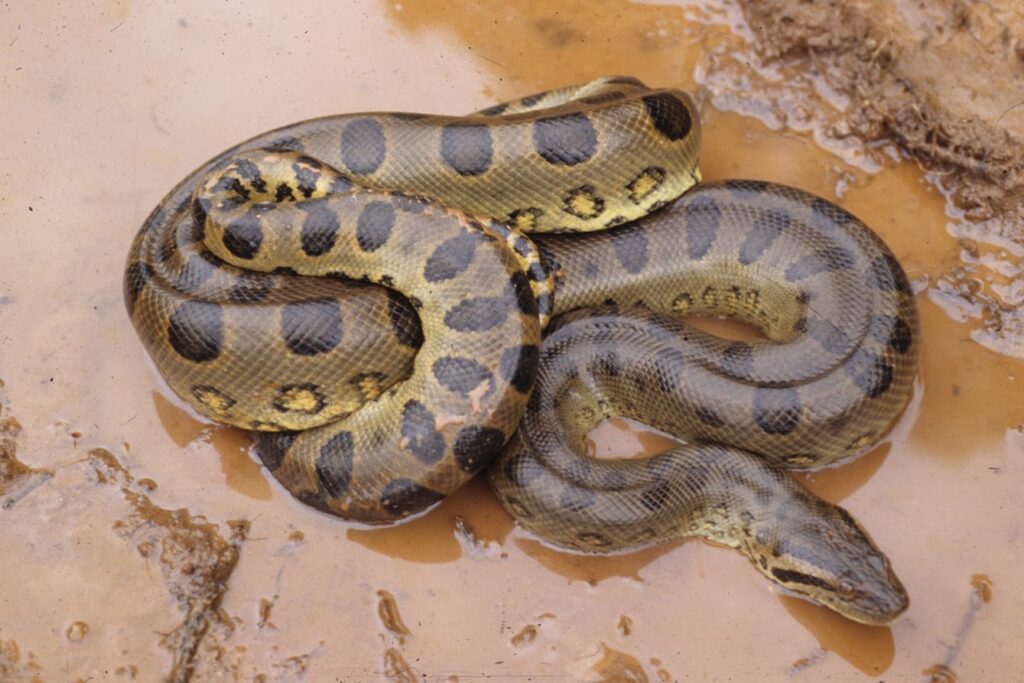
Among the Desana and other Tukano-speaking peoples of the Colombian and Brazilian Amazon, the river itself is imagined as a great anaconda — the physical waterway and the mythological creature superimposed. Gerardo Reichel-Dolmatoff, the Austrian-Colombian anthropologist who spent decades among these communities and is considered a foundational figure in the study of Amazonian religion, documented in Amazonian Cosmos (University of Chicago Press, 1971) how the Desana understand a creator Sun being — pamurí-mahsë — as having sent the ancestral people to earth by canoe, the canoe itself identified with an anaconda. The interior of the canoe, where people traveled, is the body of the serpent. To be born into the world is to have passed through the anaconda.
In Quechua-speaking traditions of the Peruvian Amazon, the great water serpent is known as Yacumama — “mother of the waters” (yacu: water; mama: mother). Her counterpart in the forest is Sachamama, the “mother of the jungle.” The two are complementary figures: one governs the rivers, one the trees; both are immense, both are primordial, both are the organizing presences of their respective domains. Stephan Beyer’s Singing to the Plants: A Guide to Mestizo Shamanism in the Upper Amazon (University of New Mexico Press, 2009) notes that within Upper Amazonian mestizo shamanism, these are understood as species of beings rather than individual creatures — there are many yacumamas, many sachamamas, each governing a particular stretch of river or forest. The shamanic logic here is not monotheistic: power is distributed, local, specific.
The connection between anaconda and water in Amazonian mythology is not primarily metaphorical. The anaconda lives in water, hunts in water, drags its prey into water. It moves between the terrestrial and the aquatic. In several traditions, the anaconda is credited with having created the river system itself, or with sustaining it — without the serpent, the river would lose its animating force. This is a logic that Andeans who thought the Amaru lived in the depths of lakes and rivers would have recognised immediately. The question is not whether these traditions are genealogically related in any demonstrable sense — the relationship is largely unanswerable, and should not be assumed. The question is what it says about the relationship between serpents and water that the conjunction recurs so persistently across such different cultural worlds.
IV. What the Stones Remember
When the Spanish arrived in the Andes in 1532, they brought with them a theological vocabulary in which serpents were unambiguously evil. The colonial chroniclers who documented Andean religion were sometimes the same people charged with destroying it. Guamán Poma de Ayala, writing as an indigenous voice navigating colonial authority, used the words amaro and serpiente interchangeably — allowing the Spanish word for serpent to carry its Biblical freight into the Quechua concept, or attempting to hold the two apart; it is not always possible to tell which. Cobo described the veneration of live serpents with evident distaste. The colonial record of Andean serpent veneration is simultaneously a record of its suppression.
The consequences are irreversible. Traditions that were oral, or encoded in forms the Spanish could not read — textiles, ceramics, the knotted-cord records called khipu — have been partially or wholly lost. What the Andean world knew about the Amaru before 1532 is accessible only in fragments and through the filter of a colonial encounter that understood the serpent as the enemy of God. This is not a peripheral methodological concern. It is the central difficulty of the field.
What survives is substantial nevertheless. And the stones. At Chavín de Huántar, the serpent is carved into the temple itself, into the nose ornaments worn by the powerful, into the textiles that spread the cult across the Andean world. No colonial authority could suppress what was already stone, already three thousand years old by the time the first missionaries arrived.
A Note on the Mapuche Serpents
The Mapuche tradition of southern Chile preserves one of the most structurally distinctive serpent myths in South America: the battle of Trentren Vilu and Caicai Vilu. Trentren is the earth serpent, protector of humanity; Caicai is the sea serpent, who strikes the ocean with its fish-shaped tail to unleash a world-flood in punishment for human ingratitude. The two fight until exhaustion, and the landscape they leave behind — mountains thrust upward, valleys drowned, the Chiloé archipelago created from submerged coastline — is the southern Chilean geography as the Mapuche understand it. Earthquakes and tsunamis are ongoing manifestations of the unresolved conflict between them.
This myth was deliberately held back from the body of the article because it belongs geographically and culturally to southern South America rather than to the Andean or Amazonian world treated above. It is also a tradition sufficiently rich to warrant careful treatment in its own right, and the scholarly sources available for it — primarily focused on its geological and geomorphological dimensions rather than its mythological depth — do not yet support the level of analysis applied to the Amaru or the Amazonian anaconda traditions here.
A Note on Sources and Scholarly Uncertainty
The primary archaeological reference for Chavín de Huántar is Richard L. Burger, Chavin and the Origins of Andean Civilization (Thames and Hudson, 1992), and the more recent collective volume edited by Burger and Jason Nesbitt, Reconsidering the Chavín Phenomenon in the Twenty-First Century (Dumbarton Oaks, 2023). The hydraulic and sensory-manipulation aspects of the site draw on John W. Rick’s excavation work at Stanford, summarised in William Conklin and Jeffrey Quilter, eds., Chavín: Art, Architecture, and Culture (Cotsen Institute of Archaeology Press at UCLA, 2008). Rick’s interpretation of Chavín as a centre for manufacturing religious authority through multi-sensory manipulation is compelling but, as with all interpretive claims about a culture without writing, should be understood as scholarly hypothesis rather than established fact.
For Inca and Andean mythology, the core references are: Gary Urton, Inca Myths (University of Texas Press / British Museum Press, 1999); and Paul Steele and Catherine J. Allen, Handbook of Inca Mythology (ABC-CLIO, 2004), which contains a dedicated entry on the Amaru. The standard English translation of the Huarochirí Manuscript is Frank Salomon and George L. Urioste, The Huarochirí Manuscript: A Testament of Ancient and Colonial Andean Religion (University of Texas Press, 1991); direct access to this text was not available during the preparation of this article, and claims touching on its content are anchored on Margarita E. Gentile, “El Amaru como emblema de los Incas del Cusco (Siglos XVI–XVII),” El Futuro del Pasado, no. 8, 2017, pp. 297–327, which analyses the colonial documentation extensively. Colonial chronicles — Guamán Poma de Ayala’s Nueva Corónica y Buen Gobierno (c. 1615), Bernabé Cobo’s Historia del Nuevo Mundo (1653), and Joan de Santa Cruz Pachacuti Yamqui Salcamaygua’s chronicle (c. 1613) — are indispensable primary sources but require careful reading: all were written under colonial conditions that shaped what could be said, how, and to whom.
On the Staff God and Tiwanaku iconography, the article by M. Viau-Courville, “Spatial Configuration in Tiwanaku Art: A Review of Stone Carved Imagery and Staff Gods” (ResearchGate, 2014), offers close analysis of the Gateway of the Sun figure. The broader debate on the Staff God as a pan-Andean continuity is introduced in John H. Rowe’s foundational 1946 paper on Inca religion and revisited in the Tiwanaku scholarship cited above. The presence of serpentine elements in Tiwanaku iconography more broadly is not in scholarly dispute; the precise attribution of specific serpentine features on the Gateway of the Sun figure is, and this article has been deliberately cautious on that point.
For Amazonian serpent mythology, Gerardo Reichel-Dolmatoff’s Amazonian Cosmos: The Sexual and Religious Symbolism of the Tukano Indians (University of Chicago Press, 1971) remains the essential reference for Desana and Tukano traditions, with the important caveat that his interpretive framework has been subject to criticism by later scholars and that his account reflects fieldwork from the 1960s in a specific community. Stephan Beyer, Singing to the Plants: A Guide to Mestizo Shamanism in the Upper Amazon (University of New Mexico Press, 2009) covers Yacumama and Sachamama in the Upper Amazon mestizo context.
On the Mapuche serpents, the structural features of the Trentren/Caicai myth are well documented across popular and institutional sources including the Museo Chileno de Arte Precolombino. An article treating the myth in relation to seismic and geological phenomena — “Influence of Geological Processes in the Cosmovision of the Mapuche Native People in South Central Chile” — appears on ResearchGate (2021) and offers a disciplined starting point, but the deep mythological scholarship on this tradition remains, to this writer’s knowledge, largely in Spanish and has not been fully integrated here.
Bibliography
Primary Sources — Not Directly Consulted
The following primary sources are referenced in this article via secondary scholarship. They are listed here for the reader’s benefit.
Cobo, Bernabé. Historia del Nuevo Mundo. 1653. Translated by Roland Hamilton as History of the Inca Empire. Austin: University of Texas Press, 1979.
Garcilaso de la Vega. Comentarios Reales de los Incas. 1609. Translated by Harold V. Livermore as Royal Commentaries of the Incas and General History of Peru. Austin: University of Texas Press, 1966.
Guamán Poma de Ayala, Felipe. Nueva Corónica y Buen Gobierno. c. 1615. Edited by John V. Murra, Rolena Adorno, and Jorge L. Urioste. Madrid: Historia 16, 1987.
Salomon, Frank, and George L. Urioste, trans. The Huarochirí Manuscript: A Testament of Ancient and Colonial Andean Religion. Austin: University of Texas Press, 1991.
Santa Cruz Pachacuti Yamqui Salcamaygua, Joan de. Relación de Antigüedades deste Reyno del Pirú. c. 1613. In Tres Relaciones de Antigüedades Peruanas, edited by Marcos Jiménez de la Espada. Madrid: Ministerio de Fomento, 1879.
Archaeology — Chavín de Huántar
Burger, Richard L. Chavin and the Origins of Andean Civilization. London: Thames and Hudson, 1992.
Burger, Richard L., and Jason Nesbitt, eds. Reconsidering the Chavín Phenomenon in the Twenty-First Century. Washington, DC: Dumbarton Oaks, 2023.
Conklin, William, and Jeffrey Quilter, eds. Chavín: Art, Architecture, and Culture. Los Angeles: Cotsen Institute of Archaeology Press at UCLA, 2008.
Andean Mythology and Religion
Gentile, Margarita E. “El Amaru como emblema de los Incas del Cusco (Siglos XVI–XVII).” El Futuro del Pasado, no. 8 (2017): 297–327.
Steele, Paul, and Catherine J. Allen. Handbook of Inca Mythology. Santa Barbara: ABC-CLIO, 2004.
Urton, Gary. Inca Myths. London and Austin: British Museum Press and University of Texas Press, 1999.
Amazonian Traditions
Beyer, Stephan. Singing to the Plants: A Guide to Mestizo Shamanism in the Upper Amazon. Albuquerque: University of New Mexico Press, 2009.
Reichel-Dolmatoff, Gerardo. Amazonian Cosmos: The Sexual and Religious Symbolism of the Tukano Indians. Chicago: University of Chicago Press, 1971.