In 1950, cataloguing several hundred engraved gemstones scattered across museums and private collections on two continents, the American classicist Campbell Bonner paused over a single green jasper pendant, clouded faintly with red, then held in the collection of the New York dealer Joseph Brummer. Its face carried a crude lion-headed figure; around its edge, in a hand neither careful nor careless, someone had cut seven names — Ialdabaoth, Iao, Sabaoth, Adonai, Eloai, Horaios, Astaphaios — that match, almost word for word, the roster of seven ruling archons that the heresiologists Irenaeus and Origen attribute to a sect they called Ophite. Bonner treated the object with unusual caution. Of the several hundred gems that nineteenth- and twentieth-century scholarship had confidently labelled “Gnostic,” he judged, this pendant might be one of only a handful that actually deserved the name.
This article is about what happens to a serpent once it leaves the hands that first gave it meaning. Between the second century and the twentieth, the figure of the serpent, coiled, crowned, or biting its own tail, passes through Gnostic sectarians, Roman gem-cutters, medieval alchemists, and Swiss psychoanalysts, and at nearly every handoff it is taken up by someone who understands only part of what came before and reshapes it anyway. Reappropriation, here, is not a loose metaphor for cultural exchange in general; it is a specific, repeated, and traceable gesture: one sect’s polemical rival stealing its central symbol and reversing the verdict on it, one civilization’s ordinary coin-type reused as another culture’s healing charm, one psychologist mining a colonial-era translation for material to build a theory that his own source had already tried to correct. The four cases that follow, moving roughly from the second century to the nineteen-thirties, examine how that gesture repeats itself, and how often the borrowers misunderstand, sometimes productively, exactly what they are borrowing.
The Ophites and Naasenes: An Inversion Narrower Than It Looks
Ask someone who has read a little about Gnosticism what the Ophites believed, and you will likely hear some version of the following: a heretical Christian sect that worshipped the serpent of Eden, reading Genesis backward so that the snake becomes the hero of the story and the god who forbids the fruit becomes the villain. The story has an obvious appeal — it flatters a modern taste for contrarian scripture — and in its confident, popular form, it is largely wrong.
Irenaeus, writing around 180 CE and closer to the sect he describes than any source that survives, does not report anything so simple. In his account, the serpent that persuades Eve to eat the fruit is praised for a single act — the advice itself — while remaining, as a being, the offspring of a lower and hostile power, variously named Ialdabaoth or Samael. The Finnish scholar Tuomas Rasimus, whose 2009 monograph remains the most careful modern treatment of this material, calls it a double evaluation: the counsel is good, the counsellor is not thereby redeemed. Nothing in the surviving sources describes ritual veneration of an actual snake, and Rasimus is blunt about it — the notion that the group called, or calling itself, “Ophite” practiced anything resembling serpent worship is, in his words, “highly unlikely.” Even the label is unstable: it surfaces late in the heresiological record, probably coined by hostile outsiders rather than adopted by insiders, and modern scholarship still cannot fully settle its relationship to a second, overlapping current known as the Naasenes.
If the Ophite serpent is only conditionally rehabilitated, the Sethian current preserved in the Apocryphon of John goes in the opposite direction entirely. There the serpent is not merely unredeemed — it is worse than its counterpart in Genesis, recast as the instrument of sexual corruption, an agent of the creator’s basest impulse rather than an emissary of forbidden wisdom. Two currents, emerging from a broadly similar milieu, arrive at opposite verdicts on the same animal. There is no single Gnostic position on the serpent. There is a spectrum, and most of it is more hostile to the creature than popular summary allows.
The identification most readers actually associate with Gnostic serpent theology — the snake as a figure for Christ himself — rests on thinner ground still. Hippolytus’s report on the Naasenes preserves a discourse built substantially around a play on words: the Greek term for shrine, naos, sounds enough like the Hebrew term for serpent, naas, that the group’s teacher apparently concluded every temple on earth, whatever god it nominally served, had secretly been dedicated to the serpent all along — and since the serpent stood in his system for the life-giving “watery substance” identified with Christ, everyone who had ever worshipped at any shrine had unknowingly worshipped Jesus. It is an argument from etymology and universal claim, not a developed reading of Eden. The American scholar M. David Litwa, in the most recent full study of the group, published in 2023, warns against the confident modern habit of finding a coherent snake theology in a text that mentions snakes only glancingly, and names, as a specific instance of the overreach, a claim by another contemporary scholar linking the Naasene serpent to Egyptian cosmology — a comparison Litwa rejects outright, finding no basis for it anywhere in the surviving report.
None of this makes the equation of Christ and serpent a pure modern fabrication, but it rests on fewer legs than it appears to. Serpentine form recurs throughout Gnostic cosmological diagrams more broadly. Origen reports a seven-archon system in which the fourth ruler alone bears the shape of a hissing serpent, named Raphael, one power among several rather than a Christ-figure: evidence of a cosmology generally comfortable with serpent-shaped divinity, not of a doctrine that singles the serpent out for salvific status. The specific claim that Christ himself takes serpent form surfaces independently in only two places: the Naasene wordplay already discussed, and, in an entirely different register, astrological rather than exegetical, an interpretation in which the constellation Ophiuchus — the Serpent-Holder — is read by at least one Gnostic source as Christ, wrestling the beast to keep it from the crown reserved for humankind. Two independent routes, two different kinds of argument, converging separately on some version of the same identification. That convergence is genuine. What it is not is proof of a settled Gnostic doctrine equating serpent and Saviour. It is evidence of a live possibility, tried more than once, embraced fully by none of the major currents, and flattened by later summary into something far more decisive than any single source ever actually claimed.
Abraxas: The Invention of a Name
Turn over enough Roman-period gemstones from Egypt and Syria and, sooner or later, you meet him: a squat figure with the head of a cock, a torso armoured like a Roman soldier, a whip or shield in each hand, and, in place of legs, two serpents rearing outward from his hips. Collectors and scholars have called him Abraxas since at least the seventeenth century, and the name has stuck so thoroughly that Carl Jung could use it, three centuries later, as though everyone already knew what it meant.
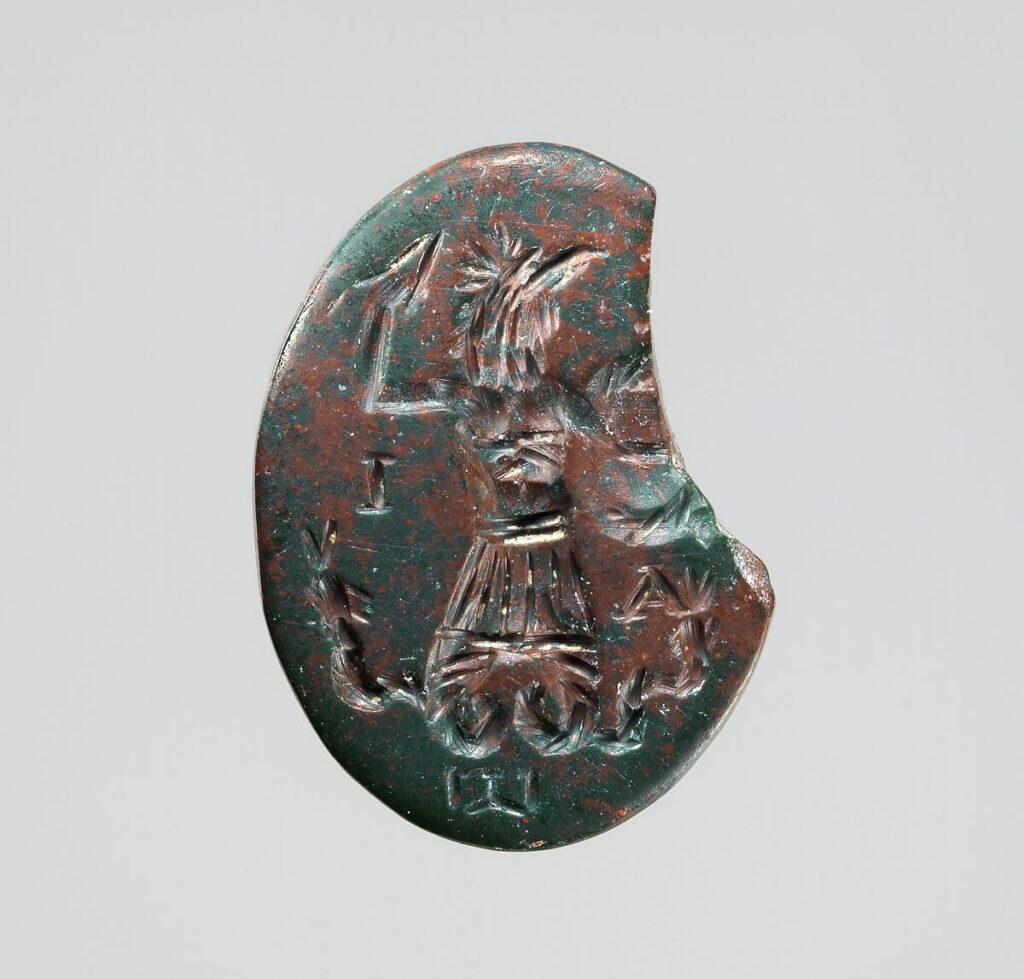
Almost nobody does — least of all the antiquarians who coined the label. In 1950 the same Campbell Bonner who identified the Brummer gem devoted an entire chapter of his catalogue to arguing that the name is very probably wrong. Most of these gems, when they carry a legible name at all, are inscribed not with Abrasax but with Iao, a Greek rendering of the Hebrew divine name, while the word Abrasax itself turns up on dozens of amulet types that have nothing to do with the cock-headed figure. Bonner read it as what magicians of the period called a word of power, valued for its numerical weight — the Greek letters of Abrasax sum, by the ancient convention of isopsephy, to three hundred sixty-five — rather than for any fixed identity it names. He doubted, too, that the figure owed much to Gnostic theology at all, proposing instead, with real caution about how far the idea could be pushed, that the design might encode the Hebrew word gibbor, “mighty one,” by way of the Septuagint’s habit of rendering it as “giant.” A recent reassessment by the Hungarian archaeologist Árpád Nagy, working from a far larger corpus than Bonner had access to, arrives independently at nearly the same idea seventy years later, with considerably more confidence: the cock, the armour, and the serpent legs may together spell out, in image rather than text, a name of the God of Israel — a way of representing the divine without the graven image the second commandment forbids.
The category itself has a paper trail, and it does not lead back to antiquity. The habit of calling these objects “Gnostic gems” begins in 1657, when the antiquarians Jean l’Heureux and Jean Chifflet published a study — pointedly titled after the very name in question — that first gathered this class of amulet under a single, religiously loaded heading. Bonner’s own choice of title, three centuries later, reads as a quiet correction: Studies in Magical Amulets, not gnostic gems. The scholarly consensus he represents holds that the great majority of these objects have no demonstrable connection to any Gnostic sect at all — that they belong instead to the vast, syncretic, and doctrinally indifferent magical culture of Roman Egypt, in which Jewish, Egyptian, Persian, and Greek names circulated as interchangeable sources of power, borrowed for their sound and their numerology rather than their theology.
Which returns us to the Brummer gem. Its seven inscribed archon names match Irenaeus’s Ophite list closely enough, and its lion-headed figure corresponds closely enough to Origen’s description of Ialdabaoth, that Bonner set it apart from the general run of “Gnostic” amulets as a genuine exception — an authentic trace of an actual sectarian cosmology, surviving among hundreds of objects that had merely borrowed the label’s prestige.
The name outlived the correction. In 1916, during a period of private psychological crisis, Carl Jung wrote a short visionary text titled Septem Sermones ad Mortuos — Seven Sermons to the Dead — and gave its central, unsettling deity the name Abraxas: a god beyond the ordinary gods, holding good and evil, light and darkness, together in a single figure too terrible to be named directly by any one tradition. Jung’s own path to the name is documented with some precision. He first read the German classicist Albrecht Dieterich’s scholarly study Abraxas in early 1913, while researching an entirely different book, and returned to Gnostic literature more intensively during military service in 1915, struck, his own later account suggests, by how closely its imagery matched the visions he was recording in his private notebooks that year. The god Jung built was compelling enough that later readers took him for authentic ancient doctrine. He is, more precisely, an early twentieth-century invention wearing a name a seventeenth-century antiquarian had already misapplied to an object whose maker, eighteen centuries earlier, most likely intended to spell out something else entirely.
The Ouroboros: How a Serpent’s Border Became a Cosmology
Open Bonner’s catalogue to almost any page and, sooner or later, a small circular serpent appears, tail gripped in its own jaws, doing nothing more dramatic than framing whatever image or inscription sits at the amulet’s centre. It borders a Harpocrates seated on a lotus. It rings a Sarapis enthroned above a mummified Osiris. It encircles blocks of magical syllables that Bonner suspected meant nothing at all. Having catalogued dozens of these appearances across sixteen chapters, Bonner reaches, near the book’s end, for his own glossary, and states the conclusion plainly: despite the design’s constant recurrence, nothing in the images or their accompanying inscriptions suggests any fixed meaning attaches to it. On the amulets he spent a career studying, the serpent biting its own tail is, in his own phrase, little more than a conventional border.
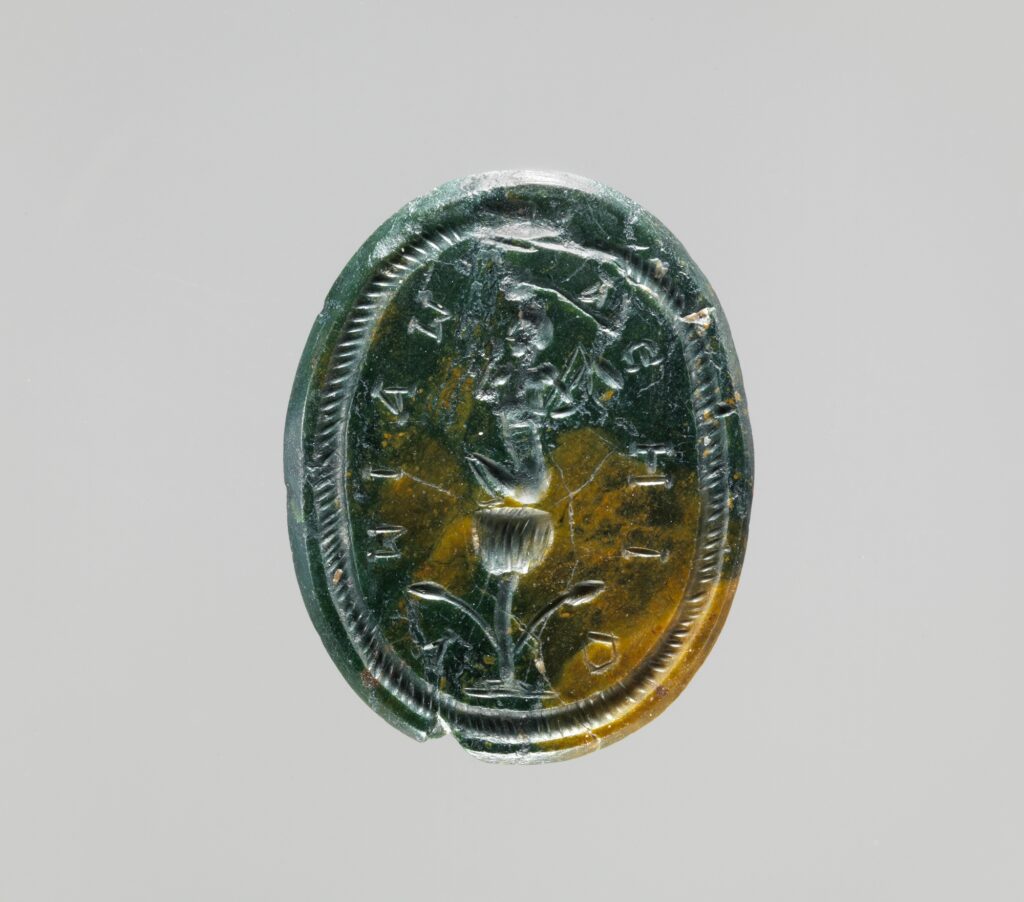
That the same shape could later carry the weight of an entire cosmology is, on this evidence, something close to an accident of transmission. The design itself is older than any of its famous readings: a coiled, self-devouring serpent appears on the reverse of the Metternich Stele, the largest surviving Egyptian magical stela, enclosing a menagerie of protective creatures within a cartouche that Egyptologists read as a symbol of Nun, the primordial waters out of which the ordered world first emerged — a genuinely cosmological use, predating by many centuries the reading most people now take for granted.
That later reading is Greek, and it belongs to a specific manuscript tradition of alchemical texts rather than to magical amulets at all. Its most celebrated instance appears in the tenth-century Byzantine manuscript known as Marcianus graecus 299, where a coiled serpent is inscribed with the words hen to pan — “the one, the all” — a visual shorthand for a strand of Greek monist philosophy in which all apparent multiplicity resolves into a single underlying substance, transformation folding endlessly back into unity. The historian of science Lawrence Principe, whose 2013 account of the discipline remains the standard modern synthesis, treats this image as a genuine artifact of ancient chemical philosophy: evidence that early practitioners already thought in terms of cyclical transformation, matter returning to matter through a chain of operations. It is not the same gesture, in other words, as the amulet-maker’s protective circle. It is a specific philosophical claim, attached to a specific manuscript tradition, arriving centuries after the design had already been doing simpler work elsewhere.

The gap between those two registers — decorative frame, philosophical emblem — closes almost entirely once the symbol reaches the nineteenth century, and what fills it is invention rather than recovery. Principe traces the origin of alchemy’s now-familiar reputation as a spiritual or psychological discipline to a single, identifiable moment: the English writer Mary Anne Atwood’s 1850 study, which read the entire alchemical corpus through the lens of contemporary Mesmerism, projecting ideas about animal magnetism and trance states backward onto texts written centuries before either existed — so thoroughly that Atwood, apparently alarmed at what she had revealed, tried to burn nearly the entire print run of her own book. The reading she inaugurated passed, independently, through the American army officer Ethan Allen Hitchcock, who arrived at a Christian-moralizing version of the same idea, and then through the French occultist and publisher François Jollivet-Castelot, who fused laboratory experiment with esoteric doctrine so completely that he adopted the ouroboros as his own personal emblem, printing it on the cover of his journal as a badge of the unity of matter he believed alchemy had always been reaching toward.
Carl Jung inherited this tradition rather than discovering it independently — he had read deeply in nineteenth-century occult literature well before he turned his analytic attention to alchemical texts — and he completed its transformation from craft history into psychological doctrine, reading the ouroboros and its surrounding imagery as unconscious projections of the individuating self rather than as records of laboratory practice or philosophical argument. Principe’s verdict on the entire lineage is stated with more bluntness than caution: none of it amounts to a historically accurate account of what alchemists before the eighteenth century actually believed they were doing. It is a rich and, on its own terms, worthwhile tradition of reinterpretation — built by readers working centuries after the fact, filling a symbol that had mostly done quiet, unglamorous work as a magical amulet’s border with a philosophical weight it had carried only briefly, in one Byzantine manuscript, before nineteenth-century occultism decided that weight had been there all along.
Kundalini: A Reappropriation That Knows Itself
In one of the case notes Jung shared with his seminar audience in 1932, a patient in analysis produced, apparently without any conscious knowledge of the mythological tradition she was drawing on, a vision that Jung recognized on sight: a great feathered serpent, which he identified, unprompted, as Quetzalcoatl — the Mesoamerican god this publication has already traced from stone platform to colonial chronicle and beyond. Jung took the recognition as confirmation of his central working assumption: that the symbolic vocabulary his patients produced spontaneously drew on a substrate of image common to all human minds, regardless of what any individual patient consciously knew about Aztec religion. What the case shows more plainly, in hindsight, is Jung’s own working habit — a readiness to fold any serpent, from any tradition, into a single interpretive framework built substantially out of one particular tradition he had made his own that year: the kundalini of Hindu tantra.
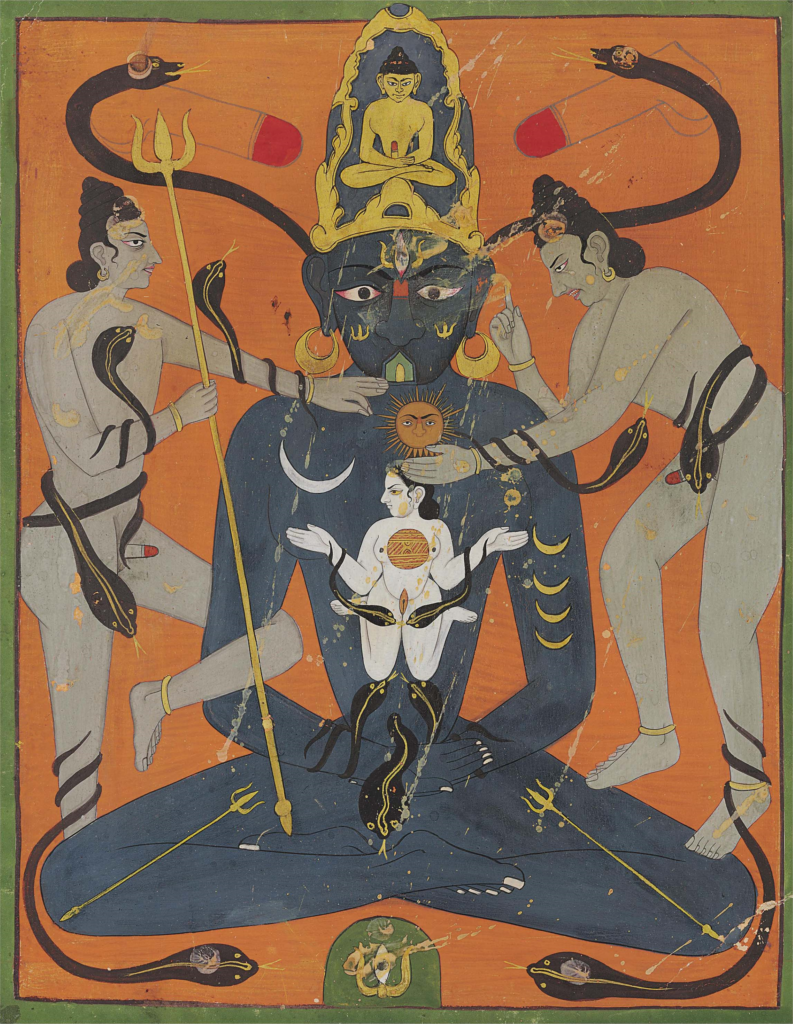
Jung’s primary source for that tradition was Arthur Avalon’s 1919 translation and commentary, The Serpent Power — Avalon being the pen name of Sir John Woodroffe, a British judge in colonial Calcutta whose engagement with Bengali tantric scholarship, whatever its limits, was serious and sustained.
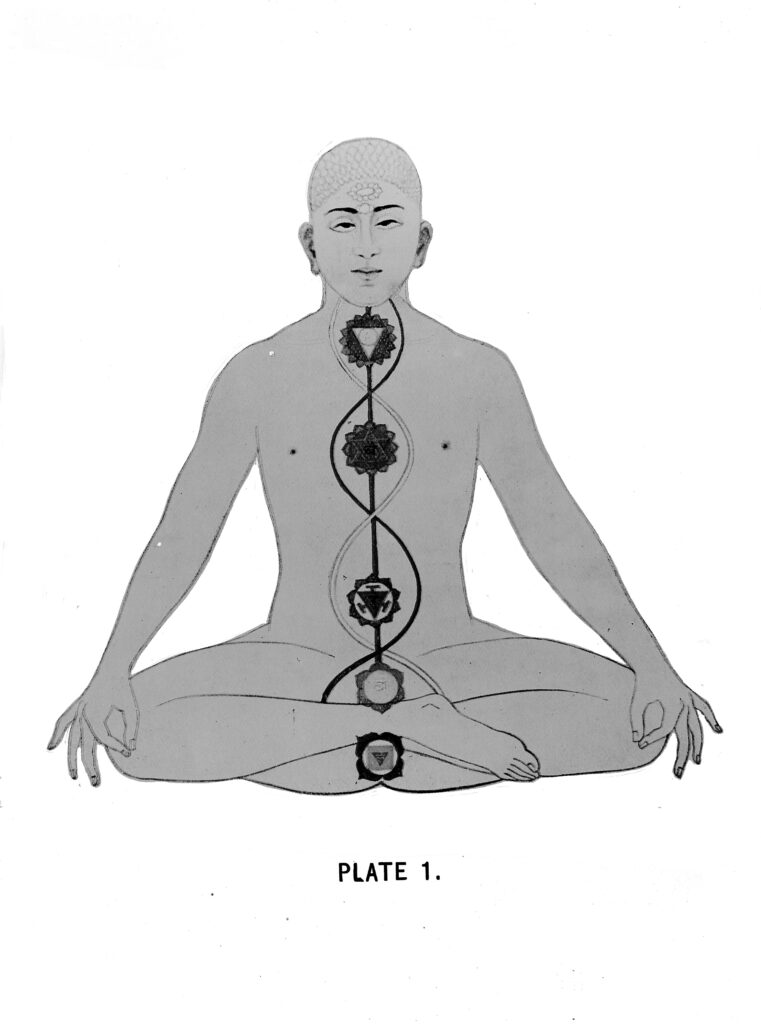
Jung’s personal copy, preserved among his papers, is heavily underlined. What the underlining does not obviously register is that Woodroffe had already, in his own introduction, fought exactly the battle Jung believed himself to be fighting. Several pages of that introduction are given over to a point-by-point correction of the Theosophist C. W. Leadbeater’s popular account of the chakra system, which Woodroffe judged to have substituted Leadbeater’s own invention — on the number of petals in each lotus, the nature of the central channel, the location of the centres themselves — for anything an actual Indian tantric practitioner would recognize. When Jung, in his 1932 lectures, announced his own intention to distance himself from what he called the Theosophists’ appropriation of Eastern teaching, he was repeating, without any apparent awareness of the repetition, a correction his own principal source had already made thirteen years before.
Jung’s distance from Theosophy, in other words, was borrowed at the very moment he was declaring it. And it carried a curious asymmetry: he was entirely willing to reappropriate the kundalini symbolism for his own psychological system, reading the serpent’s ascent through the chakras as a map of individuation and identifying Kundalini herself with the anima, his own term for the unconscious feminine principle in the male psyche, while actively warning his largely European audience against attempting to practice the yoga whose symbolism he was busy reinterpreting. He described the prospect of a European undertaking authentic kundalini yoga as a kind of mimetic derangement, and predicted instead that the West would eventually produce a yoga of its own, built on specifically Christian foundations. He wanted the symbol and not the discipline that had produced it — a fair working definition of appropriation, however carefully he tried to distinguish his own procedure from the Theosophists’ cruder version of the same operation.
The clearest evidence that Jung understood, at some level, exactly which tradition he was folding into which, arrives almost as an aside, late in his seminar: Kundalini, he tells his audience, is nothing other than “the Saviour Serpent of the Gnostics” — the very figure this article opened with, the serpent that a handful of second-century sectarians tentatively, incompletely, and controversially identified with Christ. Jung’s own reappropriation, in other words, closes a circle that began in Roman Egypt and passed through a Byzantine manuscript and a misidentified antique gemstone before arriving, by the nineteen-thirties, in a Zurich lecture hall — one more borrower, taking up a serpent that had already changed hands more times than he seems to have known, and shaping it, once more, into something new.
A Note on Sources and Scholarly Uncertainty
The scholarship on the Ophites and Naasenes divides in a way this article has tried to preserve rather than paper over. Tuomas Rasimus’s 2009 monograph anchors most of the argument in the first section, but access to it was partial: the prologue and first chapter were read directly, while chapters two through four were consulted through a detailed, page-referenced summary by the scholar M. David Litwa rather than the primary text itself. Rasimus’s own 2015 encyclopedia entries on “Ophites” and “Naassenes,” read in full, supplied the section’s most load-bearing claims and are quoted directly from them. Litwa’s own 2023 monograph on the Naasenes, consulted in full for its central chapters, complicates Rasimus’s account of the Naasene Christ-serpent identification rather than simply confirming it. That tension is left deliberately visible in the text rather than smoothed over.
Campbell Bonner’s 1950 catalogue of magical amulets was read in its entirety — all sixteen narrative chapters — though its several-hundred-entry plate catalogue was sampled for leads rather than read description by description. Véronique Dasen and Árpád Nagy’s 2019 chapter, which updates Bonner’s findings on the Abrasax figure in light of more recent scholarship, was read in full. One claim in the Abraxas section — that Bonner’s own choice of title was an implicit correction of the antiquarian “Gnostic gems” tradition of 1657 — is an inference connecting two documented facts, not a claim Bonner makes explicitly, and should be read as interpretation rather than established fact.
Lawrence Principe’s 2013 history of alchemy was read in full through its fourth chapter; its epilogue, endnotes, and bibliography were not confirmed read, and any claim resting on that material would need separate verification. Carl Jung’s 1932 seminar on Kundalini yoga, in Sonu Shamdasani’s edition, was read in its entirety, as was Arthur Avalon’s 1919 The Serpent Power, with the exception of that book’s closing Sanskrit text in devanagari script, which the transcription tools available for this research could not render and which would not in any case serve an English-language readership. The detail of Jung’s 1913 reading of Dieterich and his 1915 immersion in Gnostic literature comes from Sonu Shamdasani’s introductory essay to The Black Books, read directly rather than through a secondary summary.
Several sources relevant to this article were identified but never obtained. Maria Grazia Lancellotti’s 2000 monograph on the Naasenes is, for this article’s purposes, largely superseded by Litwa’s more recent treatment, though a specialist would want to consult both. Simone Michel’s 2004 catalogue of magical gems, the modern successor to Bonner’s own, could not be accessed. Julian Strube’s 2020 chapter on Hinduism and Western esotericism was available only as an abstract and opening page. Elizabeth De Michelis’s and Wouter Hanegraaff’s foundational studies of modern yoga and New Age religion, respectively, could not be obtained through any free channel during the drafting of this article. Their absence reflects access, not relevance, and readers with library privileges may find them useful correctives.
Two errors were caught during drafting rather than before it, and are recorded here for transparency rather than left silently fixed: an early draft misnamed the American army officer Ethan Allen Hitchcock and misstated his profession, and conflated a serpent-shaped Gnostic archon with a Christ-serpent identification the source material does not support. Both are corrected in the text above.
Bibliography
Primary and Ancient Sources
(consulted through the secondary literature cited below, not as standalone critical editions; no specific online edition verified directly for this article)
Hippolytus. Refutation of All Heresies.
Irenaeus. Against Heresies.
Origen. Contra Celsum.
Modern Scholarship
Bonner, Campbell. Studies in Magical Amulets, Chiefly Graeco-Egyptian. Ann Arbor: University of Michigan Press, 1950. https://archive.org/details/studiesinmagical0000bonn.
Dasen, Véronique, and Árpád M. Nagy. “Gems.” In Guide to the Study of Ancient Magic, edited by David Frankfurter, 416–455. Leiden: Brill, 2019. https://www.academia.edu/38614491.
Jung, C. G. The Black Books, 1913–1932: Notebooks of Transformation. Edited by Sonu Shamdasani. 7 vols. New York: W. W. Norton, 2020. (no verified online edition; consulted via a copy supplied directly to the author of this article).
Jung, C. G. The Psychology of Kundalini Yoga: Notes of the Seminar Given in 1932. Edited by Sonu Shamdasani. Princeton: Princeton University Press, 2012. https://openlibrary.org/books/OL807517M/The_psychology_of_Kundalini_yoga.
Litwa, M. David. The Naassenes: Exploring an Early Christian Identity. Abingdon: Routledge, 2023. https://www.routledge.com/The-Naassenes-Exploring-an-Early-Christian-Identity/Litwa/p/book/9781032587516.
Principe, Lawrence M. The Secrets of Alchemy. Chicago: University of Chicago Press, 2013. https://books.google.com/books/about/The_Secrets_of_Alchemy.html?id=cs9_mXyN0OsC.
Rasimus, Tuomas. “Naassenes.” In The Encyclopedia of Ancient History, edited by Roger S. Bagnall, Kai Brodersen, Craige B. Champion, Andrew Erskine, and Sabine R. Huebner. Malden, MA: Wiley-Blackwell, 2015. https://www.academia.edu/15734367/Naassenes.
Rasimus, Tuomas. “Ophites.” In The Encyclopedia of Ancient History, edited by Roger S. Bagnall, Kai Brodersen, Craige B. Champion, Andrew Erskine, and Sabine R. Huebner. Malden, MA: Wiley-Blackwell, 2015. https://www.academia.edu/15685654/Ophites.
Rasimus, Tuomas. Paradise Reconsidered in Gnostic Mythmaking: Rethinking Sethianism in Light of the Ophite Evidence. Nag Hammadi and Manichaean Studies 68. Leiden: Brill, 2009. https://brill.com/display/title/15530.
Woodroffe, John [Arthur Avalon, pseud.]. The Serpent Power. 2nd ed. London: Luzac, 1919. https://archive.org/details/TheSerpentPowerByArthurAvalon.
Identified but Not Directly Consulted
De Michelis, Elizabeth. A History of Modern Yoga: Patañjali and Western Esotericism. London: Continuum, 2004. https://archive.org/details/historyofmoderny0000demi (preview access only).
Hanegraaff, Wouter J. New Age Religion and Western Culture: Esotericism in the Mirror of Secular Thought. Leiden: Brill, 1996. (no accessible online edition found).
Lancellotti, Maria Grazia. The Naassenes: A Gnostic Identity among Judaism, Christianity, Classical and Ancient Near Eastern Traditions. Münster: Ugarit-Verlag, 2000. (no accessible online edition found).
Michel, Simone. Die magischen Gemmen: Zu Bildern und Zauberformeln auf geschnittenen Steinen der Antike und Neuzeit. Berlin: Akademie Verlag, 2004. https://www.degruyterbrill.com/document/doi/10.1524/9783050050003/html?lang=en (paywalled).
Strube, Julian. “Hinduism, Western Esotericism, and New Age Religion in Europe.” In Handbook of Hinduism in Europe, edited by Knut A. Jacobsen and Ferdinando Sardella. Leiden: Brill, 2020. https://www.researchgate.net/publication/346442529_Hinduism_Western_Esotericism_and_New_Age_Religion_in_Europe (abstract and opening page only).