Open a dictionary of Akkadian religious vocabulary at the entries for snakes and dragons and the profusion is immediate: bashmu, mushhushshu, mushmahhu, ushumgallu, the ordinary word ṣēru for a plain snake underfoot, and a handful of proper names — Nirah, Labbu — belonging to serpents that share their name with no one else. Add to this the tens of thousands of surviving cuneiform tablets, the glazed-brick dragons still standing on Babylon’s reconstructed Ishtar Gate, and a creation epic whose central antagonist is routinely described, in the popular imagination, as a dragon of world-ending size. Mesopotamia looks, from a distance, like the one place in this whole survey where the sources should finally be generous enough to let a serpent hold still.
They are not, and the reasons why turn out to matter more than a tidy catalogue would have. The most famous candidate for “the Mesopotamian dragon” — Tiamat, antagonist of the Babylonian creation epic Enuma Elish — is never once called a serpent or a dragon in the text that made her famous, and the one artifact long cited as her portrait has since been reassigned, on the strength of an obscure omen tablet, to an entirely different god and an entirely different monster. Meanwhile a minor underworld deity nobody outside Assyriology has heard of, Ningishzida, turns out to be genuinely and enduringly serpentine — except that the particular dragon his own family is best known for is not, strictly, his; it belongs to a chain of gods who inherited it from each other by conquest, the way a defeated city’s regalia might pass to its conquerors. Two Akkadian words that modern dictionaries fold into a single term, bashmu, may or may not have described the same creature to the people who used them. And two separate poems, without any demonstrable link between them, independently tell the same story about a sea giving birth to a monster.
None of this is a shortage of evidence. Mesopotamia has, if anything, too much: too many words, too many local traditions, too many centuries across which a single motif can drift, change hands, and resurface somewhere else wearing a different name. What follows is five attempts to take that abundance seriously rather than smooth it into a single origin story — a misidentified plaque, a god with two snakes, a dragon that changed political allegiance three times, a philological tangle nobody has fully undone, and a case of two stories converging on the same shape without ever having met.
1. A Plaque That Changed Its Mind
On an early second-millennium clay plaque from a temple at Khafaje, on the Diyala river east of Baghdad, a warrior god thrusts a blade into the stomach of a bound captive. The captive’s hands are tied behind its back. It wears a fleecy skirt and nothing above the waist. Its head is shaped like a twelve-pointed sun disk, and at the center of that disk sits a single eye. When Henri Frankfort, who excavated the temple, first published the scene in 1936, he proposed that the victim was a fire-demon, a Near Eastern ancestor of the Greek Cyclops. Eighteen years later, in a general survey of Near Eastern art, he described the scene only as a god killing a cyclops, and admitted that he did not know who the destroyer of the “fiery cyclops” was.
Other archaeologists lived with that uncertainty for decades. Then, in 1971, the archaeologist Yigael Yadin proposed a name for the warrior: Marduk. The victim, in his reading, was Tiamat, and the plaque became visual proof of the Babylonian creation epic’s central battle. The identification had a certain gravity to it — Yadin was not a fringe figure — and it held. A second scholar, in 1972, kept Yadin’s cast of characters but reinterpreted the single eye as a wound. A third, in 1976, brought forward a similar seal in support. In 1983, the Assyriologist J. J. A. van Dijk used a photograph of the plaque as the frontispiece to his edition of the Sumerian poem Lugale, and captioned it differently again: Ninurta slaying the demon Asakku. Three separate mythological pairings, argued over four decades, for the same two figures on the same piece of clay. Nobody could agree who they were, but almost everyone assumed they were somebody from a known story.
They were not. In 2012, Andrew George published a tablet from a private archive of Babylonian diviners’ texts belonging to the little-known Sealand Dynasty, roughly the sixteenth century BCE — an omen text, of all things — recording that the god Nergal had once slain a creature called igitelû, “one-eye.” Related terms turn up in omen tablets from Susa, where the same word identifies stillborn human and pig fetuses born with a single eye on the forehead. Nergal, it turned out, was the one deity on record as a slayer of monocular monsters. No other god shares that distinction. The Khafaje plaque depicts Nergal killing a cyclops. It has nothing to do with Marduk, nothing to do with Tiamat, and nothing to do with Ninurta. Forty years of accumulated identification dissolved on the strength of a single omen tablet about a god, a monster, and the reading of an animal’s entrails.
I open with the plaque because it is a useful warning before saying anything about Tiamat’s body. It would be easy to write that Tiamat is a serpent, a dragon, a sea-monster, and stop there — the assumption is everywhere, and it is not obviously wrong on its face. But nowhere in the Enuma Elish is Tiamat called a serpent. Nowhere is she called a dragon. Her name is simply the Akkadian word for the sea, tiamtu, used in its bare form, without the grammatical ending a common noun would normally carry when it is not standing in for somebody’s name. The poem’s opening lines make the point directly: before anything else existed, Apsu — the fresh waters — and Tiamat — the salt waters — mingled themselves together as a single body. That is not a description of a monster. It is a description of an ocean.
What she becomes over the following tablets is less consistent than the label “sea serpent” suggests. As W. G. Lambert put it in his critical edition of the poem, published from his unfinished papers after his death, Tiamat’s presentation shifts as the poem needs it to: now a body of water, now a corporeal monster with animal limbs. When Marduk finally kills her, in the poem’s fourth tablet, and sets about building the world from what is left, her body becomes a kind of cosmic geography rather than a carcass. Her eyes are opened into the sources of the Tigris and Euphrates. Her nostrils are dammed to hold back her waters. Her breasts are raised into mountains, and wells are bored through them for springs. Only once, almost in passing, does something like an animal appear: her tail, twisted and woven into a structure the text calls the Durmahu. It is the single most physically concrete detail we have, and it arrives buried in a list of cosmographic renovations, not offered as a description of what she looked like.
There is a reason the poem never quite settles on a shape for her, and it has nothing to do with missing tablets or careless scribes. The entire structure of the combat — two senior gods who decline the challenge, a junior god who accepts it in exchange for supreme rank, a net, a wind driven into the enemy’s mouth, a weapon that strikes home only on the second attempt — is borrowed. It comes from an older story about Ninurta’s fight against the monster-bird Anzu, a lion-headed eagle with no serpentine features whatsoever. Marduk, in the combat scene, is essentially playing Ninurta’s part. Lambert’s own conclusion is blunt: Tiamat’s proper character, whatever it was, has been obscured by this borrowed scaffolding. Even the business of splitting her body into heaven and earth turns out to come from somewhere else again — an older Sumerian idea about the sky and the earth once having been a single joined mass, pulled apart, with no monster and no corpse involved at all.
Apsu, her partner in that opening act of mingling, gets even less. He is dissolved by a spell before the poem’s real business begins, and he is never given a body to lose. Not every primordial water in Mesopotamian myth becomes a creature. Some of them stay water.
What makes this worth dwelling on is not that Tiamat turns out to be a disappointment. It is that Mesopotamia, in the same period and often in the same temples, produced deities who were unambiguously, iconographically serpentine — carved that way, described that way, for centuries. The contrast is where the real story starts.
2. Ningishzida and the Twin Serpent
A green steatite vase, dedicated by Gudea, ruler of Lagash around 2100 BCE and now in the Louvre, shows two serpents coiled around a central staff, their bodies crossing each other at even intervals from base to tip, flanked on either side by a pair of horned, winged dragons. An inscription identifies the recipient of the offering: Ningishzida. Unlike the object at the center of the last section, nobody has ever proposed that this vase might depict something else. The god it names really is, on this evidence and a great deal more like it, a serpent — carved that way, described that way, across the length of Mesopotamian history.
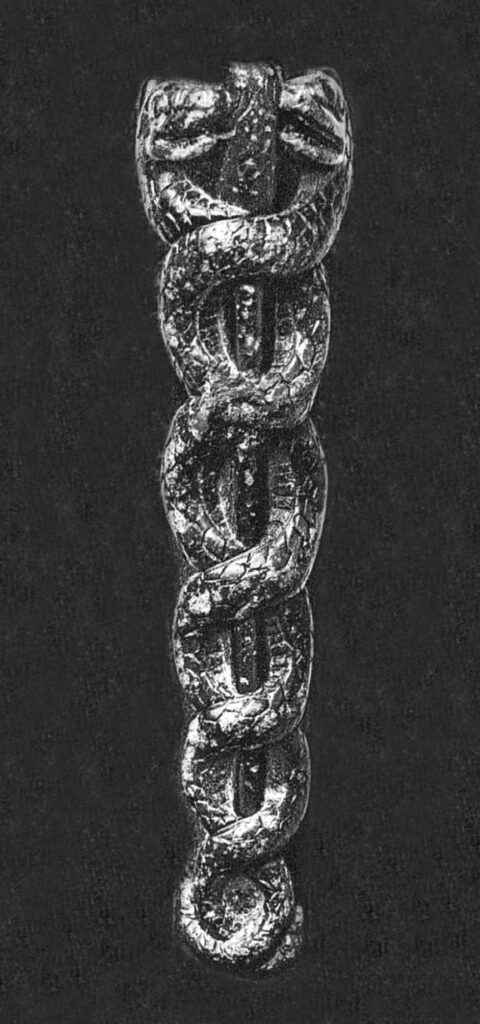
Ningishzida’s genealogy is unusually well fixed for a Sumerian deity. He is the son of Ninazu and his wife Ningirida; one Ur III source instead names his mother as Ereshdaa. Gudea’s own Cylinder B calls him “scion of An,” which implies a longer chain of descent running from An through Enlil and Ninazu down to Ningishzida himself. His wife carries the epithet “the Lady who lets the good juice grow” — a fertility title suited to a god associated, as we will see, with vegetation as much as with the underworld — though in the specifically Lagašite tradition that his family belonged to, his consort appears instead as Geshtinanna, herself styled chief scribe of the netherworld.
None of this, on its own, would distinguish him from dozens of other minor gods in the Sumerian pantheon. What distinguishes Ningishzida is the persistence of the snake as his literal form, not merely his attribute, across roughly two thousand years of representation — on cylinder seals, on votive objects like the Gudea vase, in god-lists that gloss his name and puzzle, even in antiquity, over its correct pronunciation. It is this genuine, longstanding serpentine identity that has made Ningishzida a natural candidate for a much larger claim: that the paired-serpent motif on objects like the Gudea vase is an ancestor, however distant, of the two snakes twined around the staff of the Greek kerykeion — the caduceus, the wand later associated with Hermes and, by a further and more confused set of associations, with medicine. The suggestion goes back to William Hayes Ward’s observation, in 1910, of the visual parallel between the two motifs, developed six years later by A. L. Frothingham into a fuller argument for direct Babylonian origin — and more than a century of subsequent scholarship has neither confirmed the connection nor put it to rest.
There is, in fact, a complication closer to home, and it is a useful one. Frans Wiggermann’s study of the ritual and mythological texts around Mesopotamia’s dragon-monsters notes that in the specifically Lagašite tradition, Ningishzida is indeed associated with the great composite dragon known as the mushhushshu — but that this is not, strictly, his own animal. His proper animal, the one that belongs to him by right rather than by regional overlap, is a plainer and much less famous snake called Nirah. Even a god who is authentically, iconographically a serpent, in other words, turns out on closer inspection to have more than one serpent attached to his name, serving different functions and belonging, originally, to different corners of the mythological landscape. The dragon most associated with Ningishzida’s own family line — the one his father Ninazu seems to have owned first — is the subject of the next section, and its history turns out to be considerably stranger than a simple case of one god having one animal.
3. The Dragon That Changed Masters
The mushhushshu changed shape before it changed owners. In the earliest images we have of it, from the middle of the third millennium BCE, the creature has a lion’s head and no claws to speak of. Over the following centuries, piece by piece, the lion recedes and the snake advances, until the version that glares out from the glazed brick reliefs of Babylon’s Ishtar Gate — built under Nebuchadnezzar II, now reconstructed in Berlin — is almost entirely serpentine: a scaled body, a horned snake’s head with a forked tongue, front legs that are a lion’s, hind legs that are an eagle’s talons. A composite creature does not stay put. Neither, it turns out, did its master.
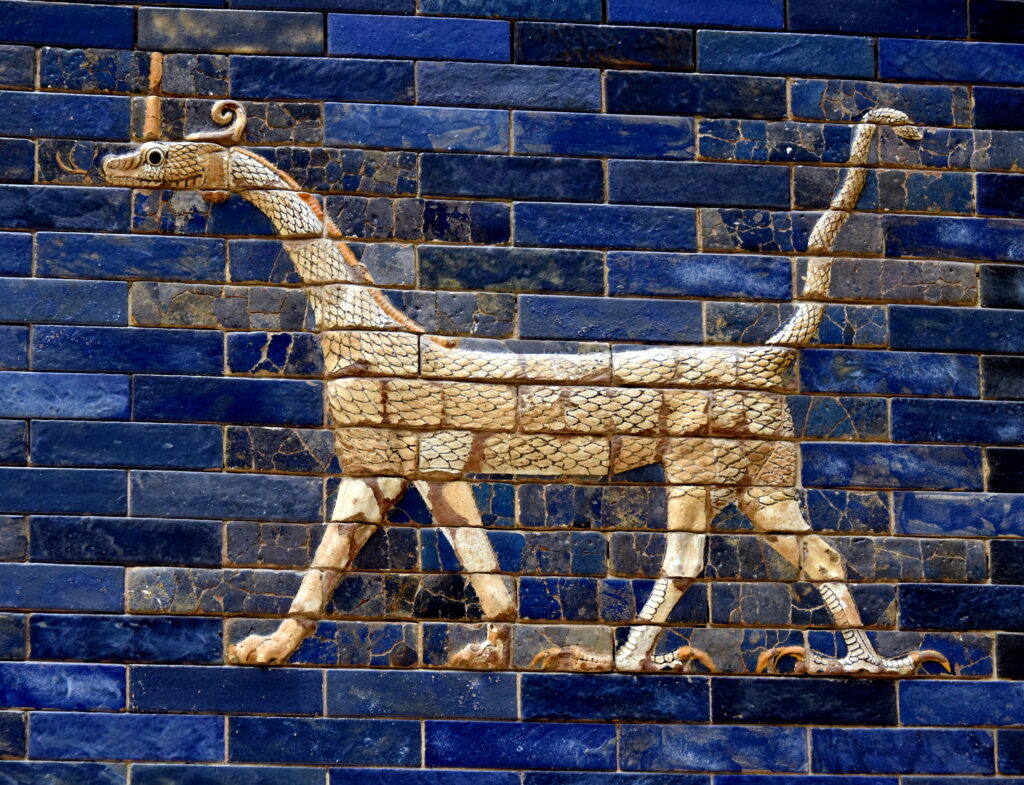
The mushhushshu‘s earliest known owner is Ninazu, lord of the underworld before that office passed to Nergal, and known in his own right as king of the snakes. An early Akkadian sculpture from Ešnunna, on the Diyala river, shows a god — probably Ninazu — rendered with scales across his own body. Ešnunna is the key to what happens next. At some point in the Old Akkadian period, a god of foreign origin named Tishpak displaces Ninazu as the city’s patron deity; a later incantation describes Tishpak’s own skin as green, which is as close as an Akkadian text gets to saying a god has snakeskin without quite saying it. Tishpak did not simply inherit Ninazu’s dragon. A fragmentary myth recounts his victory over it — over the very monster that would then become his own emblem, carried from then on on his cylinder seals. Conquest first, adoption after: the mushhushshu‘s loyalty runs to whoever last defeated it.
That pattern repeats. Hammurabi conquered Ešnunna in the eighteenth century BCE, and in the centuries that follow, the mushhushshu migrates south, attaching itself to Babylon’s own state god Marduk and to his son Nabu — the same transfer of allegiance the city’s political fortunes had just imposed on Ešnunna itself. It stays there for the better part of a millennium, guarding the processional way into Babylon on Nebuchadnezzar’s glazed reliefs alongside bulls and lions, the dragon of a city at its height. Then Sennacherib sacks Babylon in 689 BCE, and the mushhushshu changes hands again — this time to Ashur, the state god of the conquering Assyrians. A creature assembled from the discarded parts of a lion and a snake, over two thousand years, kept ending up in the retinue of whichever god had just won.
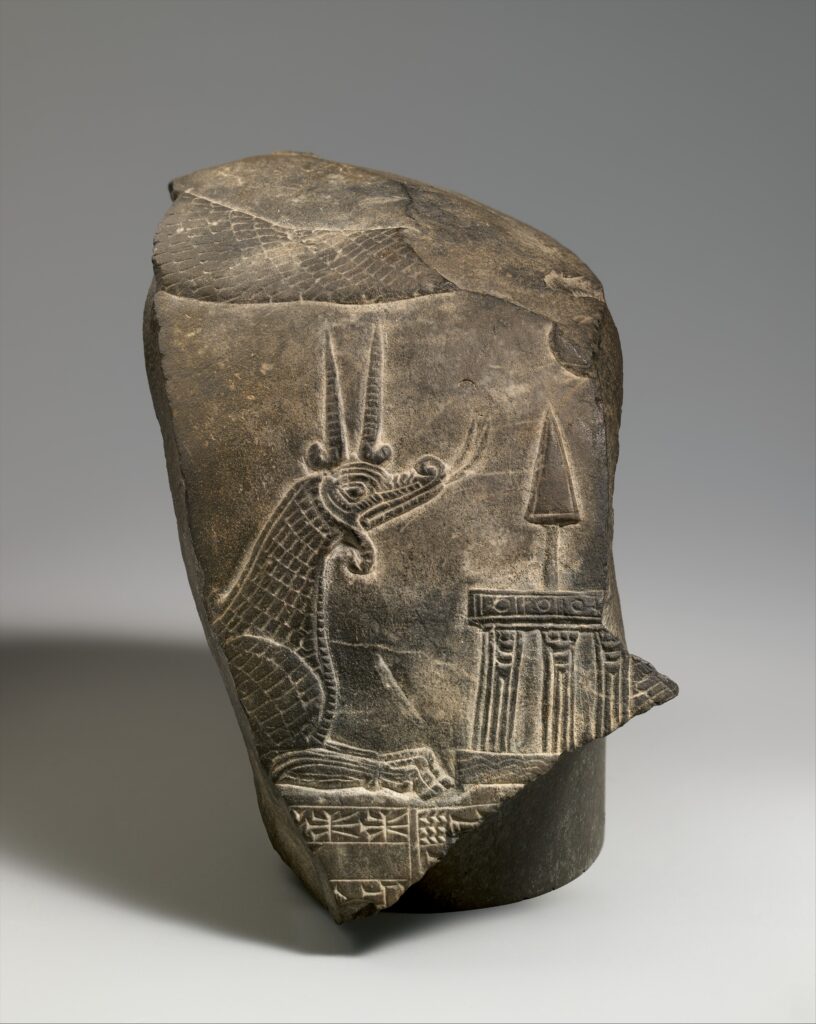
Enuma Elish itself preserves a small trace of the Marduk phase of this history, easy to miss. In the poem’s fifth tablet, not long after Marduk has dispatched Tiamat’s eleven monster-children, the text notes — the line is damaged, but the sense is not in doubt — that he plants his feet upon the mushhushshu. It is one line, in a poem otherwise uninterested in this particular dragon, and it is worth pausing on for exactly that reason: even a text with its own agenda, its own borrowed combat-myth structure, its own reluctance to describe its central monster in any consistent shape, could not quite avoid gesturing at the real, contemporary, political fact that Marduk’s Babylon had a dragon of its own — inherited, like so much else in the city’s theology, from a war.
4. Bashmu, and the Cousins That Won’t Untangle
A serpent is born in the sea. It grows to sixty leagues in length, its head alone rising thirty leagues into the air; its eyelids, in the poem’s own arithmetic, stretch half a league apart. It eats fish, birds, wild asses, and men. The gods, alarmed, send Nergal to deal with it — and the tablet breaks off just as he sets out, before showing whether he succeeds. The text that tells this story is a fragmentary tablet catalogued as KAR 6 — a companion piece, in spirit if not in direct lineage, to the two dragon-fights already discussed in this article. Its monster has a name in Akkadian: bashmu.
Untangling what bashmu actually is turns out to be harder than killing one. The word is Akkadian, but it translates not one Sumerian term but two, and the two do not obviously describe the same creature. The first, usum, is glossed “Venomous Snake” and appears in iconographic sources as horned and equipped with a pair of forelegs. The second, muš-sha-tur, is glossed “Birth Goddess Snake” — an epithet that hints at some now-obscure connection to childbirth or to a birth goddess — and appears horned but entirely footless. Akkadian scribes folded both into the single word bashmu, and it is not always possible, from a given text alone, to tell which of the two ancestors is meant. When the eleven monsters born to Tiamat are counted in Enuma Elish, the bashmu among them is, on the balance of the evidence, the footless muš-sha-tur type rather than the four-legged usum — one more small, specific correction to whatever mental picture “Tiamat’s monster army” tends to conjure.
Bashmu‘s mythological standing is unusually mobile even by the standards of this article. It surfaces as an advisor to Tishpak in some texts and as his defeated enemy in others; it is counted, from the Ur III period onward, among the roster of “warriors” that Ninurta puts down in his own campaigns; and after Marduk annexes the mushhushshu in the second millennium, bashmu appears to have functioned as a kind of consolation prize — the symbolic animal left over for gods who had lost their dragon to Babylon and needed another serpent to stand behind their thrones. A related, larger term, ushumgallu, “Prime Venomous Snake,” floats free of any single owner altogether and turns up in later texts as an interchangeable stand-in for the mushhushshu itself: “the dragon of Nabu,” “the dragon of Ninurta,” the same generic magnificence attached to whichever god the scribe had in mind that day.
None of this resolves into a tidy chart. Where usum ends and muš-sha-tur begins, how far ushumgallu is a distinct being rather than a rhetorical flourish, whether bashmu and the mushhushshu were ever felt by the people who used both words to be different animals at all — specialists working from the same texts and images still answer these questions differently.
5. A Story Told Twice Without Knowing It
Before the serpent, there is noise. Humanity, in this telling, has grown loud and unruly enough that its collective groaning keeps the god Enlil from sleep — the same complaint, put to the same use, that opens the flood story in the Atra-hasis Epic. Enlil’s solution here is not a flood. He asks a question and answers it himself: who will give birth to a serpent? Let the Sea give birth to the serpent. It does. This is not the opening of Enuma Elish. It is a different, shorter, badly damaged composition usually called the Slaying of Labbu, and the word translated “the Sea” here is the common noun tamtu, not the proper name Tiamat. It is easy to conflate the two — early translators did exactly that, rendering tamtu as “Tiamat” and letting readers assume they were reading a variant scene from the familiar epic. They were not. This is a separate sea, giving birth to a separate monster, in a separate poem.
That monster has a name, or something close to one. The cuneiform signs that spell it are genuinely ambiguous — a century of scholarship has floated three possible readings, and settled, without full confidence, on labbu, a word related to the ordinary term for lion. The fit is uncomfortable: the poem itself, in the same breath it introduces the creature, calls it not a lion but a ṣēru, an ordinary serpent, and then describes something fifty leagues long and a single league wide, its mouth six cubits across, its ear-flaps spanning twelve — dimensions no lion, mythological or otherwise, has ever needed.
The tablet asks for a volunteer to kill it, and the first name to appear is Tishpak — the same god who, two sections ago, inherited a dragon by first defeating it. Then the clay breaks. Tishpak seems to be raising objections just as the surviving text runs out, and when the tablet resumes on its other side, the champion who actually goes on to kill the monster is unnamed — his identity lost in the same gap that swallowed Tishpak’s answer. It is entirely possible that the god who eventually takes up the challenge is Tishpak after all, and the poem’s setting in the Diyala region, Tishpak’s own territory, would support that reading — but the tablet does not let us confirm it.
The resemblance to Enuma Elish‘s central battle is close enough that Lambert himself points it out: a cloud and a strong wind used to pin the creature down, arrows to finish it, and — once it is dead — blood that keeps flowing from the carcass for a duration the text gives with mock-bureaucratic precision: three years, three months, one day, and one night. It would be satisfying to conclude that one poem borrowed from the other, that we have caught Babylonian scribes recycling a plot. But nothing in the evidence supports a line of descent running in either direction. What we have instead are two compositions, from the same broad culture, independently reaching for the same basic shape — a sea that births a monster, a god who kills it — without either needing to have read the other. It is the same caution this whole article has been built on, arriving from the opposite direction. Where the Khafaje plaque taught that two things which look alike are not always the same story, Labbu and Tiamat teach the reverse: that two things which are not the same story can still, independently, take the same shape. Tishpak took a dragon that had belonged to someone else, and was, perhaps, sent to face a second one that had belonged to no one — though on that second point, the tablet keeps its own counsel. Mesopotamia’s serpents rarely stay put long enough to be counted twice the same way.
A Note on Sources and Scholarly Uncertainty
The account of Tiamat’s textual character in the first section rests substantially on two sources read in full: the entry on Tiamat in the University of Pennsylvania’s Ancient Mesopotamian Gods and Goddesses project (ORACC), written by Sophus Helle, and Robert D. Miller’s 2014 article “Tracking the Dragon across the Ancient Near East” in Archiv Orientální. The reidentification of the Khafaje plaque follows Andrew George’s 2012 article in Bibliotheca Orientalis, also read in full; George’s own account should be consulted for the technical philology behind the reading of igitelû.
The passages from Enuma Elish quoted or described throughout the article are drawn from W. G. Lambert’s posthumous critical edition, Babylonian Creation Myths (2013), read in the sections directly relevant to this article — the translation and commentary on Tablets I through VII, the essays “Marduk’s Dragon” and “Tiāmat,” the edition of the Slaying of Labbu and of a second, related dragon-slaying fragment (KAR 6), and the discussion of the poem’s composition and its debt to the Ninurta-Anzu tradition — rather than cover to cover. The book’s full introduction and its treatment of Marduk’s fifty names were not read in their entirety, and any claim resting on those unread sections should be independently verified before being relied upon elsewhere. Alexander Heidel’s earlier translation, The Babylonian Genesis (1951), and L. W. King’s The Seven Tablets of Creation (1902), were consulted during the early stages of research; both are markedly less complete than Lambert’s edition, particularly for Tablet V, and are not cited as authorities in the final text. King’s older rendering of the Slaying of Labbu, in particular, translates the common noun for “the Sea” (tamtu) as the proper name “Tiamat” in a way that Lambert’s more recent edition does not support; readers consulting King’s translation independently should bear this discrepancy in mind.
The history of the mushhushshu and bashmu in the third and fourth sections follows F. A. M. Wiggermann’s Mesopotamian Protective Spirits: The Ritual Texts (1992), specifically the chapter “Inventory of Monsters” (pp. 141–187), read in full. Wiggermann’s separate Reallexikon der Assyriologie entries on mushhushshu and on Nin-ĝišzida, and W. G. Lambert’s 1984 article on the muš-huš in the CEPOA volume L’animal, l’homme, le dieu dans le Proche-Orient ancien, were sought but could not be located; the account given here relies on Wiggermann 1992 and Lambert 2013 in their place. The distinction between usum and muš-sha-tur, and the question of how far ushumgallu names a distinct being rather than functioning as an honorific, follow Wiggermann’s own discussion (1992, pp. 164–169) and are presented as unresolved because Wiggermann himself does not resolve them; no systematic review of scholarship since 1992 has been undertaken on this specific point.
The genealogical details on Ningishzida in the second section — his parentage, his wife’s name and epithet, the Ur III variant naming his mother as Ereš-da-a — are drawn from a single page of the Reallexikon der Assyriologie entry on Nin-ĝišzida (vol. IX, p. 368), covering only the opening sections on spelling, meaning, and family. The entry’s later sections, on the god’s character, mythology, and astral associations — precisely where a fuller scholarly discussion of the double-serpent motif would appear — were not available for this article and were not consulted.
The hypothesis connecting the Gudea vase’s twin serpents to the Greek caduceus is treated in the text as genuinely unresolved, and that treatment should be taken at face value rather than as a hedge: the two foundational publications, William Hayes Ward’s The Seal Cylinders of Western Asia (1910) and A. L. Frothingham’s “Babylonian Origin of Hermes the Snake-God, and of the Caduceus” (1916), were not read directly for this article. Their arguments are described here at second hand, from references in later literature; a reader who wants to weigh the case for or against the connection should consult those two publications rather than rely on this summary.
The uncertainty over who kills Labbu in the Slaying of Labbu is not a rhetorical device. The relevant tablet is genuinely broken at the point where the successful champion would be named, and Lambert’s own edition presents Tishpak’s role as a plausible inference rather than a secured fact. The specific figures given for Labbu’s body, the weapons used against it, and the duration of its bleeding are taken directly from Lambert’s transliteration and translation of the text (pp. 361–365) and were checked line by line against that edition specifically.
Bibliography
Primary Sources (Ancient Compositions, Cited via Modern Editions)
Lambert, W. G. Babylonian Creation Myths. Mesopotamian Civilizations 16. Winona Lake, IN: Eisenbrauns, 2013.
Secondary Sources
George, Andrew R. “Nergal and the Babylonian Cyclops.” Bibliotheca Orientalis 69, no. 5–6 (2012): 421–426.
Helle, Sophus. “Tiamat.” Ancient Mesopotamian Gods and Goddesses. Open Richly Annotated Cuneiform Corpus (Oracc), University of Pennsylvania, 2019. https://oracc.museum.upenn.edu/amgg/listofdeities/tiamat/.
Jacobsen, Thorkild. “The Battle between Marduk and Tiamat.” Journal of the American Oriental Society 88, no. 1 (1968): 104–108.
Miller, Robert D. “Tracking the Dragon across the Ancient Near East.” Archiv Orientální 82, no. 2 (2014): 225–245.
Wiggermann, F. A. M. Mesopotamian Protective Spirits: The Ritual Texts. Cuneiform Monographs 1. Groningen: STYX & PP Publications, 1992.
Consulted in Early Research, Superseded in the Final Text
Heidel, Alexander. The Babylonian Genesis: The Story of Creation. 2nd ed. Chicago: University of Chicago Press, 1951.
King, Leonard W. The Seven Tablets of Creation. London: Luzac and Co., 1902.
Sought but Not Directly Consulted
Frothingham, A. L. “Babylonian Origin of Hermes the Snake-God, and of the Caduceus I.” American Journal of Archaeology 20, no. 2 (1916): 175–211.
Lambert, W. G. “The History of the muš-ḫuš in Ancient Mesopotamia.” In L’animal, l’homme, le dieu dans le Proche-Orient ancien: Actes du colloque de Cartigny 1981, edited by Philippe Borgeaud, Yves Christe, and Ivanka Urio, 87–94. Cahiers du CEPOA 2. Leuven: Peeters, 1984.
Ward, William Hayes. The Seal Cylinders of Western Asia. Washington, DC: Carnegie Institution, 1910.
Wiggermann, F. A. M. “Mušḫuššu.” In Reallexikon der Assyriologie und Vorderasiatischen Archäologie, vol. 8, 455–462. Berlin: De Gruyter, 1997.
Wiggermann, F. A. M. “Nin-ĝišzida.” In Reallexikon der Assyriologie und Vorderasiatischen Archäologie, vol. IX, 368–374. Berlin: De Gruyter, 1998. (Only p. 368 consulted; see Note on Sources above.)