Of all the world’s major mythological traditions, the Slavic one left behind the least of itself in its own words. There was no Slavic Snorri to write down what the old gods were for, no priesthood keeping temple records that outlasted the temples. What survives instead is a scatter of evidence never meant to explain itself: a circular platform of ash on a hilltop above the Volkhov, a bronze pin shaped like a serpent’s jaws, a nursery rhyme sung by children who had long forgotten what it once asked of them, a line in a merchant’s travel diary, a legal charter naming a hill after a god nobody worshipped anymore. Piecing a serpent mythology out of this material means working at every possible remove from the thing itself — through chroniclers hostile to what they described, through comparative linguists reconstructing words no one ever wrote down, through nineteenth-century folklorists collecting songs from people who no longer knew why they sang them, and, in one notorious case, through a forger who understood exactly how badly scholars wanted the missing pieces to turn up.
This article follows that evidence roughly along a gradient, from a site where the ground itself preserves two overlapping cults, through a reconstructed duel between a thunder-god and his serpent adversary that may never have existed in the precise form scholars have pieced together, to a text invented outright in the twentieth century to fill a gap that was never really there to fill. The serpent is not one figure across any of this. It is the yashcher and Zmey Gorynych, Perun’s rival and Zilant’s namesake, an import from Cyrenaica and a snake coiled in a horse’s skull — a shape that keeps recurring through the Slavic evidence without ever quite settling into a single story.
Peryn: Excavating Layered Gods
In 1951, the archaeologist Valentin Sedov opened a trench on a low rise above the Volkhov River, a few kilometers south of Novgorod, at a place the locals still called Peryn. What he found was a circular platform some twenty-one meters across, with a pit at its center and, ringing it, a shallow trench broken into eight symmetrical lobes, each holding the ash and charcoal of a fire that had once burned there. I keep coming back to what the excavation actually gave the myth: a footprint. The pit had held an idol, standing where eight flames could be seen burning around it at once — a detail no chronicler invented, because no chronicler needed to. The ground remembered it without them.
The idol was Perun’s, or so the site’s name and its correspondence with the written sources suggest. In 980, according to the Primary Chronicle, Vladimir’s uncle Dobrynia raised a wooden image of the god here on his nephew’s orders, part of a broader, briefly enforced pantheon meant to give the Rus’ state a single sky god at its center. Eight years later Vladimir converted to Christianity, and the same Dobrynia, now acting alongside Bishop Ioakim, destroyed the shrine: the idol was bound with ropes, dragged through the mud, beaten with sticks, and shoved into the Volkhov. A local chronicle preserves what happened next in a strange, almost bureaucratic aside: a peasant from the village of Pidьba, downstream to the north, going out early to fetch pots for the city, found the idol had drifted as far as his own mooring-line, and pushed it back out into the current with a pole, telling it, not unkindly, that it had eaten and drunk its fill and should now go on its way. The idol continued downstream. It behaved, in other words, exactly as driftwood behaves.
That ordinariness is the point, because it sets up a contrast that the seventeenth century makes explicit. A manuscript miscellany called the Tsvetnik, copied in 1665 and now recognized as drawing on genuinely older material, tells a second story set at the same site, involving a different creature entirely: not Perun, but a sorcerer who had taken the shape of a crocodile, strangled in the Volkhov by the enraged population and thrown into the river to drown. His body did not drift downstream like Perun’s idol. It went the other way — against the current, upstream, back to the foot of the very hill at Peryn where, the text says, this crocodile-sorcerer had first established the site as a place of pagan worship, long before anyone raised a statue to Perun there at all. Adam Olearius, passing through the region decades earlier in 1654, recorded a related but distinct local memory: that Novgorod’s pagans had once kept a perpetual fire here in honor of a god associated with flint and lightning, tended under penalty of death, on the same ground the monastery of Peryn now occupied.
Boris Rybakov, working through these accounts in the 1980s, read them as evidence of two gods where the tradition, and later scholarship, had assumed only one: an older, aquatic, reptilian power at Peryn, and a younger, sky-facing one installed on top of it by state decree. He is admirably honest about the difficulty this creates. The seventeenth-century scribe who copied the Tsvetnik account had, in Rybakov’s own assessment, failed to properly separate two layers of memory that had become entangled in the telling — the historical Perun, dated and documented, and something else, unnamed and undated, that the historical record only lets us glimpse through the shape of what came after it. Whether that something else was a real cult, a folk memory of an unrelated reptile, or an origin story invented to explain a name nobody could otherwise account for, is not a question the sources allow anyone to close.
I do not think Peryn offers a single serpent to describe. It offers a site where at least two accounts of divine power — one moving with the river, one against it — were pressed into the same small hill, and never quite reconciled by the people who wrote them down.
Before Perun: The Yashcher
In 1906, near the village of Blažki in the Poltava region, the archaeologist V. A. Gorodcov recovered a small bronze fibula from a grave that predates any written record of Perun by several centuries. Read from top to bottom, its design tells a story in two registers: above, a human figure flanked by swans; below, four more swans surrounding the head of a lizard-like creature, its jaws open toward the pin. Rybakov, who catalogued the piece, hesitated over the identity of the upper figure — Dažbog, he guessed, on the strength of the swans, birds long associated with solar psychopomps in Slavic folklore, though he conceded the case was thin. About the lower figure he was more confident. This was the yashcher — the lizard, or serpent-lizard — and it recurs on fibula after fibula excavated across the middle Dnieper basin, on a piece from Pastyrskoe where a round human head sits flanked by two serpents that terminate in the same open-jawed lizard heads, and on others found as far west as Serbia and as far northeast as burial sites along the Oka. Whatever the yashcher was, it was not a local curiosity. It was worn.
It also outlasted the conversion. On a set of bronze arches recovered from a church at Vščiž, dated to the mid-twelfth century and signed by a master craftsman named Konstantin — “Lord, help your servant Konstantin,” reads the inscription — two yashchers bite down on rectangular cartouches, their jaws still open in the same gesture as the pagan fibulae five centuries older. A church was not a place where old motifs survived by accident. Someone had judged this one worth keeping.
The clearest surviving trace of what people thought the yashcher wanted comes from a children’s game recorded in Belarusian and Russian variants under the name “Yashcher” or “Yasha.” A child crouches in the center of a ring, playing the yashcher; the others circle, singing that he sits on an oak stump demanding a bride, and one by one they surrender a “gift” — a girl, in the earliest collected texts — who is led into the circle and, in some versions, symbolically drowned. Boris Rybakov read this as the fossilized memory of a real practice, a human offering to a river-and-earth power that predated any weathercock sky-god. I find it a striking reading, and not an uncontested one: the folklorist N. K. Kozlova has argued that the evidence for actual sacrifice is thin, and T. A. Bernštam has proposed instead that the yashcher of the game represents a totemic ancestor bound up with rites of male initiation rather than a victim’s death. The game survives; what it once meant does not survive with the same certainty.
What does survive, independently, is testimony that people took the creature literally. Sigismund von Herberstein, describing sixteenth-century Lithuania from firsthand observation, records a domestic cult of small four-legged reptiles called gyvoity, kept and fed in the household like Roman penates, on the understanding that misfortune followed if the creature went hungry. Herberstein was a diplomat, not a folklorist, and had no motive to invent this. Somewhere behind the fibulae, the church arches, and the children’s ring game was a genuine belief that a small reptilian power lived in the ground and the water and had to be kept content.
None of this is unique to the Slavic world, and I want to make the comparison here precisely because it was not made by the Slavic material’s own interpreters. In the Rigveda, a serpent called Ahi Budhnya — “Serpent of the Deep” — dwells in the bottom of rivers and is invoked not to be provoked. Calvert Watkins, working through the linguistic evidence, showed that the same root recurs in a place no one had thought to look: the Serbo-Croatian badnjak, the oak log cut and burned at Christmas, whose ritual — felled in silence, carried into the house after sunset, addressed as “Old Badnjak” facing his own son, the “Young God” — dramatizes the same transition from an old, chthonic order to a new one that the Vedic hymn addresses to the river-serpent. The same root, by a different sound change, gives the Greek dragon Python. I do not think the Slavic yashcher, the Vedic serpent of the deep, and Apollo’s adversary at Delphi are the same story told three times. I think a single Indo-European word for “the bottom, the depths” split into three unrelated-looking names for three creatures who all, it turns out, live in the same place: down, in the dark, under the house or under the water, waiting to be fed.
Perun, Veles, and the Reconstructed Duel
A charm collected in the Belarusian countryside and printed in the nineteenth century runs, more or less: in an open field, by the sea, stands a wide-leaved oak; under that oak lie old sheep, and old black wool; on the black wool lies a serpent, coiled. Variants of the same image turn up across dozens of similar texts, muttered as a cure against snakebite: the tree, the wool, the serpent, always in that order, always low, always dark. It is not obvious, reading one charm in isolation, that this scrap of village folk-magic is doing anything more than warding off an actual snake in an actual field. It becomes something else only when it is set beside a second body of material — hymns, not charms — recorded three thousand kilometers away and at least two and a half thousand years earlier, in which a thunder-god’s adversary is likewise found beneath a tree, on a fleece, at the base of a cosmic axis whose roots no one has seen.
This is the comparison Vjacheslav Ivanov and Vladimir Toporov built into their reconstruction of what they called, without false modesty, “the basic myth”: a five-part narrative they believed had survived, in fragments, in Belarusian folklore and Lithuanian folktales, and which they proposed as a common Balto-Slavic — ultimately Indo-European — inheritance. Stripped to its structure, it goes like this. A thunder-god occupies the heights: a mountain, the sky, the crown of a cosmic tree. His adversary, a serpent, occupies the depths: the tree’s roots, resting on black wool. The serpent steals horned cattle and hides them in a cave behind a rock; the thunder-god shatters the rock and frees them. When directly threatened, the serpent flees — first as a man, then a horse, then a cow, then into the tree itself, then under a stone — and the thunder-god, mounted and armed with a weapon shaped like lightning, pursues him through each disguise in turn, striking the tree, splitting the stone. When the serpent finally falls, water is released: rain comes, and what remains of the adversary sinks into the ground.
Ivanov and Toporov were careful, in the article where they laid this out, to say what they were doing: reconstructing, not reporting. No single text gives the whole sequence. It survives, if it survives, only as a mosaic assembled from charms like the one above, from a Belarusian folk tale in which shepherds are warned never to admit that their cattle belong to the “Tsar Zmiulan,” from Lithuanian songs naming Perkūnas’s mountain-abode, from a handful of chronicle formulas. Aleksandr Koptev, working the same seam through the East Slavic epic tradition rather than the charm corpus, finds a structurally similar story already dressed in later, Christianized clothing: Nikita Kozhemyaka, or the bylina hero Dobrynya, ploughing a furrow with the captured serpent Zmey Gorynych yoked to it like an ox — a furrow that becomes, in the telling, a boundary marking the edge of the human world — and riding out afterward to the Kalinov Bridge over the river Smorodina, the crossing-point into the world of the dead, where the final duel is fought. Whether this bridge and this furrow are lineal descendants of the thunder-god’s pursuit or a much later, independently assembled echo of the same shape is not a question either scholar pretends to answer with certainty.
Even the god’s name will not settle into place, and I find that fact more interesting than a settled etymology would be. Watkins, working purely from linguistic evidence, lays out two competing derivations for Perunъ that have never been reconciled. One connects it to a root meaning “rock” or “that which one strikes against” — the same root behind the Hittite word for a rock outcrop and the Vedic word for mountain — which would make Perun, etymologically, the god of the crag his adversary hides behind. The other derivation, which Watkins calls an open puzzle rather than a solved one, links the name instead to a root for thunder itself, related by a plausible but unprovable sound-shift to the Greek word for a thunderbolt. A god whose name might mean either “he of the rock” or “he of the thunder” is not, on this evidence, a figure anyone has fully recovered — only two.
Against this drift of reconstruction stands one item that is not reconstructed at all. A charter issued in 1302 by Lev Danylovych, prince of Galicia, describing the boundary of a land grant, directs the reader’s eye from a certain hill down to a place called Perunov Dub — Perun’s Oak. It is a throwaway phrase in a legal document, meant only to help a surveyor find his way, and for exactly that reason it is worth more than any amount of comparative etymology: someone in fourteenth-century Galicia used the phrase as an ordinary place name, the way one might say “by the old mill,” with no interest in myth at all. The same compound recurs, independently, in Lithuanian folklore as Perkūno ąžuolas and in Latvian as Pērkona ozols — the thunder-god’s oak, named the same way in three neighboring but distinct traditions, none of them obviously borrowing from the others.
There is, finally, a stranger possibility folded into this material, one that unsettles the duel itself rather than merely its details. Ivanov and Toporov, and independently the folklorist Gruznova, note traces of what would have to be an older layer still: a serpent who is not an adversary but a benefactor, bringing fire, fertility, and wealth rather than stealing them. If such a figure existed before the duel took shape, then the battle between thunder-god and serpent would not be the oldest stratum of the story but a later one, laid down over a time when the serpent’s role was closer to that of the Slavic yashcher discussed above than to that of Zmey Gorynych — a reversal that the surviving material can gesture toward but never prove.
Even Rybakov, working from Vladimir’s pantheon of 980 rather than from comparative linguistics, arrives at a hierarchy that sits uneasily beside the thunder-god’s duel. He notices that Perun, installed at the head of the prince’s assembly of idols, is flanked by an older, less martial figure — Stribog, sometimes folded into the more archaic Rod — whom he compares, in passing, to the Greek Ouranos: a remote father-sky, senior to Perun rather than his mirror-image opponent. On this reading Perun’s prominence in 980 owes less to any inherited cosmic seniority than to the immediate needs of a warband and a new state, a god raised to the top of the pantheon by tenth-century politics as much as by tenth-century inheritance. Two Slavicists working from entirely different bodies of evidence — one from charms and folk tales, the other from the bare list of a prince’s idols — cannot agree on whether Perun is the oldest god in the story or the newest.
Veles himself resists being reduced to the serpent’s half of the equation, and the fullest reconstruction of his story only sharpens the discomfort. Giuseppe Maiello and Nikola Danišová, cataloguing every direct textual attestation of Veles from the Primary Chronicle through the Igor Tale to a handful of later Czech texts that use his name as a byword for demon, assemble from Russian folk sources a version of the myth considerably more elaborate than anything in the reconstructed duel discussed above. In this telling, Mokoš — the goddess most consistently linked to fertility and the earth in the East Slavic sources — appears as Perun’s wife, and it is her and their son, called Perunič, “Perun’s son” by the patronymic ending common to Slavic naming, whom Veles abducts, already transformed into a dragon; the theft brings on a drought. Perun kills him with lightning and casts him underground, where Veles undergoes a second transformation, this time explicitly into a serpent, in order to shed his old, dead body and be reborn. This is not a simile borrowed for effect; the source names the change of shape outright, dragon above ground and serpent below it, and no version of the Ivanov-Toporov schema, and nothing in the charms or byliny discussed above, carries this specific detail of literal metamorphosis into serpent form as the vehicle of rebirth. It survives only in the folk material Maiello and Danišová have gathered, and it complicates any tidy reading of the duel as a single, final defeat. The god’s fate splits again in the folk record after Christianization: the pastoral, protective side of his cult migrates to Saint Blaise, patron of cattle across a swath of Slavic Europe still marked, in places, by a documented harvest ritual of leaving a braided “tuft of Veles” standing uncut in the last row of the field; the darker, chthonic and magical side migrates instead to the generic demon, the čert, of later folklore. A single god, in other words, does not merely fight a duel and lose. He is abducted from, killed, reborn through a change of shape into the very form this article is about, and finally divided between a saint and a devil — proof that the far end of this story was never as settled as the reconstructed schema, on its own, would suggest.
From Serpent to Dragon: Zmey Gorynych and Zilant
Ask most Russian speakers to describe Zmey Gorynych and they will draw the same creature: three heads, sometimes more, a barbed tail, wings broad enough to blacken a village in shadow, legs planted like a lizard’s, fire pouring from every mouth at once. It is, by any reasonable definition, a dragon. And yet the name itself says otherwise. Zmey is simply the Russian word for serpent — the same root that gives zmeya, an ordinary snake in the grass — and it is only the second half of the name, Gorynych, that carries the fire and the mountain: a patronymic meaning something like “son of the mountain” or, by a different but equally plausible derivation, “son of burning.” Even the plain word zmeya is not as plain as it looks: standard reconstructions trace it back to an old adjective built on zemlja, “earth,” making a serpent, at the root of its own name, an earth-creature before it is anything else — a quiet echo of the yashcher‘s underground domain, in a word most speakers use without ever hearing the ground in it. The creature that folklore drew with wings and legs was never renamed to match any of this. He kept a serpent’s name straight through his own metamorphosis into something a serpent, strictly speaking, is not.
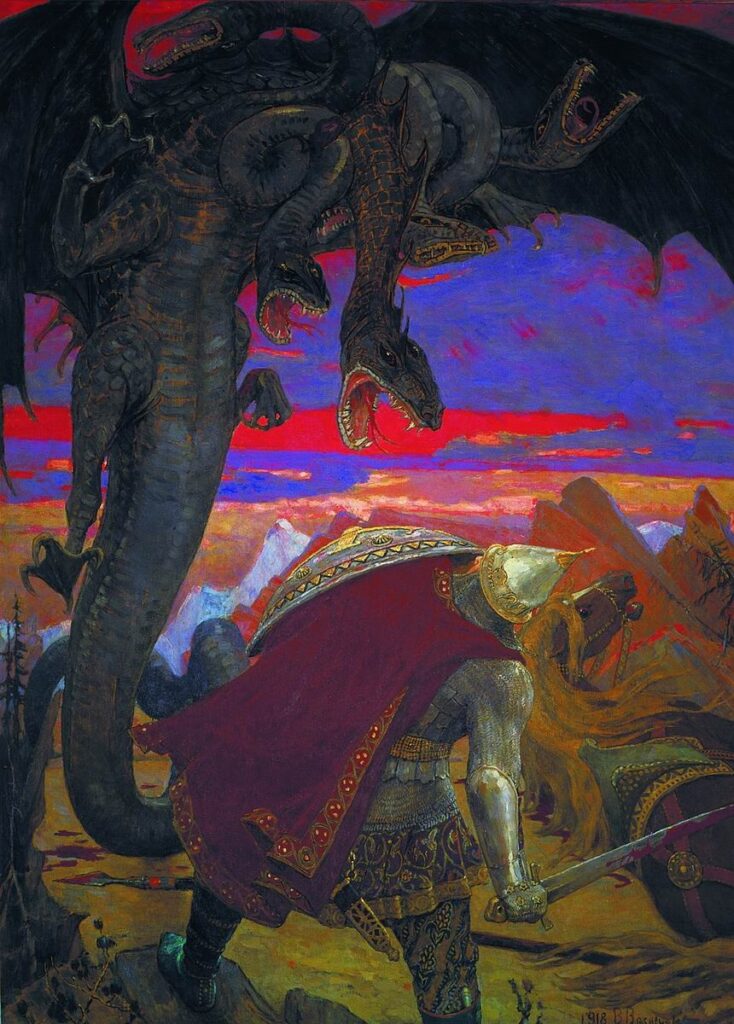
That drift did not happen all at once, and the byliny that survive catch it partway through. In the cattle-theft tales collected across Belarusian and Russian territory, shepherds tending a stolen herd are warned never to admit whose animals they are minding: if asked, they must say the cattle belong to a wealthy human lord, never to “Tsar Zmiulan” or “Zmey Gorymets” — for if the god of thunder hears the true owner’s name spoken aloud, he will come with fire and lightning and burn shepherd and herd alike. The scene is close kin to the reconstructed duel discussed above — a stolen herd, a thunder-god’s wrath, a serpent-lord hiding behind a human alias — but the figure at its center already carries a title, “Gorymets,” built from the same root as Gorynych: the mountain-burner, not yet drawn with wings, but already something more than a snake sunning itself under an oak.
The wings themselves, when they do appear, are not obviously a late corruption. In one strand of Belarusian epic poetry, a horned serpent-falcon nests in oak trees — twelve oaks, the songs specify, one for each of its horns — a hybrid creature perched at the top of the tree rather than coiled at its roots. Serbian and Bulgarian songs preserve a version of the same image split into two separate birds: in the Serbian text, a falcon builds its nest at the crown of a tree while a serpent hides among the roots below; in the Bulgarian, it is a nightingale that sings above while the serpent lies hidden beneath. Ivanov and Toporov, reading these three texts against one another, proposed that the split is secondary — that behind the falcon-at-the-top and the serpent-at-the-bottom lies a single older image, a winged serpent occupying both positions at once, later pulled apart into a bird and a snake as the story’s tellers lost track of what a feathered serpent was supposed to look like. If that reading holds, then Zmey Gorynych’s wings are not simply what happens to a folk monster over centuries of retelling. They may be the return, in a new guise, of something considerably older than the duel itself.
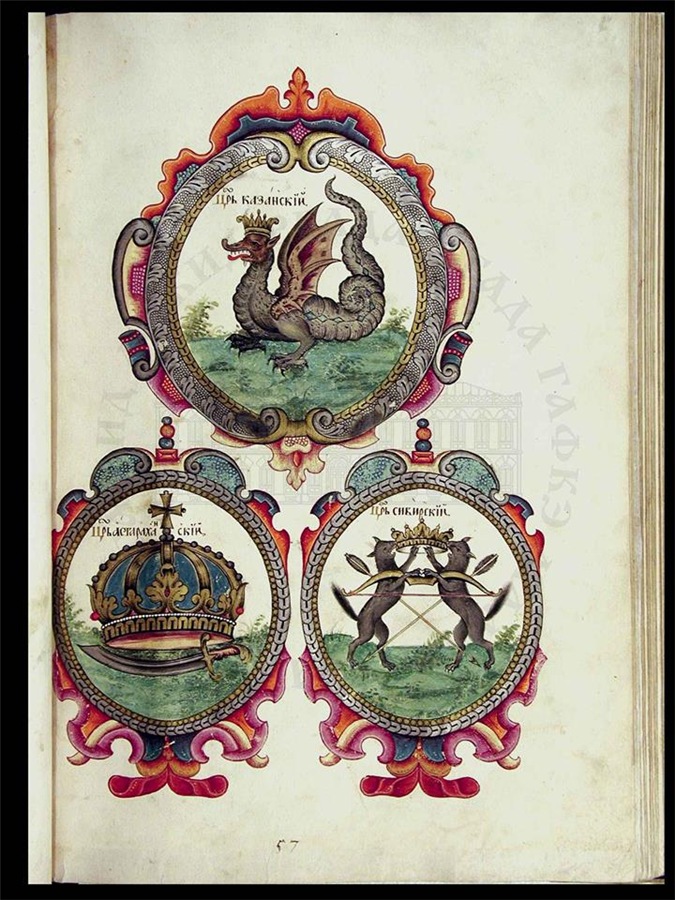
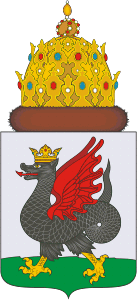
A useful parallel case, from an entirely different language family, is Zilant, the winged serpent that still appears on the coat of arms of Kazan. His inclusion here rests on two separate grounds, not one. The first is practical: this site has no article planned on Turkic or Tatar mythology, and Zilant’s connection to the Slavic material — proximity, shared territory, centuries of contact along the Volga — makes him accessible nowhere else on these pages. The second is structural, and it is the stronger of the two: zilant derives from the proto-Turkic yılan, simply meaning “serpent,” the exact same semantic starting point as zmey. The heraldic dragon on Kazan’s crest — legs, wings, the full apparatus — is a post-conquest invention, largely fixed under Russian imperial heraldry after the sixteenth century. Strip that away and what remains, linguistically, is another serpent whose name never caught up with its final shape.
The South Slavic zmaj belongs in this section only briefly, as a counterweight rather than a parallel case, and I want to be honest that I have not yet read Čajkanović’s own account directly — what follows comes from how his work is cited elsewhere. Where Zmey Gorynych is consistently an adversary and Zilant a civic emblem, the zmaj of Serbian and Bulgarian tradition is more often a benefactor: a protective, occasionally amorous figure who fathers lines of heroes, opposed not to the thunder-god but to genuinely malevolent serpent-monsters — the ala or aždaja — against whom he defends the harvest and the sky. The etymology tracks the same root as zmey; the moral valence does not. I note it here and move past it, a reminder that “serpent becomes dragon” in the Slavic world was never a single, one-directional story.
One further creature belongs here, not because it grew out of a Slavic serpent-word the way Zilant did, but for the opposite reason: because it did not. The basilisk — “king of serpents,” able to kill with a glance — enters the classical record through Pliny the Elder, who placed its origins in Cyrenaica, a very long way from the Volkhov or the Vistula. It has no Slavic root, no folk etymology tying it to earth or mountain or burning, nothing resembling the deep linguistic anchor that makes Zilant, for all his distance, still legible as kin to zmey. What it has instead is a documented local landing, first fixed in print in 1739 by Antoni Chryzanty Łapczyński, whose Majestat polski places a basilisk in the cellar of a Warsaw townhouse that had burned down years before; citations of the book disagree, confusingly, on whether Łapczyński himself dated the events to 1557 or to 1587, a discrepancy this article has not been able to settle against the original. Łapczyński’s book already folded in a second, older account: a Vilnius basilisk reported some years earlier by the Jesuit Adam Naramowski under the reign of Sigismund Augustus, retold as a Lithuanian counterpart to the Warsaw story. In both cellars the creature is undone the same way — a condemned prisoner, offered his life in exchange, is dressed head to foot in mirrors and glass and sent down to face it, only to find the basilisk already dead of its own reflected gaze. It was this written version that the poet Artur Oppman popularized for Warsaw children in the early twentieth century, and it was through a still later retelling, by Roman Zmorski in the nineteenth century, that the cellar acquired the specific address most Poles now know it by, the street Krzywe Koło — a detail absent from Łapczyński’s own text. Popular writers have occasionally traced a line from the mirror-trick to the monster J. K. Rowling later placed beneath Hogwarts, defeated by indirect sight rather than a direct look — an appealing connection, though not one Rowling herself is known to have confirmed, and one that may owe as much to the far older trope of Perseus and Medusa as to any single Polish legend. I keep the basilisk in this chapter for the sake of contrast rather than kinship: not every armored, dangerous reptile wandering through Slavic sources actually grew there.
The Serpent in the Skull: Oleg’s Death
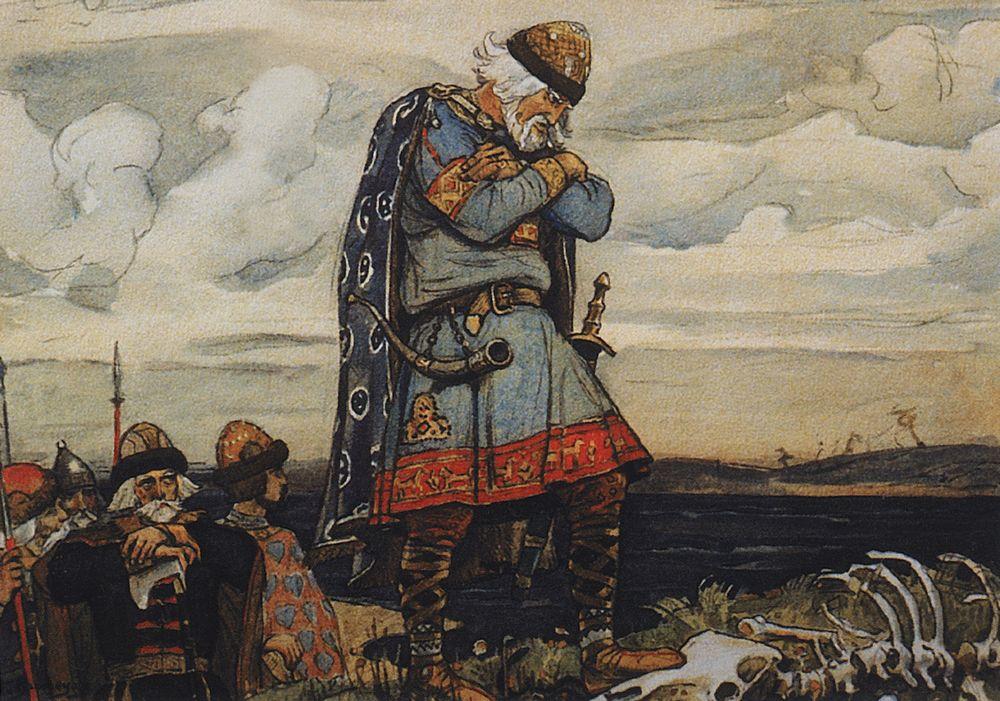
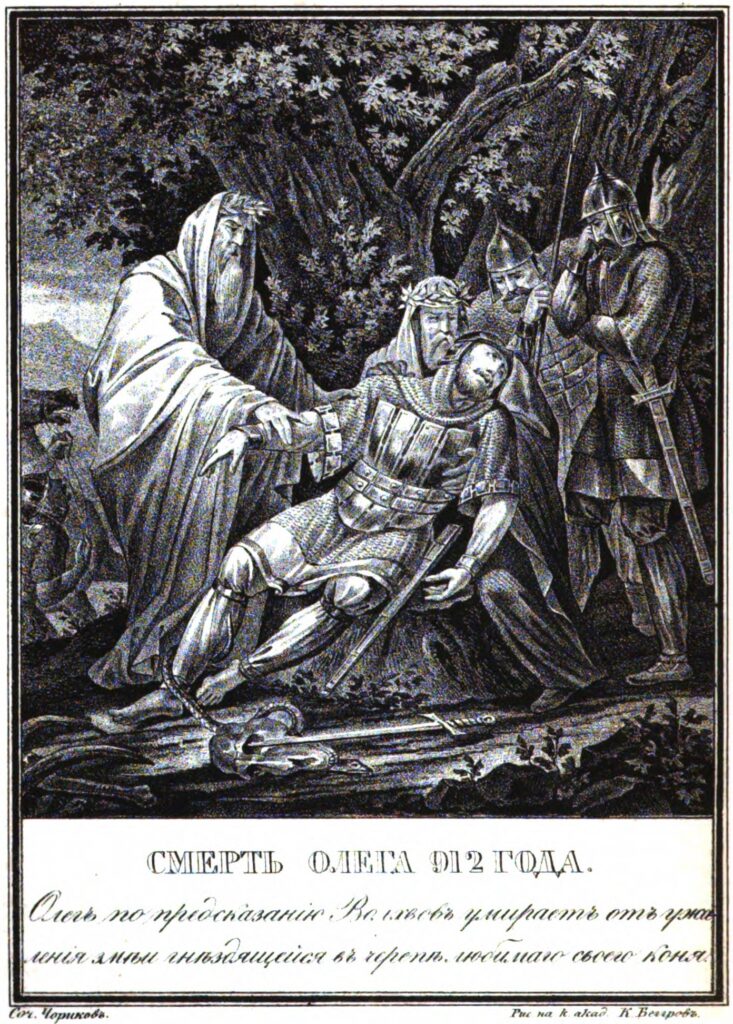
The story is told plainly enough in the Primary Chronicle, under the year 912, with none of the hedging that surrounds Perun’s duel or the yashcher‘s rituals — and I want to hold onto that plainness for a moment before complicating it. Prince Oleg of Kiev, having ruled for decades, consults his diviners about the manner of his death. They tell him it will come from his own horse — a favorite mount he has ridden for years. Oleg takes this seriously enough to act on it: he sets the horse aside, has it fed and cared for, but never rides it again, and gives orders that it never be brought into his presence. Years pass. Word reaches him that the horse has died. Oleg, by now confident the prophecy has failed him, asks to see its remains, laughs at the bare skull lying in the grass, and plants his foot on it, remarking that this, apparently, was meant to kill him. A snake, coiled inside the skull, strikes his foot. He sickens and dies.
What makes this episode worth a section of its own is not its strangeness but its solidity. Unlike the reconstructed duel or the yashcher’s rites, this is not a mosaic assembled from charms and byliny collected centuries after the fact; it is a scene in a chronicle, attached to a named ruler with a datable reign, and the chronicler reports it as fact rather than survival. That solidity makes the episode’s closest parallel all the more striking. In the Old Norse Örvar-Odds saga, the hero Örvar-Oddr receives an identical prophecy from a prophetess in his youth — that his own horse, Faxi, will be the cause of his death. He kills the horse himself, buries it deep, and leaves home for decades of raiding and adventure. Returning as an old man to his childhood farmstead, he finds the burial mound has eroded; a horse’s skull lies exposed at its edge. He kicks it, mocking the old prediction the way Oleg mocks his own — and a snake emerges from the skull and bites him in the leg. He dies from the wound, as Oleg does.
Two heroes, two skulls, two serpents, an ocean and several centuries apart: the resemblance is too exact to be coincidence, and scholars have argued for well over a century about which direction the debt runs. Nora Chadwick, working through the Scandinavian evidence in detail, reports the theory of Adolf Stender-Petersen that the story is ultimately of Turkic origin, carried westward through Byzantium and the Varangian trade routes that ran from Constantinople to Kiev and on into Scandinavia — which would make the Norse version, not the Russian one, the borrower. But Chadwick makes one observation that cuts the other way on a single point of detail: the snake itself appears to be missing from what can be reconstructed of the earliest, most “authentically” Scandinavian layers of the Örvar-Oddr tradition, and may have been added to the story only after it had already picked up Russian coloring. If that is right, the tale as a whole may have traveled west, but the snake — the one element that makes Oleg’s death and Örvar-Oddr’s death identical rather than merely similar — may have traveled east to west a second time, folded in on the Russian side before the story crossed back. Diffusion here is not a single arrow but something closer to a knot.
Robert Fisher, reading the same episode against the rest of Oleg’s career rather than against Örvar-Oddr, arrives at a different kind of comparison, and one I find more persuasive than the trifunctional scheme. He points to how Oleg had already taken Kiev years earlier: not by siege, but by hiding armed men in his boats, sending word ahead that he was merely a merchant bound for Byzantium, and cutting down the city’s rulers, Askold and Dir, the moment they stepped out to greet him — a ruse the Primary Chronicle reports without any apparent discomfort at its treachery. The same chronicle calls Oleg veshchiy, “the wise one,” a word whose root reaches toward second sight rather than mere cleverness. Fisher’s comparison is not to Örvar-Oddr but to Romulus, whose own end in the Roman tradition is not a death at all but a disappearance — swallowed by a storm cloud during a military review, translated rather than killed, the body never found. Read this way, Oleg’s death by serpent is not primarily a case of a widely diffused folktale motif landing on a convenient historical ruler. It is the closing move of a king whose entire reign had already been narrated as more than ordinarily foreseeing, brought down at last only by the one blind spot his own foresight left uncovered.
A different kind of reading, glimpsed in secondary literature rather than verified directly, reads the three elements of the death — the prophecy, the horse, the serpent — as a miniature of the three Dumézilian functions: sovereignty foretelling its own end, the warrior’s mount, and a serpent standing in for fertility and its collapse. It is a tidy scheme, and I am drawn to tidy schemes less than I probably should be; between it and Fisher’s reading, I find the latter does more with what the chronicle actually says about Oleg, rather than importing a structure the text itself never gestures toward. A magician-king does not simply die. He is undone by the one danger his own foresight failed to close off, in a manner uncanny enough to be worth writing down.
Inventing a Serpent: The Book of Veles
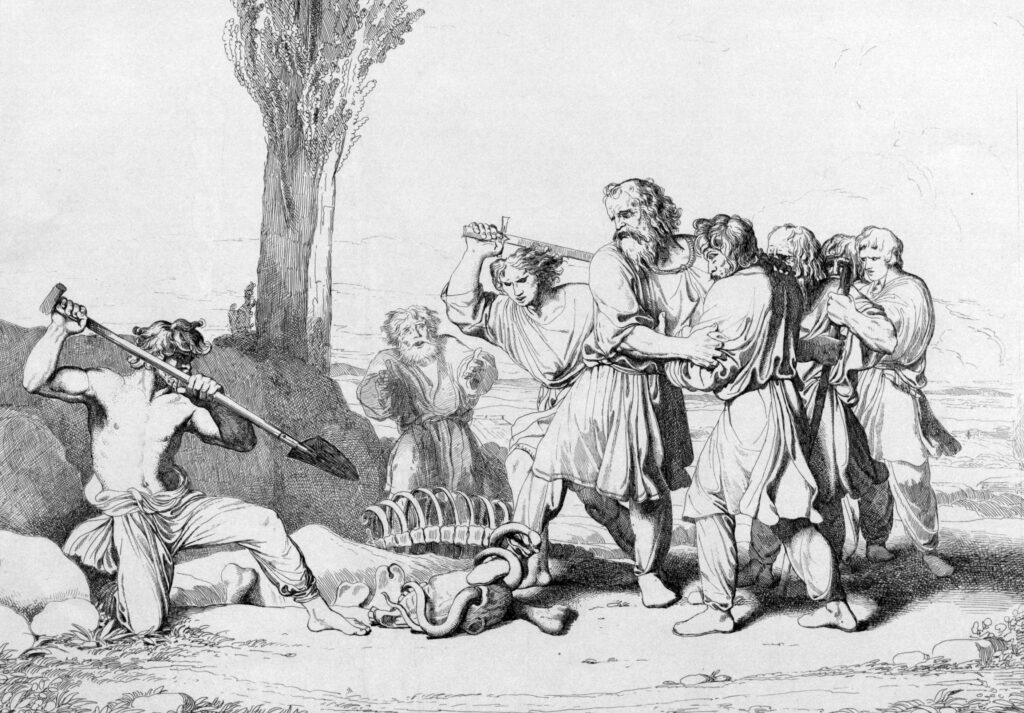
Between 1953 and 1959, in a handful of Russian émigré periodicals — most prominently a San Francisco newspaper — a self-taught historian and chemist named Yuri Mirolyubov began circulating a text he said had been copied, letter by letter, from a set of wooden tablets. The tablets themselves, he explained, had come from an émigré officer named Izenbek, who claimed to have found them somewhere in Ukraine in 1919; Izenbek kept them under close guard for two decades, refusing even a university researcher’s request to examine them, and died in Brussels on August 13, 1941, during the Nazi occupation of the city, at which point the tablets themselves disappear from the record — only Mirolyubov’s own transcriptions and a single photograph, said to document one plank, survive. That photograph did not hold up under scrutiny for long: in 1959 the Soviet linguist L. P. Zhukovskaya identified fold marks in it consistent with a photograph of a drawing on paper, not of an engraved wooden plank. What survived, on Mirolyubov’s account, was a chronicle of the pre-Christian Slavs tracing their descent all the way from India and stretching back a thousand years before Rurik, invoking Perun and a god named Veles as narrator and protector, written in a script no philologist had ever independently verified. Published in full in 1966 and again through Mirolyubov’s collected papers in the 1970s, it became known as the Vlesbook, or the Book of Veles.
Scholars who examined the surviving transcriptions found the forgery legible as a forgery for reasons more damning than a missing set of tablets. The philologist Oleg Tvorogov’s definitive 1990 analysis showed the language to be an artificial compound of grammatical forms drawn from wildly different centuries and dialects of Slavic development, produced, in his own assessment, by someone unacquainted with the comparative grammar of the Slavic languages and incapable of constructing a coherent one of his own. One strand of later scholarship even proposes that Mirolyubov was not the original forger at all, but had inherited, by way of Izenbek, the work of Alexander Sulakadzev, a documented antiquarian and manuscript-forger active in the early nineteenth century — more than a hundred years before the Book surfaced in San Francisco. None of this has done much to slow the text’s second life. Since the 1970s the Book of Veles has circulated widely among Rodnovery communities — the modern Slavic neopagan movement — as scripture, and it resurfaces every decade or so in a new edition claiming, on one ground or another, to rehabilitate its authenticity.
It is tempting to treat this as an isolated embarrassment, a twentieth-century curiosity unconnected to anything discussed in the sections above. The pattern says otherwise. Stamatis Zochios, tracing the pedigree of two other supposed Slavic deities, Kupala and Koliada, back through five centuries of scholarship, finds the same mechanism operating long before Mirolyubov and his tablets. Polish chroniclers of the fifteenth and sixteenth centuries — Długosz, Miechowski, Kromer — manufactured Slavic gods by holding native folk practices up against the Greco-Roman pantheon and demanding a match: a summer bonfire festival becomes “Kupala” because a god was needed to preside over it, on the assumption, borrowed wholesale from classical models, that every festival must have one. East Slavic chroniclers of the seventeenth century inherited these manufactured names and treated them as established fact. Russian mythologists of the nineteenth century — writing under the double influence of Romantic nationalism and the German school of solar mythology that read every folk custom as a faded sun-myth — elaborated the invention further, building etymologies that later philologists would dismantle piece by piece: Kupala, most likely, is nothing more than a folk-garbled memory of Ioann Kupatel’, John the Baptist, tied to the ritual bathing (kupat’) associated with his summer feast day; Koliada is very probably just the Latin calendae, the first of the month, borrowed early and reinterpreted as a person once its foreign origin was forgotten. Neither was ever a god. Both were manufactured as one, by scholars doing exactly what scholars are trained not to do: filling a gap in the record with what the framework required to be there.
Read against that five-hundred-year genealogy, the Book of Veles looks less like an aberration than like the same machine running one more cycle, with a forger standing in for a chronicler and a Cold War émigré press standing in for a Renaissance printing house. It bears an uncomfortably close structural resemblance, too, to a case already examined on this site: Iolo Morganwg’s Gorsedd, invented whole in eighteenth-century Wales and still convened today as though it were an unbroken survival of druidic practice. Two forgers, working in different centuries and different languages, arrived independently at the same solution to the same problem — a record felt to be missing, and a modern hand willing to supply it. Veles himself, meanwhile, carries on in two entirely separate afterlives that never touch: reconstructed with real philological caution in the pages of scholars working from chronicle attestations and folk incantation, and invoked with none at all by a narrator who never existed, on tablets that were never found.
A Note on Sources and Scholarly Uncertainty
The organizing principle of this article — moving from the layered, ambiguous ground at Peryn toward the frank fabrication of the Book of Veles — is an editorial choice, not a neutral report of how confident each claim happens to be. Readers should understand it as a deliberate gradient rather than a scale imposed by the material itself: figures like the yashcher and Zmey Gorynych do not become “more speculative” as the article proceeds so much as the article is arranged to move from terrain where attestation and reconstruction sit closest together toward terrain where they pull furthest apart.
Two chronological points bear restating plainly. First, Leo Klejn’s Voskreshenie Peruna (2004) postdates both Boris Rybakov’s Yazychestvo Drevney Rusi (1987) and Rybakov’s death (2001) by roughly two decades; it is a retrospective revision of Rybakov’s work, not a position Rybakov ever had the chance to answer, and this article has tried throughout to describe their relationship in those terms rather than as a live scholarly argument. Access to Klejn’s book was in any case partial — the introduction and roughly the first seventeen pages of Part I, consulted via the Internet Archive — and the specific page references (153, 218, 231, 249) that Gruznova cites for Klejn’s critique of Rybakov’s reading of the Novgorod material were not independently verified against the original.
Second, the reconstruction attributed throughout to Vjacheslav Ivanov and Vladimir Toporov is presented here with the same caution its authors themselves attached to it. Their 1970 article states outright that they are proposing a hypothesis assembled from fragments, not reporting a text that survives whole; this article has tried never to let that qualification drop out of view. Rybakov’s own relationship to their work, discussed in the section on Perun and Veles, is genuinely mixed rather than simply confirmatory: he accepts their argument for the deep Indo-European antiquity of Perun’s cult, and independently proposes an alternative hierarchy — with Stribog or Rod, rather than Perun, occupying the oldest, most remote position in the pantheon of 980 — that sits uneasily beside a straightforward reading of the reconstructed duel. He also rejects, without much argument beyond noting the absence of supporting evidence, their proposed etymology of the god Semargl as “seven-headed.” Both scholars are cited here for what they specifically argue, not as interchangeable authorities on early Slavic religion.
Several individual claims carry their own flags. Mokoš’s status as Perun’s wife, mentioned in the reconstructed Veles myth discussed in the third section, belongs specifically to that reconstruction; it is not a settled point in the wider literature on early Slavic religion, and I have not independently verified it against other primary treatments of the pairing beyond Maiello and Danišová’s own account. The hypothesis that the children’s game “Yashcher” preserves the memory of an actual human sacrifice is Rybakov’s own reading and has been contested by later folklorists, notably N. K. Kozlova and T. A. Bernštam, who propose that the figure represents a totemic ancestor tied to initiation rites rather than a sacrificial victim; I have tried to present this as an open disagreement rather than settle it. The 1582 Pskov Chronicle entry describing “crocodiles” emerging from a river is reported here as a bare chronicle fact — real animals misidentified, a rhetorical topos, or something else again — without a settled interpretation, because none exists in the sources consulted. The relationship between Oleg’s death and the death of Örvar-Oddr in Old Norse tradition draws on Nora Chadwick’s discussion of the episode, but this material was available only in summary and abstract form rather than as a full text of her book; the direction of borrowing she proposes should be read with that limitation in mind. The trifunctional reading of the same episode (prophecy as sovereignty, horse as the warrior class, serpent as fertility) circulates in secondary literature but was not traced back to a primary scholarly argument and should be treated with corresponding caution — unlike Fisher’s own reading of the death, discussed in the body of the section, which is traced directly to his 1970 article and is the interpretation this piece actually endorses. One qualification on that endorsement: the core comparison to Romulus, and the framing of both deaths as disappearances rather than ordinary deaths, comes from Fisher’s own argument; the specific narrative details given for Romulus’s end (the storm cloud, the military review) are standard classical material, found in Livy and Plutarch, and I cannot at this remove confirm with certainty that this exact level of narrative detail was drawn from Fisher’s own prose rather than supplied from general knowledge while drafting. The comparison itself should be considered Fisher’s; the vividness of its telling may not be. The narrative details given for the discovery and loss of the Book of Veles — Izenbek’s find near Kharkiv, the precise date of his death in Brussels, and L. P. Zhukovskaya’s 1959 identification of the surviving photograph as an image of a drawing rather than of wood — are well attested across multiple independent accounts of the text’s history, but they were confirmed for this article through general web research rather than through a page-by-page reading of Radulović, the source credited in the bibliography for the section’s central argument about the forgery’s afterlife; Radulović’s own paper should not be assumed to be the source of every specific date and detail in that paragraph. The Warsaw basilisk legend rests on a single identified print source, Łapczyński’s Majestat polski of 1739 — the earliest written record, which itself later citations disagree on dating to either 1557 or 1587, an inconsistency across secondary references to the book that I have not been able to resolve against the original text. The street address now attached to the story, Krzywe Koło, does not appear to come from Łapczyński at all; it surfaces only in a nineteenth-century retelling by Roman Zmorski, and Artur Oppman’s early-twentieth-century versions for children popularized that already-composite legend rather than originating any part of it — a distinction worth being explicit about, since it resolves what could otherwise look like two competing, unreconciled fixations of the same story. The connection sometimes drawn between that legend and the monster of the second Harry Potter novel is, so far as I have been able to establish, entirely unconfirmed by its author and should not be read as more than an observation made by later popular writers.
Two further points in the fourth section rest on thinner ground than the rest of the article. The claim that Zilant’s heraldic form — wings, legs, the full dragon apparatus — was fixed only after the sixteenth-century conquest of Kazan draws on a vexillological reference site quoting a genuine period document (Carlus Allard’s 1705 Amsterdam heraldry, translated into Russian in 1709), supported by an academic conference paper on the symbol’s role in contemporary Tatar civic identity. I could not locate a dedicated scholarly monograph on Zilant’s own mythology, and I take that absence to be a genuine fact about the state of the field rather than a gap in my own reading. The description of the South Slavic zmaj as a benevolent, genealogically potent figure opposed to the ala or aždaja rests on Veselin Čajkanović’s Mit i religija u Srba (1973) and Stara srpska religija i mitologija (1994); I have not read either directly, since both are in Serbian, and I would want to consult them, or find a competent reader, before treating this section as fully sourced.
One further figure deserves a mention here rather than a place in the article proper. Volkh Vseslavich, the sorcerer-hero of the byliny, is described by Roman Jakobson and Marc Szeftel, in their study of the Vseslav epic tradition, as the son of a serpent and the princess Marfa Vseslavevna, able to transform into a wolf and other animals. He does not appear above, and his absence is a matter of editorial judgment rather than a gap in the sourcing: his birth is a filiation motif rather than a combat one, and I was not persuaded, on balance, that a coda on his parentage would sit naturally alongside the reconstructed duel in the third section without pulling the reader’s attention toward a story this article does not otherwise tell. A fuller account of him may belong in a future piece on the byliny tradition specifically, alongside the Japanese comparative material Gruznova discusses in connection with Perun, which is reserved for a planned article reflecting on the universality of the serpent symbol.
Finally, a number of primary Slavic and Baltic sources appear here at one remove: the Belarusian incantation texts, the bylina fragments concerning the cattle-thief serpent, and the 1302 charter of Lev Danylovych of Galicia are all known through their citation in Ivanov and Toporov’s 1970 article rather than through direct consultation of a critical edition, as are Adam Olearius’s 1654 account and the seventeenth-century Tsvetnik manuscript, both cited as they appear quoted in Rybakov. Where page numbers are given for Rybakov’s book, they follow the pagination of the PDF consulted at 100bestbooks.ru and have not been verified against the 1987 printed edition.
Bibliography
Primary Sources
Cross, Samuel Hazzard, and Olgerd P. Sherbowitz-Wetzor, trans. The Russian Primary Chronicle: Laurentian Text. Cambridge, MA: Medieval Academy of America, 1953.
Primary Sources — Not Directly Consulted
Adam Olearius. Podrobnoe opisanie puteshestviia golshtinskogo posol’stva v Moskoviiu i Persiiu [Detailed Description of the Holstein Embassy’s Journey to Muscovy and Persia]. Russian trans. Moscow, 1870. Cited as quoted in Rybakov, Yazychestvo Drevney Rusi.
Herberstein, Sigismund von. Zapiski o Moskovitskikh delakh [Notes on Muscovite Affairs]. Russian trans. St. Petersburg, 1908. Cited as quoted in Rybakov, Yazychestvo Drevney Rusi.
Łapczyński, Antoni Chryzanty. Majestat polski cudami w Polszcze i W. X. L. przez Pana Boga pokazanemi ubłogosławiony na publiczny widok. 1739. The earliest known printed source for the Warsaw basilisk legend and, within the same book, a retelling of the earlier Vilnius account attributed to Adam Naramowski; known only through secondary Polish-language accounts and encyclopedia entries, not consulted directly, and the discrepancy between citations dating its Warsaw episode to 1557 versus 1587 remains unresolved.
Naramowski, Adam. [Title not established, reported as a Latin-language account of a basilisk in Vilnius under Sigismund Augustus]. Known only through its retelling in Łapczyński, Majestat polski (1739), and through secondary Polish accounts of that retelling; not consulted directly, and full bibliographic details have not been established.
Oppman, Artur. Legendy warszawskie. Poznań and Warsaw: Księgarnia św. Wojciecha, 1925. The early-twentieth-century collection that popularized the basilisk legend, among others, for a general Polish readership; known through its publication history and content summaries rather than through a direct reading of the text.
Zmorski, Roman. Podania i baśnie [Legends and Fairy Tales]. Nineteenth century; exact edition and date not established. The apparent source of the Krzywe Koło street detail now attached to the Warsaw basilisk legend, itself absent from Łapczyński’s earlier account; known only through its citation in later popular retellings, not consulted directly.
Lev Danylovych, Prince of Galicia. Charter of 1302. Cited as quoted in Ivanov and Toporov, “Le mythe indo-européen du dieu de l’orage poursuivant le serpent.”
Pskovskie letopisi [Pskov Chronicles]. Vol. 2. Moscow, 1955. Cited as quoted in Rybakov, Yazychestvo Drevney Rusi.
Romanov, E. R., ed. Belorusskii sbornik [Belarusian Collection]. Vitebsk, various volumes, 1887–1901. Charm and folktale texts cited as quoted in Ivanov and Toporov, “Le mythe indo-européen du dieu de l’orage poursuivant le serpent.”
Speranskii, M. N. Russkaia ustnaia slovesnost’ [Russian Oral Literature]. Moscow, 1917. The 1665 “Tsvetnik” manuscript cited as quoted here, in turn as quoted in Rybakov, Yazychestvo Drevney Rusi.
Tvorogov, Oleg V. “Velesova kniga.” Trudy Otdela drevnerusskoi literatury 43 (1990): 170–254. Cited as summarized in Radulović, “The New Life of ‘The Book of Veles.'”
Secondary Sources — Not Directly Consulted
Čajkanović, Veselin. Mit i religija u Srba [Myth and Religion Among the Serbs]. Belgrade: Srpska književna zadruga, 1973.
———. Stara srpska religija i mitologija [Old Serbian Religion and Mythology]. Edited by Vojislav Đurić. Belgrade, 1994. These two posthumous scholarly editions are the standard source for the South Slavic zmaj figure discussed in this article’s fourth section; their precise citations were confirmed via their appearance in later academic bibliographies, but neither has been read directly and both should be consulted before publication if a fuller treatment of the zmaj is wanted.
Jakobson, Roman, and Marc Szeftel. “The Vseslav Epos.” In Russian Epic Studies, edited by Roman Jakobson and Ernest J. Simmons, 13–86. Memoirs of the American Folklore Society 42. Philadelphia: American Folklore Society, 1949. Confirms, at p. 83, that Volkh Vseslavich is described in the bylina tradition as the son of a serpent and the princess Marfa Vseslavevna — see the discussion of this figure in the notes above.
Secondary Sources
Chadwick, Nora K. The Beginnings of Russian History: An Enquiry into Sources. Cambridge: Cambridge University Press, 1946. Referenced via archive.org; available there only for controlled digital lending, not as a downloadable file.
Fisher, Robert L., Jr. “Indo-European Elements in Baltic and Slavic Chronicles.” In Myth and Law among the Indo-Europeans, edited by Jaan Puhvel, 147–158. Berkeley: University of California Press, 1970. Full volume freely available at archive.org.
Gruznova, E. B. “Novgorodskii zmiiaka-Perun i ego analogi” [The Novgorod Serpent-Perun and Its Analogues]. Rossica Antiqua, no. 1 (2010): 108–127.
Ivanov, Viacheslav V., and Vladimir N. Toporov. Issledovaniia v oblasti slavianskikh drevnostei [Studies in the Field of Slavic Antiquities]. Moscow: Nauka, 1974.
———. “Le mythe indo-européen du dieu de l’orage poursuivant le serpent: reconstruction du schéma.” In Échanges et communications: Mélanges offerts à Claude Lévi-Strauss à l’occasion de son 60ème anniversaire, edited by Jean Pouillon and Pierre Maranda, 1180–1206. The Hague: Mouton, 1970. Read in full from a PDF supplied directly to the author of this article; also listed on ResearchGate, though access there was intermittently blocked by rate-limiting when checked and is not the route by which the text was consulted.
Klejn, Leo. Voskreshenie Peruna: k rekonstruktsii vostochnoslavianskogo iazychestva [The Resurrection of Perun: Toward a Reconstruction of East Slavic Paganism]. St. Petersburg: Evraziia, 2004. Partially consulted via the Internet Archive; exact URL not retained and to be relocated if a precise citation link is needed.
Koptev, Aleksandr. “The Mythological Serpent Fighting Motif in the Russian Primary Chronicle, Epic Poetry and Fairy Tales.” In New Researches on the Religion and Mythology of the Pagan Slavs 2, edited by Patrice Lajoye and Stamatis Zochios, 213–264. Lisieux: Lingva, 2023.
Maiello, Giuseppe, and Nikola Danišová. “Veles as a Slavic Mythological Trickster.” In New Researches on the Religion and Mythology of the Pagan Slavs 2, edited by Patrice Lajoye and Stamatis Zochios, 47–76. Lisieux: Lingva, 2023. Available at academia.edu.
Radulović, Nemanja. “The New Life of ‘The Book of Veles’: The Transformation of Mystification into Myth.” In Disenchantment, Re-Enchantment and Folklore Genres, edited by Nemanja Radulović and Smiljana Djordjević-Belić, 265–276. Belgrade: Institute for Literature and Arts, 2021. Available at academia.edu.
Rybakov, Boris A. Yazychestvo Drevney Rusi [The Paganism of Ancient Rus’]. Moscow: Nauka, 1987. Consulted PDF at 100bestbooks.ru; pagination given in the notes above follows this file and has not been verified against the printed edition.
Ward, Donald J. “The Threefold Death: An Indo-European Trifunctional Sacrifice?” In Myth and Law among the Indo-Europeans, edited by Jaan Puhvel, 123–142. Berkeley: University of California Press, 1970. Full volume freely available at archive.org.
Watkins, Calvert. How to Kill a Dragon: Aspects of Indo-European Poetics. New York: Oxford University Press, 1995. Consulted via a PDF supplied directly by the author of this article; no stable public URL confirmed.
Zochios, Stamatis. “Kupala and Koliada: Two (More) Examples of Slavic Pseudomythology.” In New Researches on the Religion and Mythology of the Pagan Slavs 2, edited by Patrice Lajoye and Stamatis Zochios, 159–198. Lisieux: Lingva, 2023. Available at academia.edu.