The horned figure of Val Camonica is easy enough to describe: a tall standing man, arms raised in the orans position, antlers branching from his skull, a torc looped over one arm, and beside him — smaller, almost an afterthought to the eye that has not learned to look for it — a serpent with a ram’s head where a snake’s head should be. The carving is cut into a rock face in the Val Camonica, in the Italian Alps, and it is usually dated to around the fourth century BCE, though some specialists push the range as early as the seventh. It predates the Roman conquest of Gaul by centuries. It predates, by a considerable margin, the only text that will ever tell us what to call the figure it depicts.
That gap — between image and name, between an iconography attested twenty-five times across five centuries and a label attached exactly once — is the central fact of this article. The Celtic world gives the serpent almost no story. It gives it, instead, an extraordinary quantity of things: carved stone, cast bronze, a Roman naturalist’s secondhand report of a magical egg, a medieval Welsh poem no one can quite date, a pebble carried in Highland pockets into the nineteenth century, and — much later, much stranger — a modern religious movement that reached back into this material and rebuilt a god from it. What follows is not a survey of “Celtic serpent mythology,” because that phrase implies a coherence the evidence does not support. It is an account of five very different kinds of trace, each demanding to be read on its own terms.
Cernunnos and the Ram-Horned Serpent
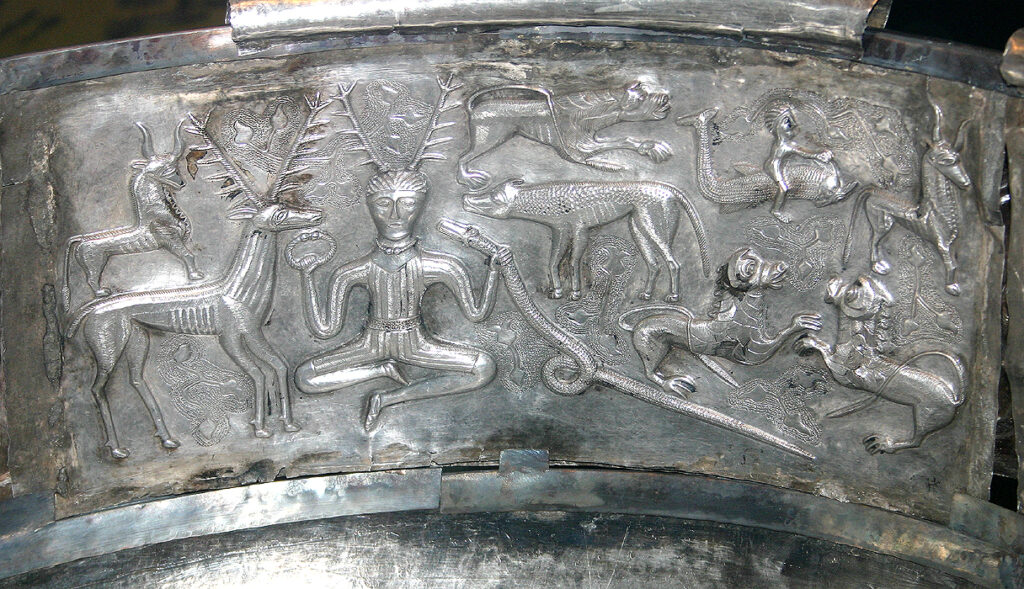
The name is Cernunnos, and it appears in the historical record precisely once: carved above the shoulders of an antlered figure on a relief now known as the Pillar of the Boatmen, erected in Lutetia — Roman Paris — by a guild of Seine boatmen sometime during the reign of Tiberius, between 14 and 37 CE. The pillar stands today in the Musée de Cluny. Everywhere else — Val Camonica, the bronze god of Étang-sur-Arroux with two ram-horned serpents coiled at his waist, the relief at Sommerécourt, the child flanked by serpents at Vendœuvres, the seated antlered figure on the inner plate of the Gundestrup Cauldron — the identification is typological, not textual. Scholars group these images together and call the type Cernunnos because the Paris pillar gives them a name to borrow, not because any of the other objects say so themselves. The art historian Phyllis Pray Bober assembled this iconographic corpus in a long 1951 article in the American Journal of Archaeology, and her catalogue still anchors most serious discussion of the type.
The recurring companion in this iconography is stranger than the god himself: a serpent with the horned or bearded head of a ram, appearing at least three times on the plates of the Gundestrup Cauldron alone — a large silver vessel, partially gilt, dredged from a peat bog in Jutland in 1891, whose date remains disputed among specialists (estimates range from roughly 200 BCE to 300 CE, with a narrower preference for the second or first century BCE) and whose manufacture some scholars attribute to Thracian rather than Celtic workshops even as its imagery is read as Celtic in subject matter. On plate A, the antlered god sits cross-legged, a torc in one raised hand, the ram-horned serpent grasped by the body in the other. But the ram’s head itself may not be original to the god at all: the serpent at Val Camonica, the earliest known depiction of the type, is a plain snake with no ram’s features, and the scholar David Fickett-Wilbar has argued that the ram-headed serpent — already an established motif in the art of the Eurasian steppe, and independently attested as far off as Shang-dynasty China — was most likely grafted onto Cernunnos by the Thracian silversmiths who made the Gundestrup Cauldron, rather than inherited from any earlier Gaulish tradition. If that is right, the single strangest thing about this god may not be Celtic in origin at all.
The same hybrid creature appears without Cernunnos too — beside Mars, beside Mercury, alone — suggesting it carried a significance of its own, not merely as an attribute of the god but as something adjacent to him. Scholars have called Cernunnos the “Lord of the Animals” in nearly identical language for half a century — the phrase, or its close equivalent, appears in Anne Ross, Proinsias MacCana, Udo Strutynski, David Rankin, and Miranda Green in turn. Fickett-Wilbar, examining the claim directly rather than accepting its repetition, found less supporting it than the consensus implied: most of the creatures on the Gundestrup plate are iconographically inert on inspection — two lions fighting each other, a boy improbably riding a fish — and only the stag and the dog appear to register Cernunnos’s presence at all. More telling still, the source every later writer cites for the label, Phyllis Pray Bober’s own 1951 study, actually concluded something different: that Cernunnos belonged to the underworld and could be identified with Pluto, not that he presided over a kingdom of animals. That conclusion went largely unrepeated. A label, it turns out, can survive the argument that produced it by simply being useful enough to pass on unread.
What none of this iconography can tell us is what any of it meant. There is no surviving Gaulish text, no liturgy, no myth in which Cernunnos acts, speaks, or is addressed. We have twenty-five known depictions and one name, and between them a silence exactly as large as the one that separates every other Celtic image from its lost meaning.
Modern popular religion has filled that silence with considerable confidence, and the story of how deserves telling. In 1921 the Egyptologist Margaret Murray published The Witch-Cult in Western Europe, arguing that the witch trials of early modern Europe had unknowingly persecuted the last practitioners of a continuous, organized, pre-Christian fertility religion centered on a horned god. Her sequel, The God of the Witches (probably 1931, though the exact date of the first edition is disputed even among specialist booksellers), gave that god a name: Cernunnos. The thesis has no supporting evidence beyond Murray’s own selective reading of trial records, and it was dismantled point by point in Norman Cohn’s Europe’s Inner Demons (1975) and again, more comprehensively, in Ronald Hutton’s The Triumph of the Moon (1999); it is now treated by historians as a textbook case of confidently argued pseudohistory. None of that prevented Gerald Gardner from folding Murray’s framework wholesale into the new religious movement he began codifying in the 1950s, in which Cernunnos became — and remains, in Gardnerian Wicca and much of contemporary Neopaganism — the Horned God, consort of the Goddess, presiding over an annual cycle of death and rebirth. The archaeology is real. The god’s Gallo-Roman name is real. The unbroken religious lineage connecting the Val Camonica carving to a twentieth-century English civil servant’s new religion is not, and no serious historian of the Celtic world or of modern Paganism argues otherwise.
The Druid’s Egg: Pliny and the Anguinum
Pliny the Elder tells the story as something he was told, and as something he came, briefly, to hold in his hand. In Book 29 of the Natural History, in a chapter devoted to serpents’ eggs, he describes an object the druids of Gaul prized above almost anything else: in summer, he writes, countless serpents twine themselves into a ball, binding it with saliva and bodily secretion, and this mass is called the anguinum (or, in some manuscript readings, urinum — even the object’s name is not entirely settled). The druids claimed it was tossed into the air on the serpents’ collective hiss and had to be caught in a cloak before touching the ground — after which the catcher was expected to flee on horseback, pursued by the serpents themselves, until a river came between them. A genuine specimen, Pliny reports, floats against the current even when set in gold.
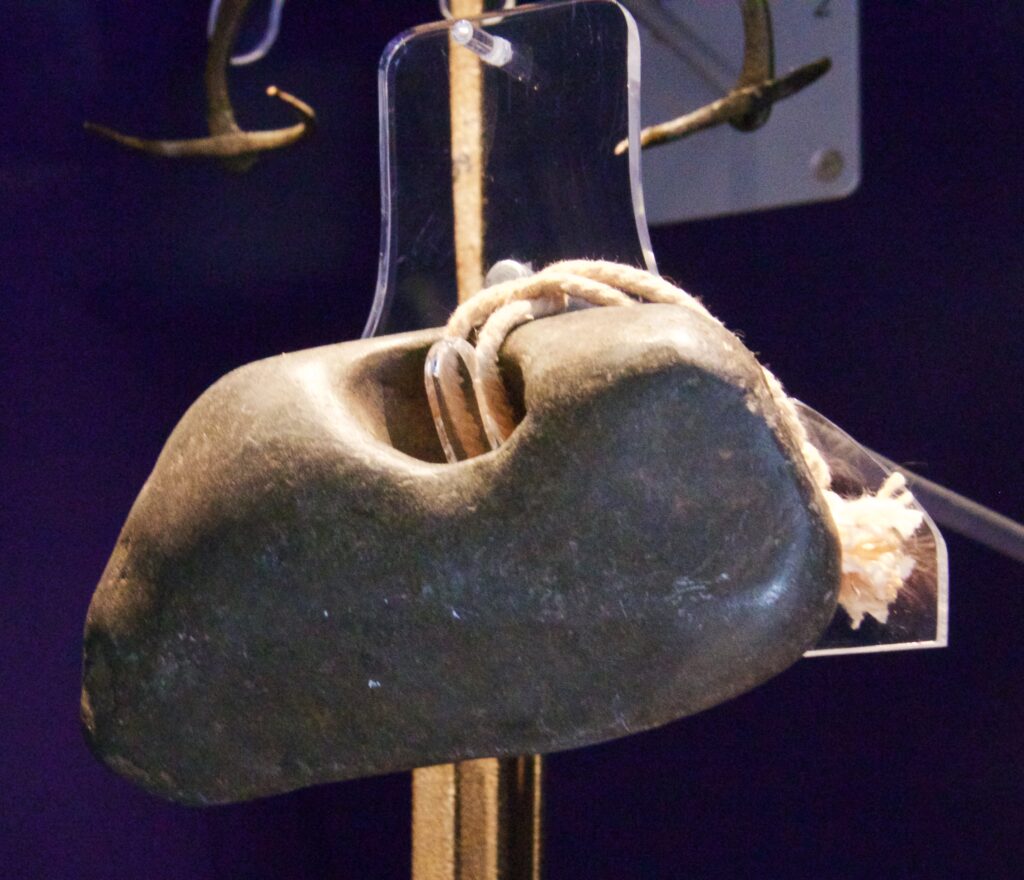
He is careful, in the way a skeptical Roman administrator is careful, to frame this as secondhand: the Druids say. But he adds a detail that reads as sincere, because it costs him nothing to invent and adds nothing to the wonder of the tale: he had seen one of these eggs himself, round, about the size of a small apple, its shell cartilaginous and pitted with cup-like hollows. And he adds a second detail that is neither wonder nor mockery but something closer to a court record — a Roman knight of the Vocontii, prosecuted before the emperor Claudius, was said to have kept an anguinum on his person during the trial, apparently for the favorable influence the druids attributed to it, and was condemned regardless. Whatever the anguinum actually was — fossil sea urchin, glass bead, something else entirely — Pliny is not reporting Gaulish religion directly. He is reporting a story Gaulish religious specialists told a Roman writer about their own practice, filtered through his own evident suspicion that magicians of every stripe like to dress up ordinary objects in impossible provenance.
The suspicion is not incidental to this one passage; it is how Pliny frames druids wherever he mentions them. The classicist Péter Kapi has traced every reference to druids across the Natural History and found a consistent pattern: the mistletoe ritual, the herbs selago and samolus, the anguinum — in every case, druids appear as practitioners of artes magicae, gatherers of charms, workers of cures, never once as the judges, teachers, and diplomats that Caesar, Strabo, and Diodorus Siculus describe, all three apparently drawing on a common earlier source, the lost ethnographic writing of Posidonius. Pliny had access to that same Posidonian tradition and did not use it, or used it and chose to set it aside. Kapi’s explanation is deliberately cautious: either the druids’ actual social role had narrowed by the time Pliny wrote, a century after Caesar, or Pliny — or whatever source he did rely on, since he almost certainly was not reporting firsthand experience — simply preferred the more colorful category of magus to the duller one of judge. Either way, the anguinum is not a neutral ethnographic detail. It is one instance of a specific and consistent authorial choice: to make druids stranger, and smaller, than the earlier Greek and Roman accounts had made them.
Glain Neidr: The Stone the Serpents Made
The story did not end with Pliny, or with Rome. In Wales it survived — transformed, relocated, stripped of the ball of serpents but not of the serpents themselves — as belief in the glain neidr, the “adder stone” or “snake stone,” a small perforated bead or pebble credited with healing powers and said to be formed by adders in the same season, through some collective act involving their bodies, which the stone’s finder had to catch before it fell. Specific Welsh specimens were recorded with named findspots — one of green glass from Aberffraw in Anglesey, another of enamelled earthenware from near Dolgellau in Meirionnydd — in the expanded English edition of William Camden’s Britannia, published by Edmund Gibson in 1695. This material most likely originates not with Camden’s own sixteenth-century Latin text but with the Welsh antiquary Edward Lhuyd, who is credited by several sources with writing the entire Wales section of Gibson’s edition (though the botanical content, notably, was handled separately by John Ray); I have not found a source naming this specific passage, so I’d call the Lhuyd attribution probable rather than confirmed. The Welsh Romantic writer Edward Davies discussed the same belief at length in his 1809 study of what he took to be surviving druidic tradition — a book that belongs to a very particular moment in Welsh antiquarianism, and whose claims about ancient druidism proper should be treated with considerably more caution than its record of a genuinely observed folk belief.
This is worth stating plainly, because the two things are not the same kind of evidence. That rural communities in Wales, Scotland, and Cornwall held onto some version of a serpent-made healing stone across many centuries is a documented fact of folklore, however faint or locally variable its individual attestations. That this folklore constitutes an unbroken transmission of druidic religious practice from the first century to the nineteenth is a much larger and much less supportable claim, and it is exactly the kind of claim nineteenth-century antiquarianism was disposed to make about anything it found charming and old.
Two Serpents in the Book of Taliesin
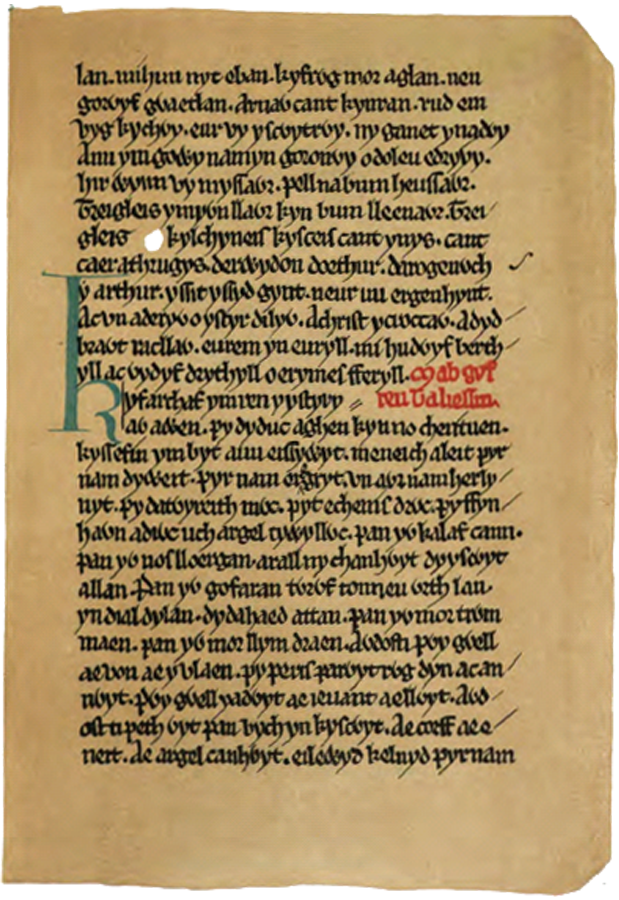
The richest textual trace comes from a poem whose own date no one can fix with confidence: Cad Goddeu, “The Battle of the Trees,” preserved in the Book of Taliesin, a manuscript compiled sometime in the mid-fourteenth century (Peniarth MS 2, now held by the National Library of Wales) but drawing, in the judgment of most Celticists, on material substantially older than the manuscript itself — how much older is a question no one has settled. The poem is long, strange, and resistant to paraphrase: a first-person catalogue of the narrator’s past transformations, an account of a battle in which an army of enchanted trees fights alongside the narrator, boasts, prophecy, and — twice, in two separate movements of the poem — a serpent.
The first appears in the battle itself. The speaker, fighting alongside his trees, describes attacking a hundred-headed monster with armies massed under its tongue, a hundred-clawed toad, and — in the phrase that has stayed with every reader who has come across it — a snake bearing tortured souls within its flesh. The second appears later, in a shorter, separate sequence of transformations distinct from the poem’s famous opening catalogue: the narrator says, in the repeated formula that structures both passages, that he has been a snake, and a viper.
Neither passage should be quoted here in the translator’s exact words — I want to be precise about wording without reproducing more than a phrase of anyone’s translation — but both are well attested across the poem’s long and complicated transmission history. The standard modern scholarly edition is Marged Haycock’s Legendary Poems from the Book of Taliesin, whose line-by-line English translation runs from page 174 to 186 of the second edition, with a hundred pages of commentary following it. An older translation, less reliable but historically important, comes from William F. Skene’s Four Ancient Books of Wales (1868), which remained the standard English point of access for over a century.
Let me be clear about what this poem is not. It is not evidence of a serpent cult, a serpent deity, or a coherent Celtic serpent mythology parallel to what one finds in Mesoamerica or the Andes. It is a single, opaque, centuries-old poem in which a shapeshifting bardic narrator claims, among eighteen or more other forms, to have been a serpent — and in which the poem’s imagined battle includes a monstrous snake among its imagined monsters. That is a real and specific literary fact, not a religious one, and the two should not be collapsed into each other.
Forging the Druids: Invention and Its Uses
Cad Goddeu enters print for the first time in 1801, in the first volume of The Myvyrian Archaiology of Wales — co-edited by a man named Edward Williams, better known by his bardic name, Iolo Morganwg. This detail matters not because it casts doubt on the poem, which survives independently in the genuine fourteenth-century manuscript and long predates its eighteenth-century editor, but because Iolo Morganwg is the single most consequential fabricator in the modern history of Welsh “tradition.” He invented, wholesale, a body of supposed ancient bardic doctrine and ritual — the Gorsedd of Bards, much of the ceremonial apparatus still performed at the National Eisteddfod today — and presented it as unbroken inheritance from druidic antiquity. The historian Ronald Hutton has traced this in detail, most fully in Blood and Mistletoe: The History of the Druids in Britain (2009), where an entire chapter is given over to Iolo Morganwg’s forgeries and their extraordinarily long afterlife in Welsh cultural self-understanding.
Iolo was not, however, a uniform liar. The literary historian Mary-Ann Constantine, who has spent longer with his manuscripts than perhaps anyone alive, draws a real distinction between his treatment of different kinds of material: the folk songs and tunes he collected on his travels through Glamorgan, unlike the Triads and the bardic doctrine he built the Gorsedd on, were largely left alone, transcribed rather than rewritten to sound more druidic. What made his larger inventions so durable, on Constantine’s account, was not their content but their construction: he learned from the public unraveling of Thomas Chatterton’s Rowley forgeries, a generation earlier, that a single invented text is fragile, but a thick weave of oral, textual, and material sources — each blended with the others at a different, harder-to-isolate degree of invention — is very hard to disprove conclusively. That is a description of a method, not just a personality, and it explains why the Gorsedd survived exposure that destroyed lesser forgers.
Robert Graves supplies a second, smaller case of the same instinct. His celebrated 1948 book The White Goddess presents an English version of Cad Goddeu that reads, to anyone unfamiliar with the manuscript tradition, as a faithful translation of an ancient text. It is not. Graves took the nineteenth-century translation of David William Nash, reordered it, and then — in a further version printed in the same book — rewrote it substantially in his own words, producing what he called a restoration of the poem’s true and deliberately obscured meaning. The result has shaped the popular understanding of Cad Goddeu, including its serpent, far more than Haycock’s careful scholarly edition ever has, simply because it reached far more readers first.
These are not marginal curiosities. They are the mechanism by which most contemporary popular writing about “Celtic serpent lore” — the blogs, the Neopagan handbooks, the tarot companion texts — actually came into being. Three distinct processes are usually blended into one undifferentiated “ancient tradition”: a documented eighteenth- and nineteenth-century forger inventing wholesale (Iolo Morganwg); a modest, genuinely old folk belief surviving at the margins of the historical record without ever having the theological weight later claimed for it (the glain neidr); and a twentieth-century new religious movement building a theology out of real archaeology plus a discredited academic hypothesis (Murray, Gardner, and the Wiccan Cernunnos). Separating these three is not pedantry. It is the only way to know, when a claim about Celtic serpents reaches you, what kind of evidence — if any — actually stands behind it.
An Island (Almost) Without Serpents
Cross the Irish Sea and the picture inverts, though less completely than I first thought. Continental Gaul gives an abundance of serpent iconography and almost no narrative; the insular traditions give almost no serpent iconography, and a narrative record that is thinner but not, in fact, empty. I found no serpent of consequence in the two texts most people mean when they say “Welsh mythology” — the four branches of the Mabinogi and Culhwch and Olwen — nor in the central action of the Táin Bó Cúailnge itself. But one of the shorter “fore-tales” attached to that central epic, the Táin Bó Fraích, preserved in the Book of Leinster (Trinity College Dublin, MS 1339, written before 1150) and in at least two other medieval manuscript witnesses, turns on a serpent twice — and the two encounters sit oddly with each other, because the tale that contains them is not one story but two, stitched together.
The first belongs to what its translator, A. H. Leahy, judged the older and more polished half: a love story, in which Fráech, courting Ailill and Medb’s daughter Findabair, is sent into a river to fetch rowan branches and is seized there by a péist — Findabair watching from the bank, a sword thrown to him at the last moment, the creature killed or driven off depending on which manuscript witness you read. The second belongs to what Leahy identified as a later, cruder continuation, datable by internal evidence no earlier than the sixth century (it mentions the Lombards, who do not appear in Italy before then): Fráech’s wife and sons have been carried off to a fortress in the Alps, and he travels there with the Ulster hero Conall Cernach to get them back. The fortress is guarded by a serpent. Rather than attacking the two heroes, it leaps into Conall’s girdle, rides there unharmed through the raid, and is released unharmed afterward. Leahy’s judgment that the tale has two different authors, from two different periods, has since been tested independently: a 2017 study applying social-network analysis to the tale’s structure found the two parts patterning differently from each other, in a way consistent with his division. The two serpents, in other words, belong to two different moments in the poem’s own history, not to a single coherent design.
Neither scene carries the weight of a cult or a theology. But between them they mean that the flat claim that Irish narrative tradition has no serpent at all is not quite right, and I want to correct it here rather than let it stand.
Ireland’s more famous association with the serpent remains an association with absence, and that part of the picture holds: the medieval legend that Saint Patrick drove every serpent from the island is not a Christianized survival of an older druidic serpent cult, as some popular sources still claim without evidence, but a hagiographic tradition explaining, after the fact, a genuine and much older biogeographical reality — Ireland has no native snakes, and never has, having separated from the rest of Europe before serpents recolonized the region after the last glaciation.
The absence generated its own story, in a place where the presence of the serpent elsewhere had generated iconography without story, and where at least one narrative fore-tale, easy to miss because it is not one of the famous ones, put a serpent to quiet and unexpected use — twice, in two different centuries, for two different reasons.
A Note on Sources and Scholarly Uncertainty
Several claims in this article rest on sources I was not able to consult directly during drafting, and I want to be explicit about each.
The discussion of Constantine’s distinction between Iolo Morganwg’s treatment of song versus his fabrication of Triads and bardic doctrine draws on two sources with different levels of directness: her own 2006 article “Songs and Stones,” which I read in full, and her 2007 book The Truth Against the World, which I have only encountered through Rosemary Sweet’s 2009 review in the English Historical Review. The “thick weave of sources” argument attributed to Constantine above is Sweet’s summary of Constantine’s argument, not my own reading of the book, and should be treated accordingly. I should also note a correction made during drafting rather than after: an earlier version of my research notes attributed a foundational 1950 exposure of Iolo’s forgeries to the scholar Griffith John Williams, a date I had taken from a non-citable AI-generated summary rather than a verified source. Checking against Constantine’s own footnotes showed the correct reference to be G. J. Williams’s Iolo Morganwg (Caerdydd, 1956), in Welsh. That error was caught before it entered this article, but I flag it here because it is exactly the kind of mistake this site’s sourcing standards exist to prevent.
The precise page reference for Miranda Green’s discussion of the ram-horned serpent and the “Lord of the Animals” motif — pp. 227–8 of Animals in Celtic Life and Myth — is supported by convergent citation across several independent secondary sources, but I have still not verified it against the physical text itself, and one of the converging sources is a wiki rather than a scholarly work. I’d treat this as probable rather than confirmed.
The figures given for the Gundestrup Cauldron (diameter 69 cm, height 42 cm, weight approximately 9 kg) and the inscription reference for the Pillar of the Boatmen (CIL XIII, 3026) are now supported by strong, consistent convergence across many independent sources, including Wikipedia’s citation of the National Museum of Denmark directly. I have not consulted the Nationalmuseet’s own catalogue or the Corpus Inscriptionum Latinarum directly, so I would still call this well-supported rather than primary-verified.
Margaret Murray’s The Witch-Cult in Western Europe (1921, Oxford: Clarendon Press) is solidly confirmed; I consulted the book’s own title page via a full-text scan. Its sequel, The God of the Witches, has a genuinely disputed publication history: a library catalogue (Open Library) independently lists a 1931 Faber and Faber first edition, which several antiquarian booksellers say they have never physically seen and are reluctant to accept without direct confirmation; those same booksellers date the Sampson Low edition they do hold to circa 1933. My best current guess is that 1931/Faber is the true first edition and the Sampson Low printing is a later reissue, but I have not confirmed this directly against WorldCat or the British Library, and I would not treat it as settled.
The discussion of Pliny’s framing of the druids draws on Péter Kapi, “The Image of the Druids in Pliny’s Natural History,” Chronica (2023), which I read in full. I have not independently verified Chronica‘s indexing or editorial standing beyond the article itself, though nothing about it reads as anything other than a properly footnoted piece of classical scholarship, and its own citations (Tierney 1959 in the Proceedings of the Royal Irish Academy, Hofeneder 2007) check out as real, locatable publications. Kapi’s article also confirms, via the classicist Alfred Ernout, that the word anguinum itself is an editorial reconstruction rather than a certainty of the manuscript tradition — some editions give urinum instead — which I mention above only in passing but want to flag clearly here: even the name of the object this section is built around is not settled philology.
The glain neidr material cites a real primary-adjacent source: the 1695 Edmund Gibson edition of Camden’s Britannia, which illustrates specific Welsh specimens with named findspots. Several independent biographical sources (Dictionary of Welsh Biography, Encyclopedia.com, a peer-reviewed article via Cambridge Core) credit Edward Lhuyd with writing the entire Wales section of this edition, which makes him the probable author of this material rather than Camden himself — but I have not found any source that names this specific passage, so I am treating the Lhuyd attribution as probable, not confirmed. I would also note that even “the whole business of Wales” turns out to have been divided by subject in practice (Lhuyd left the botanical content to John Ray), which is a reminder that broad attributions like this one can still hide exceptions.
An earlier version of this article’s closing section claimed no serpent appears in the major Irish and Welsh narrative cycles, and named only one scene from the Táin Bó Fraích. Both the omission and the singular were corrected after further research. The tale, a fore-tale to the Táin Bó Cúailnge preserved in the Book of Leinster (Trinity College Dublin, MS 1339, before 1150) and translated in full in A. H. Leahy’s Heroic Romances of Ireland (1906), contains two serpent scenes, not one, and its own English translator judged them to belong to two different compositional layers of the text — an argument based on internal evidence (a reference to the Lombards, who do not appear in Italy before the sixth century CE). This literary judgment has since been corroborated independently: a 2017 network-science study by Ralph Kenna, Máirín MacCarron, and Pádraig MacCarron, analyzing the social-network structure of the tale’s two discontinuous parts, found them to differ from each other in ways consistent with Leahy’s division, with the earlier part patterning more closely with material from the Táin Bó Cúailnge itself. I have not read this study end to end, only its abstract and the portions I could access, so I am reporting its conclusion rather than vouching for its full methodology. I have read the relevant serpent passages directly in Leahy’s translated text via the Internet Sacred Text Archive’s reproduction of it, which I am treating as a reliable rendering of Leahy’s 1906 published translation, though I have not compared it word for word against a physical copy of the original edition. A proposed connection between the Conall Cernach scene and Cernunnos does appear in the scholarly literature, not only in popular sources — Anne Ross suggested it in 1967, partly on a speculative etymology of “Cernach” and partly on the resemblance between the serpent-as-belt motif and images of Cernunnos with a snake encircling his waist. But I am persuaded by Fickett-Wilbar’s 2003 rebuttal, which draws on Paula Powers Coe’s 1995 doctoral dissertation: Conall Cernach is consistently described elsewhere as one of Ireland’s foremost warriors, for whom “victorious” (the ordinary translation of “Cernach”) fits far better than Ross’s proposed alternative, and nothing in the iconography of Cernunnos carries any martial association that would support the link. I have decided not to include this debate in the article itself, since Fickett-Wilbar’s case against it seems considerably stronger than Ross’s case for it, and rehearsing a settled-looking disagreement risked giving it more weight than the evidence supports.
The translation of the two serpent passages in Cad Goddeu is anchored here to Marged Haycock’s pagination (Legendary Poems from the Book of Taliesin, 2nd ed., Aberystwyth: CMCS, 2015) via a secondary academic source — an MA dissertation by Anne Elizabeth Wagstaffe (University of Wales Trinity Saint David, 2021), listed in the bibliography below and used strictly as a pointer toward Haycock’s edition, never as an authority in its own right, in keeping with this site’s standing policy on dissertations. Haycock’s exact wording for either passage was not directly consulted; where the poem’s content is described above, I have paraphrased rather than quoted, and no line of Haycock’s translation appears verbatim in this article. Readers who want the precise translation should go to Haycock’s edition itself, or, as a documented historical alternative, to William F. Skene’s 1868 translation.
The dating of Cad Goddeu‘s original composition — as opposed to the fourteenth-century date of the manuscript that preserves it — remains genuinely unsettled among Celticists, and I have deliberately avoided assigning it a specific century.
An earlier line of inquiry pursued a supposed episode in Giraldus Cambrensis’s Itinerarium Cambriae involving a torc guarded by a serpent in a Pembrokeshire well. I was unable to locate this passage in the available English translation of the Itinerarium, and I could not confirm it elsewhere. It does not appear in this article, and it should not be assumed to exist without further verification directly against a scholarly edition of Giraldus’s complete works, including the Descriptio Cambriae, which I was not able to consult in full.
I have also deliberately excluded Sequana, the goddess of the source of the Seine, from this article. She appears in some popular sources as a serpent-associated deity, but I could not find iconographic or epigraphic evidence solid enough to support that specific association, as distinct from her well-attested role as a healing water goddess more generally.
The account of Cohn and Hutton’s roles in critiquing Murray, and of Gerald Gardner’s adoption of her framework, is, I believe, an accurate summary of a well-documented episode in the history of modern Paganism, but I have only verified Murray’s own bibliographic details directly (see above); the Cohn and Hutton titles and publishers listed below were assembled from secondary sources during this research pass and have not been individually cross-checked against a library catalogue.
Bibliography
Bober, Phyllis Pray. “Cernunnos: Origin and Transformation of a Celtic Divinity.” American Journal of Archaeology 55, no. 1 (1951): 13–51.
Coe, Paula Powers. “Macha and Conall Cernach: A Study of Two Iconographic Patterns in Medieval Irish Narratives and Celtic Art.” PhD diss., n.p., 1995. Ann Arbor, MI: UMI Dissertation Express. (Cited via Fickett-Wilbar 2003; not consulted directly.)
Constantine, Mary-Ann. “Songs and Stones: Iolo Morganwg (1747–1826), Mason and Bard.” The Eighteenth Century 47, no. 2 (2006): 233–251. I read this article in full.
Constantine, Mary-Ann. The Truth Against the World: Iolo Morganwg and Romantic Forgery. Cardiff: University of Wales Press, 2007. Cited via Rosemary Sweet’s review (below); I have not read this book directly.
Fickett-Wilbar, David. “Cernunnos: Looking a Different Way.” Proceedings of the Harvard Celtic Colloquium 23 (2003): 80–111.
Camden, William. Britannia. Translated and enlarged by Edmund Gibson, with additions by Edward Lhuyd. London, 1695. (Contains the illustrated Welsh glain neidr specimens. Several biographical sources credit Lhuyd with writing the entire Wales section of this edition, making him the probable author of this specific material, but no source I found names this passage directly, so this attribution should be treated as probable, not confirmed.)
Cohn, Norman. Europe’s Inner Demons. London: Chatto & Heinemann, 1975.
Davies, Edward. The Mythology and Rites of the British Druids. London, 1809.
Graves, Robert. The White Goddess: A Historical Grammar of Poetic Myth. London: Faber and Faber, 1948; rev. ed. 1961.
Green, Miranda. Animals in Celtic Life and Myth. London: Routledge, 1992.
Haycock, Marged. Legendary Poems from the Book of Taliesin. 2nd ed. Aberystwyth: CMCS Publications, 2015.
Hutton, Ronald. The Druids: A History. London: Hambledon Continuum, 2007.
Hutton, Ronald. Blood and Mistletoe: The History of the Druids in Britain. New Haven: Yale University Press, 2009.
Hutton, Ronald. The Triumph of the Moon: A History of Modern Pagan Witchcraft. Oxford: Oxford University Press, 1999.
Jones, Owen, Edward Williams, and William Owen, eds. The Myvyrian Archaiology of Wales. Vol. 1. London, 1801.
Kapi, Péter. “The Image of the Druids in Pliny’s Natural History.” Chronica (2023): 70–77.
Kenna, Ralph, Máirín MacCarron, and Pádraig MacCarron, eds. Maths Meets Myths: Quantitative Approaches to Ancient Narratives. Cham: Springer International Publishing, 2017. (The chapter analyzing the network structure of the two parts of the Táin Bó Fraích is cited here for its conclusion only; I have not read the full chapter and cannot vouch for its methodology in detail.)
Leahy, A. H., trans. and ed. Heroic Romances of Ireland. Vol. 2. London: David Nutt, 1906. (Contains the Táin Bó Fraích.)
Murray, Margaret. The Witch-Cult in Western Europe. Oxford: Clarendon Press, 1921.
Murray, Margaret. The God of the Witches. London: Faber and Faber, 1931 (probable first edition, per Open Library catalogue data). A later edition was issued by Sampson Low, Marston & Co., undated by the publisher but dated circa 1933 by several antiquarian booksellers; whether this Sampson Low printing is a reissue of the 1931 Faber edition or represents a separate first-edition claim was not resolved during this drafting pass and should be checked against WorldCat or the British Library catalogue directly before publication.
The Book of Leinster (Lebor Laignech). Trinity College Dublin, MS 1339 (formerly H 2.18). 12th century, before 1150. Confirmed by convergent citation across ISOS (Dublin Institute for Advanced Studies), CELT (University College Cork), and CODECS. Contains one of the manuscript witnesses of the Táin Bó Fraích.
The Book of Taliesin (Llyfr Taliesin). Peniarth MS 2. National Library of Wales, Aberystwyth, ca. 1325–1350. Digitized facsimile available via the National Library of Wales Viewer, https://viewer.library.wales/4654784.
Pliny the Elder. Natural History, Book 29. Translated by W. H. S. Jones. Loeb Classical Library. Cambridge, MA: Harvard University Press.
Ross, Anne. Pagan Celtic Britain: Studies in Iconography and Tradition. London: Routledge and Kegan Paul, 1967. (Cited via Fickett-Wilbar 2003 for the Conall Cernach hypothesis discussed in the end notes; not consulted directly.)
Skene, William F. The Four Ancient Books of Wales. 2 vols. Edinburgh: Edmonston and Douglas, 1868.
Sweet, Rosemary. Review of The Truth Against the World: Iolo Morganwg and Romantic Forgery, by Mary-Ann Constantine. English Historical Review 124, no. 506 (2009): 199–201. I read this review in full; it is my source for the Chatterton comparison and the “thick weave of sources” argument discussed above.
Wagstaffe, Anne Elizabeth. “Cad Goddeu.” MA dissertation, University of Wales Trinity Saint David, 2021. Cited only as a pointer toward Marged Haycock’s scholarly edition, in keeping with this site’s policy on dissertations; not cited as an authority in its own right. Available via the UWTSD Repository, https://repository.uwtsd.ac.uk/id/eprint/2072/1/2072%20Wagstaffe,%20A.%20Cad%20goddeu%20(2021).pdf (link provided directly by the site’s editor; I was not able to independently verify that it loads, since automated access to this file was blocked during research).
Primary Sources — Not Directly Consulted
Davies, Sioned, trans. The Mabinogion. Oxford: Oxford University Press, 2007. (Referenced above for the absence of serpent material in the Four Branches and in Culhwch and Olwen; this negative claim was not checked against Davies’s edition directly during this drafting pass and should be verified before publication.)
Giraldus Cambrensis. Descriptio Cambriae. (Referenced in the course of research but not directly consulted; the claim originally sought from this text could not be confirmed and does not appear in the article.)
Táin Bó Cúailnge. I have now read the opening portion of Cecile O’Rahilly’s 1967 scholarly translation (the Book of Leinster recension) directly, twice over via two different routes — a course excerpt, and then the official CELT edition itself (celt.ucc.ie) — covering the pillow-talk frame story, the boyhood deeds of Cú Chulainn, and the start of the raid proper through the death of Órlám. Both attempts reached a comparable point in the text (roughly the first quarter to third of the translation) without finding a serpent, and both times I was unable to retrieve further material despite deliberately requesting more. I take this to be a genuine limitation of what I can retrieve in this format, not a lack of effort, but it means the verification remains partial rather than complete. A fuller check would require consulting the complete 272-page translation directly — in a library, or a full published edition such as Kinsella’s or Carson’s — rather than relying on what I could pull from the web.