Tutankhamun’s death mask wraps some twenty-two pounds of gold and inlay (just over ten kilograms) around a young man’s face, and at the center of his brow, rising from the striped nemes headdress, coils a single cobra. Visitors tend to look at the face — the inlaid eyes, the small chin, the strange serenity of it — and pass over the snake as an ornament, a flourish of royal costume jewelry. It is not an ornament. In the texts that explain what that cobra is for, she rears from the king’s forehead to spit fire into the eyes of his enemies, to scorch rebels to ash, to blind and burn and kill on his behalf, every single day. The most recognizable image of Egyptian kingship in the modern world is, on its own terms, a weapon.
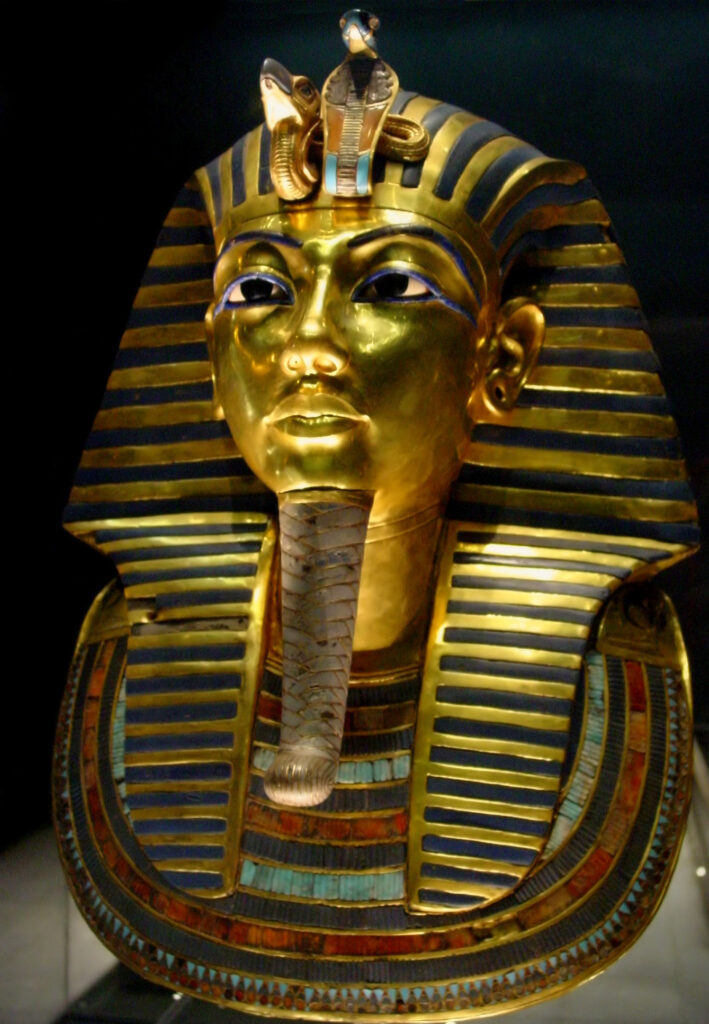
This is not a contradiction the Egyptians needed to resolve, because for them it was not a contradiction at all. The serpent that guards is the serpent that destroys — not two snakes with different temperaments, not a good cobra and a bad one, but a single force that changes its face according to what the moment requires. Egyptian religion returns to this shape again and again, and not only in the uraeus on a king’s brow: in the goddess who wanders away from the sun god and comes back to slaughter half of humanity, in the gods stationed on the solar barque whose entire job is violence performed in defense of order, in a crown that has to be eaten before it can be worn. What follows traces that single shape through four of its Egyptian bodies, and asks what it meant to build a civilization’s protection out of exactly the same substance as its cruelty.
The Eye That Wanders and Returns
At some point old enough that the Egyptians themselves had already forgotten when, the sun god’s eye left him.
The texts do not agree on why. In one telling, Re sends his own eye out into the desert to search for his lost children, Shu and Tefnut, and when the children are found and the eye returns to discover its place on Re’s face already filled by a replacement, it weeps — and from those tears, the first humans are born. In another telling, preserved on the walls of New Kingdom royal tombs as the Book of the Heavenly Cow, Re is old, and men are plotting against him, and he sends his eye out on purpose: not searching, but hunting. The eye becomes Hathor, and Hathor becomes Sakhmet, the lion-headed one, and Sakhmet wades through humanity at Herakleopolis until the fields run red, until Re himself calls it off and has beer dyed the color of blood poured across the land so that Sakhmet will stoop to drink, mistake it for the slaughter, and grow drunk, and stop. She comes home appeased, and what is left of humanity is spared. The Egyptians had a name for what had just happened, repeated in temple inscriptions from Dendera to Kom Ombo centuries later: Sakhmet of yesterday, Wadjet of today — the same goddess, the same eye, one day removed from the other.
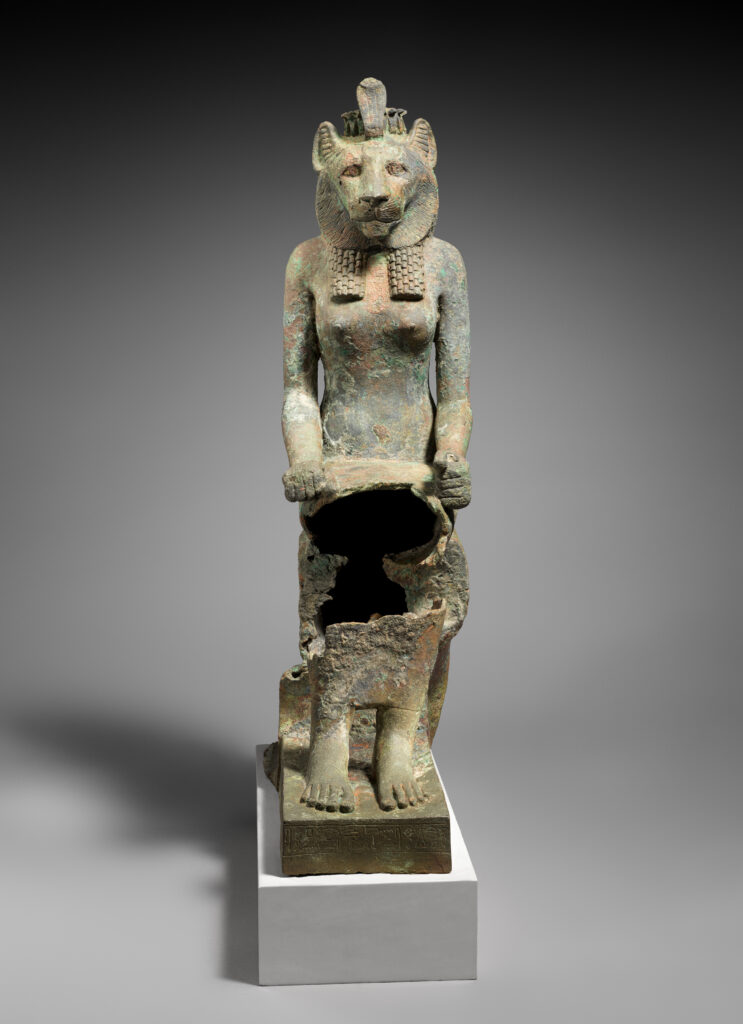
That last name matters, because Wadjet is not merely one face this eye can wear. She is the uraeus itself, the cobra on the crown, and Egyptian temple relief makes the identification explicit down to the smallest surviving amulets: small faience Udjat-eyes, the healed and restored Eye of Horus, with a tiny standing goddess worked into the iris where the pupil should be — Bastet, more often than not, soul of Isis, herald of the star Sothis whose dawn return each year announced the flooding of the Nile and the start of the new year. The wandering goddess and the wandering star rise together. When a Ptolemaic text at Elkab has the sun god welcome the eye home after her long absence in the southern deserts, he does not greet a separate deity. In John Coleman Darnell’s translation of the scene, he greets a fugitive piece of himself: “Welcome back,” he says, “upon the head of him whom you have protected — that head from which you went forth.” The eye is not sent to Nubia and then, separately, restored to the crown. Her going and her return are the myth of the uraeus leaving the brow and settling back onto it, told in the first person by the sun himself.
What the Eye demonstrates in miniature, the rest of Egyptian religion works out at scale.
Apophis’s Champions
Every night, somewhere in the twelve hours of the underworld, a serpent tries to swallow the sun, and every night he fails, and the failure changes nothing about tomorrow night. Apophis is never killed. Egyptian texts are precise about this in a way that is easy to miss if you assume, as most flood myths and dragon-slayings train a reader to assume, that a monster this persistent must eventually lose for good. He is repelled. He is cursed, felled, punished — the vocabulary of the spells against him is a vocabulary of postponement, not victory, because Apophis belongs to a category the ordinary gods do not: he was never born, and so he cannot properly die. He is, as the Egyptologist Erik Hornung reads him, simply there, the way chaos is there before creation and remains there after it, coextensive with order rather than opposed to it in any final sense. What can be organized against him is not his death. It is a rotating cast of gods willing to do, every night, the violence his existence requires.
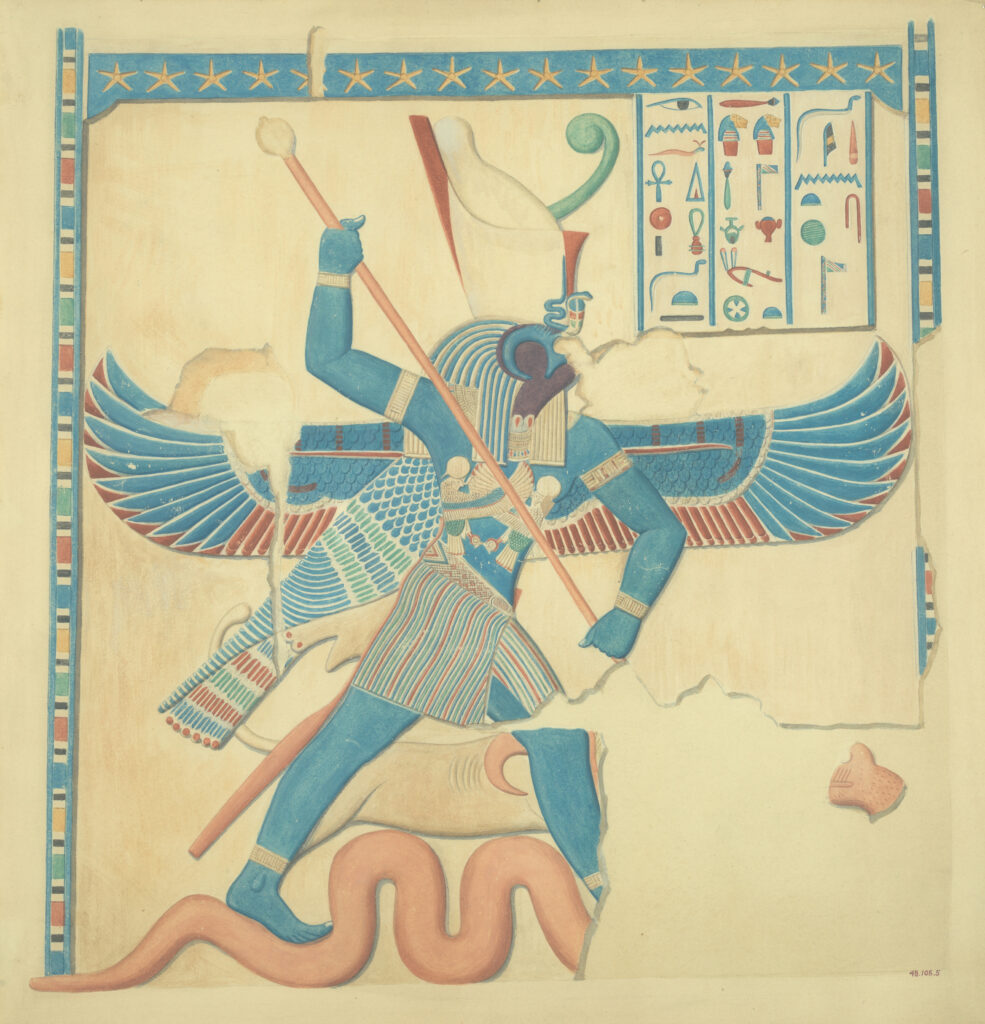
Seth is the most famous of that cast, and the most awkward, because Seth is also the murderer of Osiris — his own brother, hacked apart and scattered across Egypt — and Egyptology spent a long time trying to explain how the same figure could be cast as villain in one myth and indispensable ally in another. The explanations on offer used to run along a single track: Seth must once have been purely good, a storm-god or solar champion from an older layer of belief, later demonized by the cult of Osiris and left with this one heroic role as a fossil of what he used to be. It is a tidy story, and it does not survive contact with the evidence, which runs the wrong way: hostility toward Seth increases over Egyptian history rather than accumulating gradually from a benign origin, hardening in the aftermath of foreign invasions — and even that hardening did not dislodge him from the barque. The Bremner-Rhind papyrus, dated to 306–305 BCE, after those invasions, still shows him, “the son of Nut,” standing on the prow of the solar barque to fell the enemy at the sun’s rising. The better reading, argued by the Egyptologist Herman te Velde, does not split Seth into two gods pretending to be one. Seth in the barque is simply the violent capacity of the sun god himself, given a name and a place to stand — not a separate deity moonlighting as a bodyguard, which is why it is never Re who suffers for Seth’s aggression. It is always Apophis.
Seth was never the only candidate for that post, and this is the detail that turns a single awkward case into a pattern. Month could stand in Seth’s place; so could Onuris, Sopdu, the scorpion goddess Selkis, or Shu. So could Heka, the god the Egyptians called simply “Magic,” born — in the texts’ own account of the matter — as the eldest of Atum’s children, the very first hypostasis of the creative force that made everything else possible. In the seventh hour of the Amduat, the most dangerous hour of the sun’s nightly transit, it is Heka standing at the prow beside Isis, and a Coffin Text spell states the collaboration outright, in Herman te Velde’s translation: “Hu and Heka defeat the malignant snake for me.” Where te Velde reads Seth as specifying the violent aspect of the sun god, he reads Heka, on the same barque and against the same enemy, as specifying something adjacent but distinct: not Re’s violence but his creative, magical power, turned outward as a weapon. Heka counts among the sun god’s seven souls and fourteen life-forces, and in the Book of Overthrowing Apophis, Re says so about himself in the plainest terms available to an Egyptian text — again in te Velde’s rendering: “My name is Magician.”
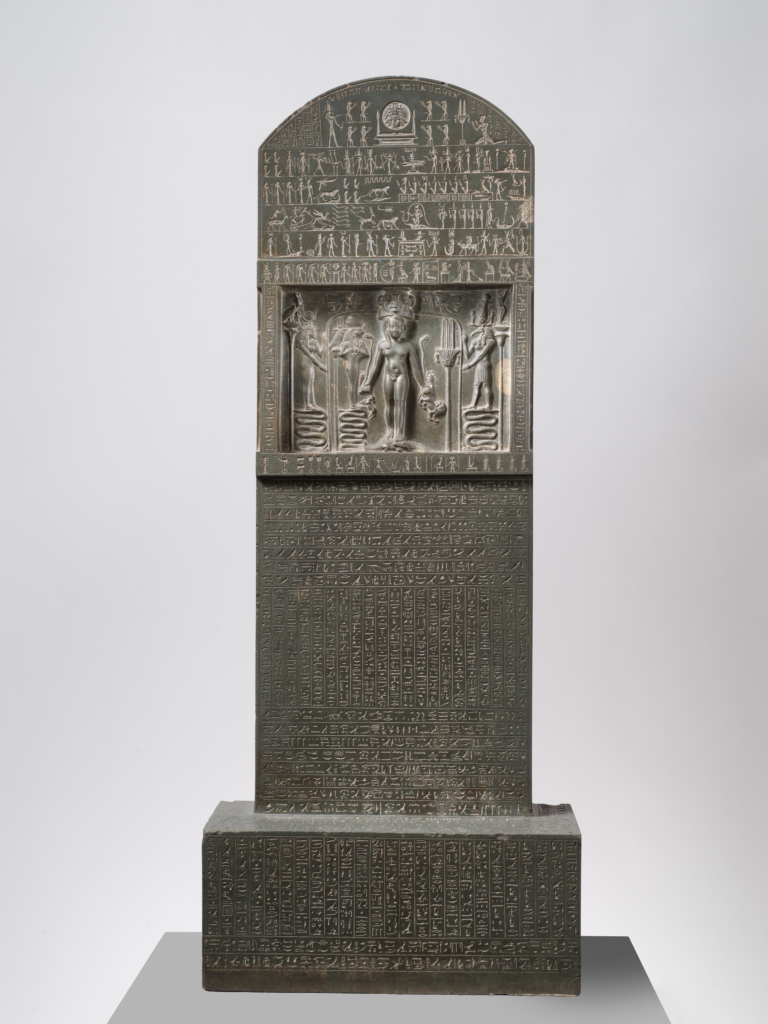
A third figure works this same seam by a different method entirely. Mehen — “the coiled one” — does not stand on the barque’s prow to fight. In the Book of Gates, as Erik Hornung describes it, he surrounds the cabin of the sun god’s boat in each hour of the night: protection by enclosure, not by combat. The Egyptologist Peter Piccione, reading the spell that invokes him, has argued that his coils serve two functions at once, and that the Egyptians never bothered to separate them: the same encirclement that shields Re from what is outside it also traps what is inside — Mehen does not merely protect the sun from his enemies, he holds those enemies prisoner within his own body, turning containment into a weapon by the same gesture that makes it a shelter. And a fourth: Nehebkau, “the one who assigns positions,” whose very name is a bureaucratic-sounding office — he confers rank on the gods and the blessed dead, relays their names to the sun god for admission into his company — but who is also, in one of the few Pyramid Texts passages that call him an enemy outright, a serpent struck down by the creator’s own adze; who appears, thick with resentment, among the fearsome interrogators of the dead in the Hall of Judgment; and whose mother is Renenutet, the cobra of the harvest herself. On the thrones of surviving statuettes of Sakhmet and Bastet — the Eye of Re in both her furious and pacified states — Nehebkau turns up carved alongside other serpent-demons in a pose the Egyptologist Alan Shorter read as commemoration of defeat rather than fellowship: not the Eye’s companion, but the Eye’s conquered enemy, permanently displayed beneath her feet.
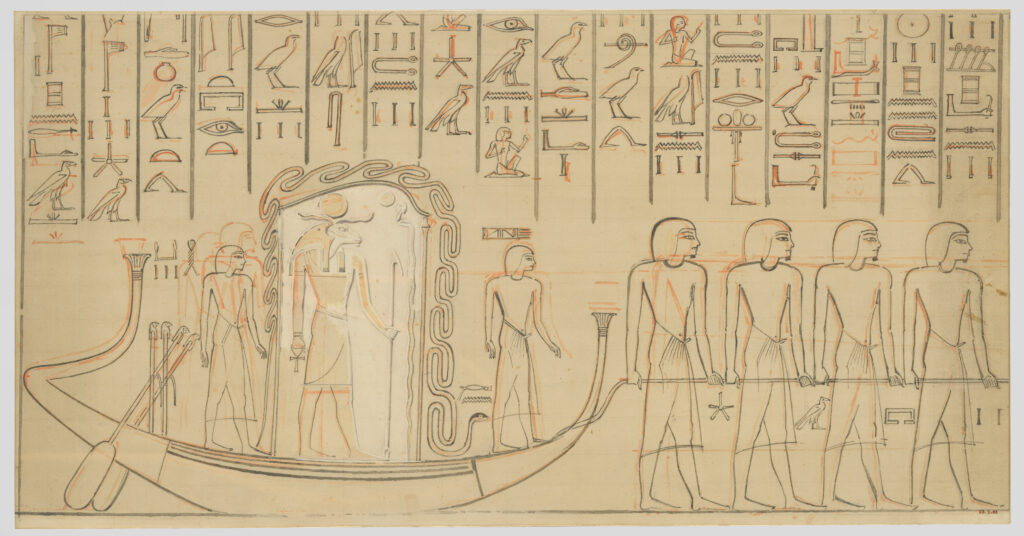
No single Egyptian text sets Seth, Heka, Mehen, and Nehebkau side by side and announces that they are performing the same theological job. But read together, what they share stops looking like coincidence. Each is described, independently, in the vocabulary already used for the Eye of Re in her destructive register — violence exercised in defense of order rather than against it, protection and aggression fused into a single, unsplittable act. Egyptian religion did not resolve the problem of a benevolent order that needs violence to survive by inventing one god to hold that contradiction. It kept inventing new gods to hold it, differently, over and over, as though the shape itself were more stable than any single name attached to it.
The Red Crown and the Blood
In Katja Goebs’s translation of one of the oldest surviving Egyptian religious compositions, the so-called Cannibal Hymn, carved into the interior of a Fifth Dynasty pyramid to describe what happens to a dead king on his way into the company of the gods: “He has eaten the Red Crown; he has swallowed the Green One.” And what happens, in the hymn’s own unflinching account, is a feast. The king rounds up the gods “whose bones are full-grown” and butchers them for meat; he eats their magic, swallows their spirits, grows large on what he has consumed, until eating the Red Crown of Lower Egypt is simply the last and most concentrated course in a meal that has already devoured everything else worth having. A second version of the same spell, copied centuries later onto a Middle Kingdom coffin, puts it from the other direction — again in Goebs’s translation: “I have eaten of the Green One, I have swallowed the Red Crown.” The crown is not merely worn after this. It is metabolized. Goebs connects the hymn’s structure to the myth of dawn itself, where the newborn sun plunges into a red flood at the foot of the sky goddess Nut before rising renewed — birth blood standing in, quite literally, for the crown’s own color, so that the king who swallows the Red Crown is re-enacting, in miniature, the sun being born bloody every morning.
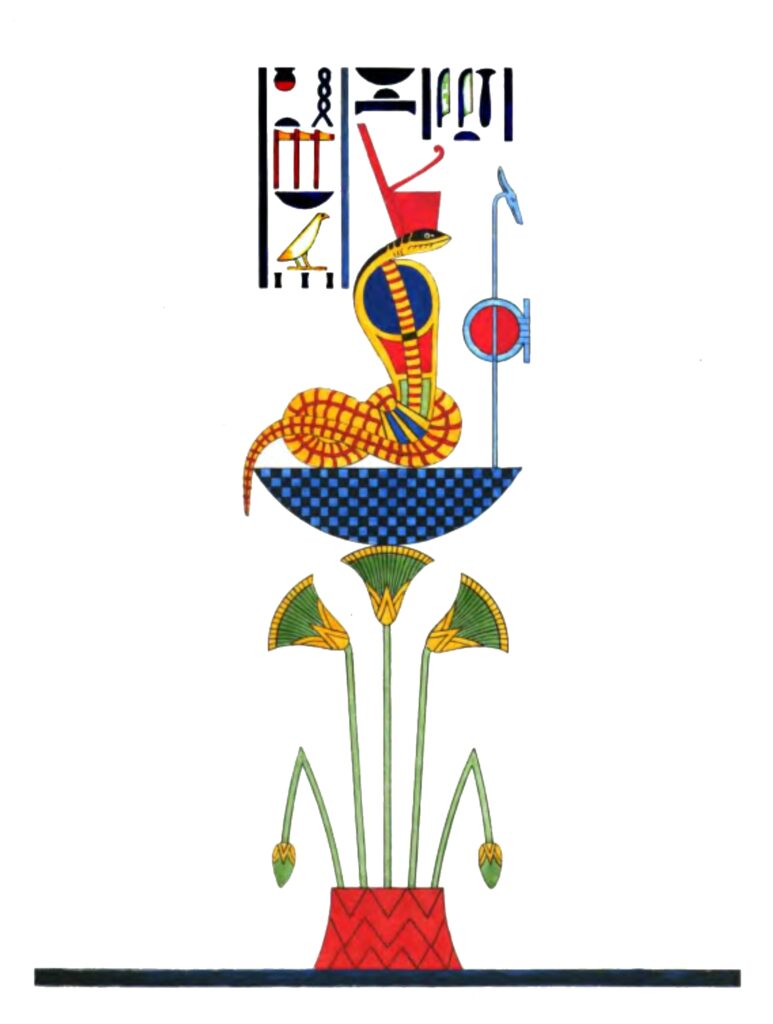
The crown that gets swallowed is not a metaphorical serpent. One Pyramid Text, in Goebs’s rendering, calls the White Crown outright “the snake that is in Elkab,” and describes the White and Red Crowns together as “the two snakes that are on your brow” — not crowns decorated with serpents, but crowns understood as serpents, a matched pair of goddesses worn as a single diadem. And the uraeus that sits atop them has its own violent point of origin, one that returns to a myth already visible in Seth’s résumé: in the version of the Horus-and-Seth conflict recorded in the Pyramid Texts and rendered in Simpson’s anthology, the deceased king becomes “the uraeus which proceeded from Seth” in the same breath that he becomes “the Eye of Horus which was not eaten but spat out” — two treasures extracted, by force, from the body of a god who had tried to swallow them. A companion text, again in Goebs’s translation, has Thoth pull “the knife which came forth from Seth” by the same method. The uraeus, the healed lunar eye, a divine blade: Seth’s body, in this reading, functions as a kind of forge, a site from which royal and cosmic instruments of power are wrenched loose rather than simply given.
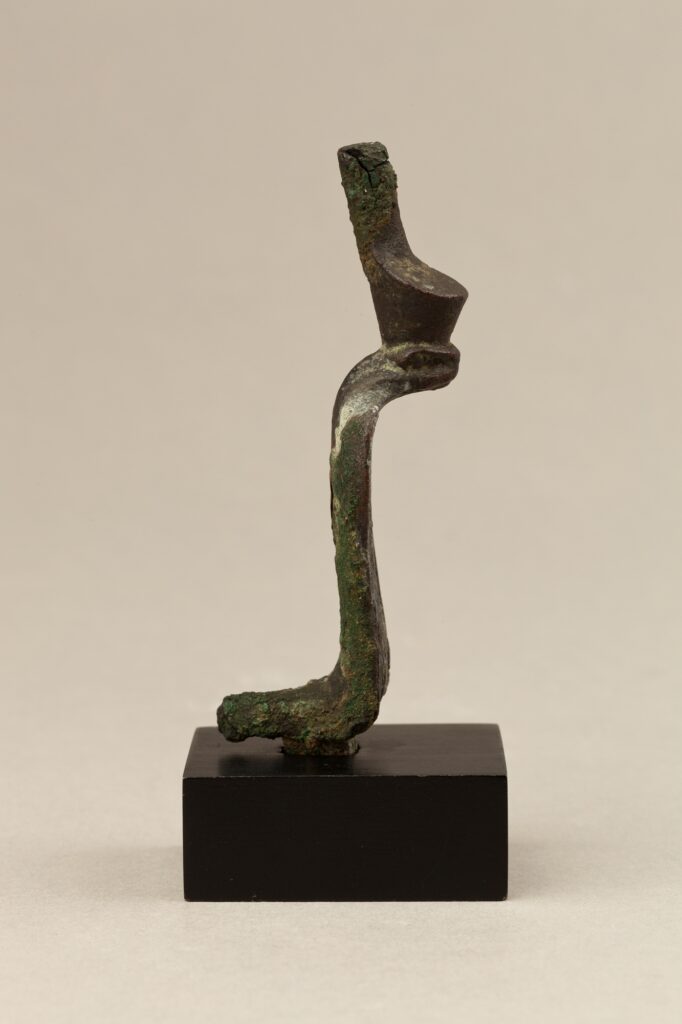
That extraction has a mirror in the serpent Mehen, whose coils reappear here wearing a second face. The Book of the Dead’s 172nd chapter, cataloguing the parts of the dead person’s body one by one, arrives at the teeth and calls them, in Piccione’s translation, “the heads of Mehen, wherein the two lords played” — Horus and Seth, gaming inside the serpent’s own skull. Temple reliefs give that riddle a literal picture: a coiled figure captioned, again per Piccione, “Mehen of the Uraei — His Two Faces,” one face Horus’s, one face Seth’s, rising from a pair of solar barques as part of the sun’s rebirth at dawn. Elsewhere, Piccione notes, Mehen appears as a closed circle, head meeting tail, coiled around the newborn sun god as Isis and Nephthys lift him into the day. It is the same serpent doing three things that Egyptian theology apparently saw no need to keep separate: enclosing the sun protectively, embodying the settled hostility between Horus and Seth, and closing into the shape a much later Greek tradition would call the ouroboros.
Even the dead body absorbs the pattern down to the skeleton. A Pyramid Text, in Goebs’s translation, has the deceased king boast of having swallowed his “heptad of uraei” — seven serpents at a stroke — which then become, inside him, his own “heptad of vertebrae”: the spine that will hold his transfigured body upright in the afterlife is built, in the text’s own terms, out of seven swallowed snakes. Nehebkau performs the identical operation in a New Kingdom spell, rendered by Shorter as “completing and establishing” the vertebrae of the deceased by name. To become an akh, a properly transfigured spirit capable of standing in the company of the gods, is to have already eaten what threatened you and let it become your own structure. The crown, the spine, the uraeus, the meal: in Egyptian funerary theology, incorporation is not a metaphor for power. It is the mechanism.
Kematef, or the Serpent Before Time
Western Thebes has a cult site the Egyptians called, without much ceremony, “the hole of the Kematef serpent” — so the Egyptologist Kurt Sethe found it named in temple inscriptions. It sat at Medinet Habu, in the shadow of what was already, by the time hieroglyphic inscriptions bother to describe the cult in detail, a very old ruin, and what was worshipped there was understood to be already dead — not a god in his prime, but the corpse of one, visited and fed like an ancestor. His name, Kematef, means “he who has completed his moment,” and the completed moment in question was nothing less than the beginning of the world.
Kematef is a form of Amun, and Amun, at Thebes, was said to be the “father of the fathers” of the Ogdoad — the eight primordial gods of Hermopolis, themselves imagined, in at least one surviving cryptographic temple inscription that Sethe worked through, not as individuals but as a single knot of serpent bodies coiling out from one center, described outright as “four horned vipers.” Late cosmogonies from Theban temples give Kematef a son: a second serpent, scarab-headed, called the Earth-Creator, who completes the work Kematef only began, properly separating sky from earth before manufacturing the Ogdoad itself in a goldsmith’s workshop at Luxor. A relief at Medinet Habu, recorded in Sethe’s own field notes, lays out the whole genealogy across four generations of a single name — Kematef the serpent first, the Earth-Creator serpent second, an ordinary Amun third, counted now as merely one god among the eight he had originally fathered, and a living cult image last, identified with Horus, heir to everything that came before him. Divinity here is not a fixed rank. It is a story the god keeps telling about his own past, in which he is, at different points, his own great-grandfather.
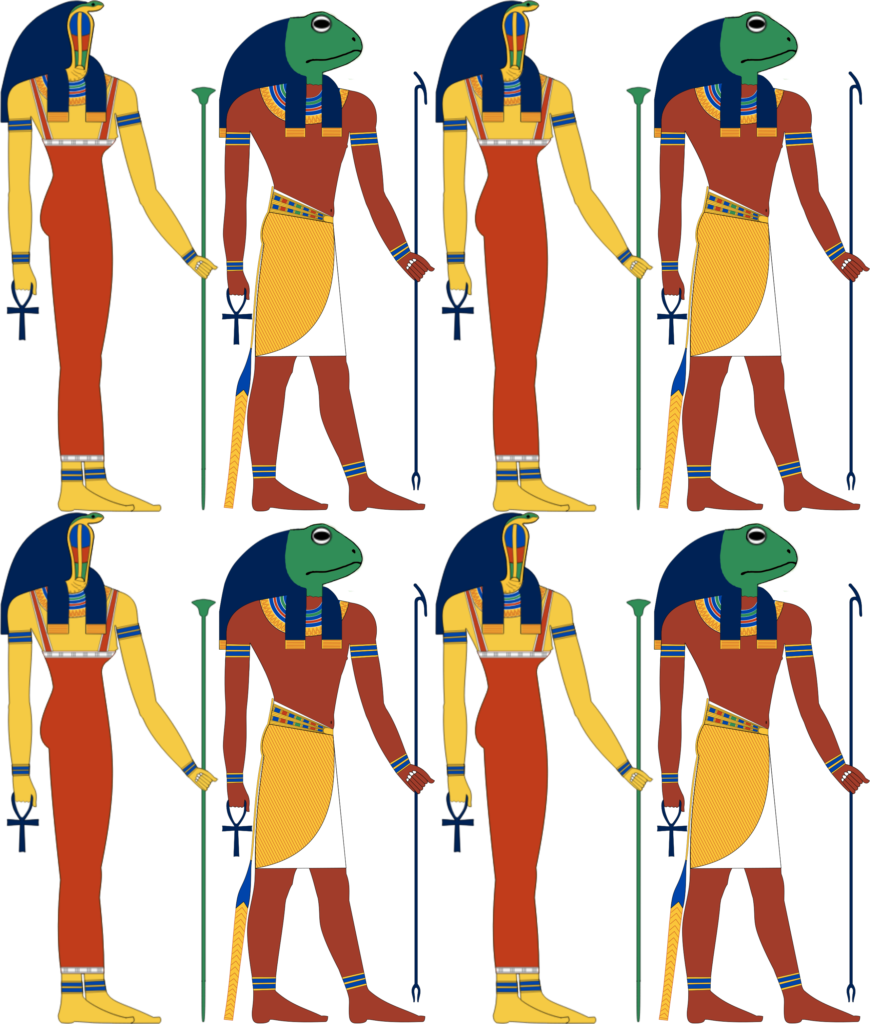
The other end of the story belongs to Atum, and it has been badly mistranslated by more popular retellings than it deserves. In the Book of the Dead’s 175th chapter, Atum tells the dead man plainly that a day is coming when he will dispatch the gods, dissolve everything he built, and let the earth sink back into Nun, the formless flood that preceded it — the same undoing, run in reverse, as the birth every text in this article has already described. Popular accounts often report what happens next as Atum and Osiris both turning into serpents together. In T. G. Allen’s scholarly translation of the passage, as in Faulkner’s, the text says something more precise, and more interesting: Atum alone will survive, remaining together with Osiris, having “assumed [his] forms of other snakes which men know not and Gods see not.” The serpent that founded the world at Hermopolis and the serpent that will outlast its ending at the close of the Book of the Dead are not two separate images pressed into service by coincidence. They are the same shape, holding open both ends of a timeline everything else in Egyptian religion works to fill.
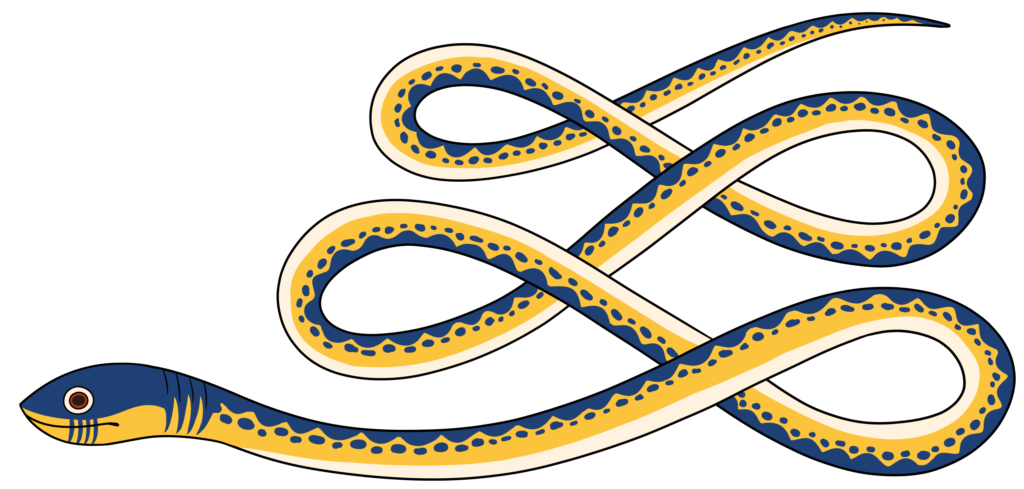
Between those two points, one further Egyptian object insists that time itself has a serpent’s shape. From the Old Kingdom onward, Egyptians played a spiral board game called mehen, its squares laid along the coiled back of a carved stone serpent, counters advancing from tail to head. By the Middle Kingdom, that same geometry had migrated into funerary literature as the “Roads of Mehen,” concentric fire-lit paths the dead traveled to reach the enthroned sun at their center — no longer a game, but an ordeal, the deceased “coming forth from the fiery breath” of the serpent whose body he had just crossed. In the Amduat’s twelfth and final hour, Re himself makes the same passage at full cosmic scale, entering a great serpent’s tail as flesh and emerging from its mouth transformed into Khepri, the scarab of the newborn morning. The Book of Gates, painted in royal tombs from Horemheb onward, says so outright. In its fourth hour, as Erik Hornung reads the scene, a many-coiled serpent represents time itself, accompanied by twelve goddesses who embody the hours of the night; in its fifth, a line of gods carries the body of a serpent that stands, once again, for time. Read against that gloss, the game board, the funerary road, and the sun’s own nightly commute are one mechanism described three times: to pass through the serpent’s coiled length is how Egyptian time renews itself, hour by hour, life by life, and world by world.
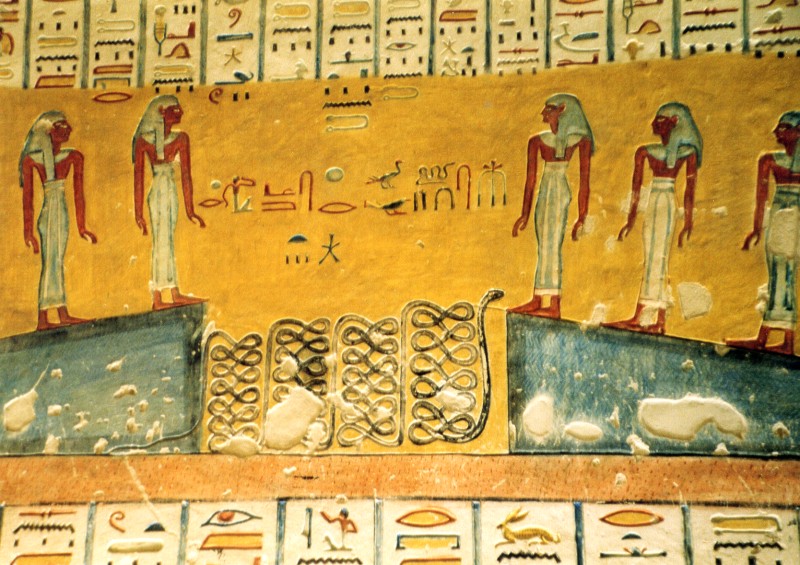
Coda: The Serpent That Eats Itself
By the time Alexandria existed to name him, the Greeks who lived there had a word for a serpent who guarded, without malice, the households and fortunes of anyone who left out food and did not look at him directly: Agathodaimon, the Good Spirit. In time, he acquired an Egyptian name as well. Writing around 100 CE, under Roman rule but claiming to translate a far older Phoenician author named Sanchuniathon, the mythographer Philo of Byblos — preserved for us only in a Christian bishop’s later quotation, and reported here through Sethe’s account of the passage — explained that snakes were drawn into sanctuary and mystery precisely because a serpent is the most spirit-like of creeping things, moving on breath alone without feet or hands, the longest-lived of animals because it sheds its age and grows young again, and, when its allotted time is finally complete, consumes itself. The Phoenicians called this serpent Agathos Daimon, Philo says. The Egyptians called him Kneph. And Kneph, a later source adds without hedging, is simply Amun — which is to say, once the vowels are stripped away and the Greek letters set aside, the name hiding inside “Kneph” is Kematef’s own.
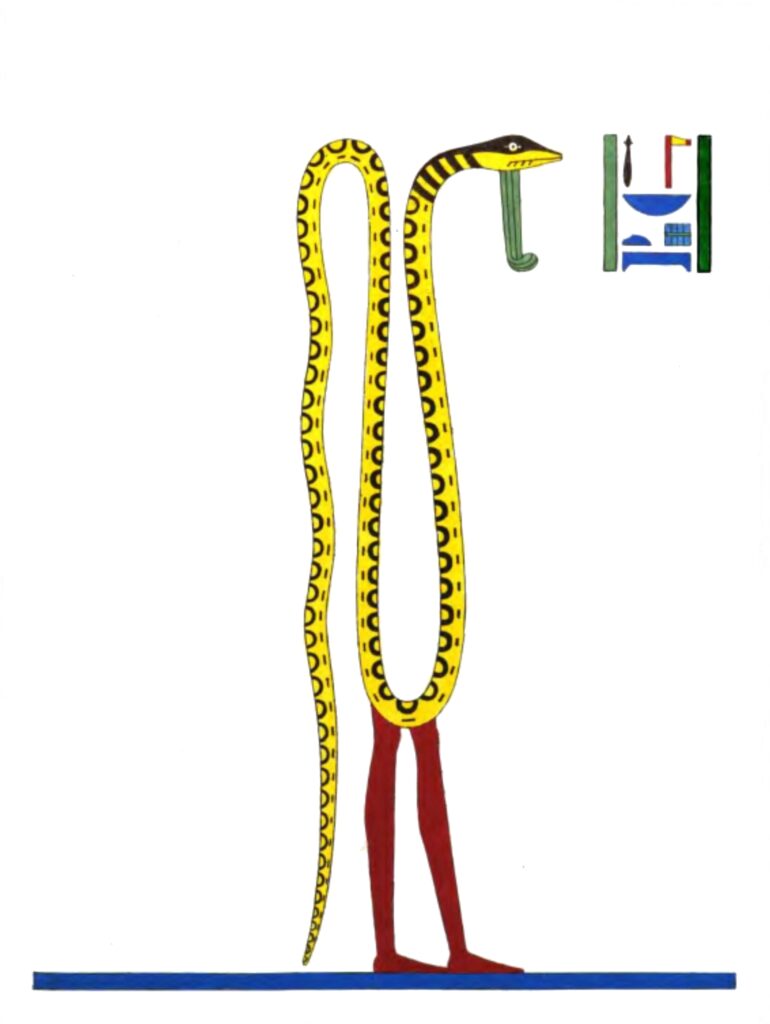
Egyptian magical papyri copied out under Roman rule keep the identification alive at street level, in instructions rather than theology: one spell, cast in Greek but drawing its imagery from an older Egyptian workshop, tells the practitioner to model a tailless serpent’s body in wax, three heads rising from it — human, goose, and gazelle, each crowned with a solar disc — and labels the finished figure, in Roy Kotansky’s translation for the standard edition of these papyri, simply “Kneph.” A glossary compiled for readers of these same papyri makes the equation formal: Kneph, it says, using the Egyptological transliteration of Kematef’s own name, functioning here as the Agathos Daimon. The self-consuming serpent of Philo’s philosophical aside and the coiled god sleeping at Medinet Habu are, by the time Rome governs Egypt, openly treated as one figure wearing two languages.
It would be satisfying to report that this same Kematef, tail in mouth, is where the ouroboros itself began — the claim shows up in more than one recent account of the Alexandrian Agathodaimon cult. But what the Egyptian and Greek sources actually describe is a serpent who consumes himself when his time is complete: not quite the same image as a closed circle, head meeting tail, and not enough on its own to make Kematef the ouroboros’s point of origin. What they do support is the equation itself — Kematef is Kneph is Agathodaimon — and a serpent-shaped ouroboros that was doing real theological work in Egypt for roughly a thousand years before any Ptolemy set foot in Alexandria, coiled defensively around New Kingdom kings in their tombs, drawn punitively around a defeated Apophis in temple ritual, and carried forward, self-devouring and self-renewing, into exactly the Gnostic and Hermetic circles this site has already followed into Roman Egypt.

A Note on Sources and Scholarly Uncertainty
The reading of Seth, Heka, Mehen, and Nehebkau as parallel “specifications” of a single violent-protective solar force is this article’s own synthesis, not a claim made outright by any one source consulted. Each individual pairing rests on a named scholarly argument — te Velde (1967) for Seth, te Velde (1970) for Heka, Piccione (1990) for Mehen’s dual containment, Goebs (2008) and Shorter (1935) for Nehebkau’s oscillation between enemy and functionary — but the decision to read the four together as one recurring theological pattern is an inference drawn across sources that do not make that connection themselves.
The claim, increasingly repeated online, that Book of the Dead 175 has Atum and Osiris both transform into serpents at the end of time is not supported by the translations consulted for this article (T. G. Allen 1974; R. O. Faulkner). Both have Atum alone announce his own transformation, while Osiris “survives together with” him. This article follows that reading; a final check against a complete print edition should still be made before this passage is cited elsewhere.
The claim that Kematef’s self-swallowing form is specifically the historical origin of the ouroboros symbol appears in recent secondary literature on the Alexandrian Agathodaimon cult (Delia 2023, via Feliciano 2016), sourced there to a chapter this article was not able to consult directly. It is presented here as circulating but unverified, not as established fact.
Herman te Velde’s 1967 argument against reading Seth’s ambivalence as the survival of an older, purely benevolent god stands, methodologically, in direct tension with Alan Shorter’s 1935 explanation of Nehebkau’s own ambivalence — which relies on exactly the kind of evolutionary, sinister-to-benevolent development that te Velde rejects for Seth. Both readings are reported here; the tension between them is not resolved.
Philo of Byblos wrote around 100 CE; his claim to be translating the far older Phoenician author Sanchuniathon has long been debated, and this article takes no position on it. The date of the Bremner-Rhind papyrus (306–305 BCE, year 12 of Alexander IV) follows Peck (2000).
Hornung’s The Ancient Egyptian Books of the Afterlife (1999) was consulted only through a partial set of supplied page images, not the complete volume; those images include the full chapter on the Book of Gates (pp. 54–77), on which the passages on Mehen and on the serpent of time rely. Several secondary works identified as relevant during research — Mysliwiec’s two-volume Studien zum Gott Atum, Russmann’s chapter on vulture and cobra iconography, Quaegebeur’s monograph on the god Shai — could not be obtained through any available channel and are absent from the bibliography below. None were judged essential to the article’s argument.
The Pyramid Text selection quoted from Simpson’s anthology (the uraeus which proceeded from Seth / the Eye of Horus spat out) is attributed there to Simpson’s edition as a whole; this article was not able to confirm which contributing translator rendered that specific passage, and cites it accordingly.
Bibliography
Primary Sources
Allen, T. G., trans. The Book of the Dead or Going Forth by Day. Studies in Ancient Oriental Civilization 37. Chicago: University of Chicago Press, 1974. https://isac.uchicago.edu/research/publications/saoc/saoc-37-book-dead-or-going-forth-day-ideas-ancient-egyptians-concerning.
Betz, H. D., ed. The Greek Magical Papyri in Translation. Chicago: University of Chicago Press, 1996.
Faulkner, R. O. “The Bremner-Rhind Papyrus.” Journal of Egyptian Archaeology 22–24 (1936–38).
Faulkner, R. O., trans. The Ancient Egyptian Coffin Texts. 3 vols. Warminster: Aris & Phillips, 1973–78. Vol. 1: https://archive.org/details/ancientegyptianc0000unse_i6e5; vol. 3: https://archive.org/details/ancientegyptianc0000unse_v5g3.
Faulkner, R. O., trans. The Ancient Egyptian Pyramid Texts. Oxford: Oxford University Press, 1969. https://archive.org/details/ancientegyptianp0000rofa.
Faulkner, R. O., trans. The Egyptian Book of the Dead: The Book of Going Forth by Day. Rev. ed. San Francisco: Chronicle Books, 1994. https://archive.org/details/egyptianbookofde0000unse.
Simpson, W. K., ed. The Literature of Ancient Egypt. 3rd ed. New Haven: Yale University Press, 2003.
Secondary Sources
Allen, J. P. Genesis in Egypt: The Philosophy of Ancient Egyptian Creation Accounts. New Haven: Yale Egyptological Seminar, 1988.
Darnell, J. C. “The Apotropaic Goddess in the Eye.” Studien zur Altägyptischen Kultur 24 (1997): 35–48.
Delia, G. “How Did a Foreign Bearded Snake Become the Protector of Alexandria and the Ptolemaic Dynasty? Reflections on the Cult of the Agathodaimon, the Cornerstone of the Greek-Egyptian Syncretism.” In The Archaeology of Ritual: Rethinking Ritual Practices in Sanctuaries and Necropoleis of the Ancient Mediterranean World; Proceedings of the International Workshop, 7th–8th February 2020, edited by E. Lundius and F. V. Timpano, 219–41. Berlin: Humboldt-Universität zu Berlin, 2023. https://doi.org/10.18452/28021.
Evans, L. “The Goddess Renenutet: Why Did a Cobra Symbolise Abundance?” Göttinger Miszellen 238 (2013): 41–50.
Goebs, K. Crowns in Egyptian Funerary Literature: Royalty, Rebirth, and Destruction. Oxford: Griffith Institute, 2008.
Guilhou, N. “Myth of the Heavenly Cow.” UCLA Encyclopedia of Egyptology, 2010. https://escholarship.org/uc/item/2vh551hn.
Hornung, E. Der ägyptische Mythos von der Himmelskuh: Eine Ätiologie des Unvollkommenen. 3rd ed. Orbis Biblicus et Orientalis 46. Freiburg: Universitätsverlag; Göttingen: Vandenhoeck & Ruprecht, 1997. https://doi.org/10.5167/uzh-138421.
Hornung, E. The Ancient Egyptian Books of the Afterlife. Translated by D. Lorton. Ithaca: Cornell University Press, 1999. https://archive.org/details/ancientegyptianb00horn.
Johnson, S. B. The Cobra Goddess of Ancient Egypt: Predynastic, Early Dynastic, and Old Kingdom Periods. London: Kegan Paul International, 1990.
Peck, W. H. “The Papyrus of Nes-min: An Egyptian Book of the Dead.” Bulletin of the Detroit Institute of Arts 74, no. 1/2 (2000): 20–31. https://www.williamhpeck.org/papyrus_of_nes_min.
Piccione, P. A. “Mehen, Mysteries, and Resurrection from the Coiled Serpent.” Journal of the American Research Center in Egypt 27 (1990): 43–52. https://www.researchgate.net/publication/254148532_Mehen_Mysteries_and_Resurrection_from_the_Coiled_Serpent.
Sethe, K. Amun und die acht Urgötter von Hermopolis. Abhandlungen der Preussischen Akademie der Wissenschaften, 1929/4. Berlin, 1929. https://archive.org/details/Sethe1929.
Shorter, A. W. “The God Nehebkau.” Journal of Egyptian Archaeology 21 (1935): 41–48. https://archive.org/details/in.ernet.dli.2015.70995.
te Velde, H. Seth, God of Confusion: A Study of His Role in Egyptian Mythology and Religion. Leiden: Brill, 1967. https://archive.org/details/sethgodofconfusi0000unse.
te Velde, H. “The God Heka in Egyptian Theology.” Jaarbericht Ex Oriente Lux 21 (1970): 175–86. https://www.jacobusvandijk.nl/docs/Heka.pdf.
te Velde, H. “The Swallow as Herald of the Dawn in Ancient Egypt.” In Ex orbe religionum: Studia Geo Widengren oblata, 26–31. Supplement to Numen 21. Leiden: Brill, 1972. https://www.jacobusvandijk.nl/docs/Swallow.pdf.