Somewhere in Rome, in a temple Pliny the Elder does not name, the skin and jaws of a serpent a hundred and twenty feet long were kept for generations. Pliny mentions them almost in passing, in his book on land animals: the creature had been taken during the Punic Wars, beside the river Bagradas in Africa, by the Roman commander Atilius Regulus, “with ballistae and siege engines, as if it were some town,” and its remains survived in Rome until the war against Numantia. I keep returning to that phrase, ut oppidum aliquod: as if it were a town. Pliny means the scale of the effort, the artillery a siege would call for, and I do not want to make him say more. But the comparison stays with me, because the stories this article follows keep treating the serpent less as an animal than as a place: something to be taken, held, and paid for.
Pliny’s phrase is a starting point, not a proof. Greek and Latin use drakōn and draco for ordinary snakes as well, and plenty of serpents in Greek myth die without anyone paying for it. But in a striking number of texts the serpent is bound to a place, a spring, a cave, a grove, a river, a citadel, the ground beneath a house, and holds something of that place’s power. Around such serpents, storytellers, priests and householders return to a small set of gestures. Some kill the serpent to take the place, and then pay for the killing as for a homicide. Some keep it fed, so that the place stays held. Some claim descent from a serpent, and carry a sacred power in their own line. Some carry the serpent itself, and with it a god, from one place to another. This is a recurring pattern, not a law. Where it holds, the serpent’s power does not vanish with the serpent; it changes hands. The sections that follow take these gestures one at a time, Greek and Roman material side by side, and ask how far the two traditions shared them.
The Price of the Spring
The oldest account of what happened at Delphi does not name the serpent. In the Homeric Hymn to Pythian Apollo, the god arrives at the foot of Parnassus, lays the foundations of his temple, and then the poem turns aside: “near by was a sweet flowing spring, and there with his strong bow the lord, the son of Zeus, killed the bloated, great she-dragon, a fierce monster wont to do great mischief to men upon earth.” She is a drakaina, a female, and she has no name. What she has is a foster-son. Hera, furious that Zeus had produced Athena from his own head without her, struck the earth with her hand and bore a child of her own, “neither like the gods nor mortal men, fell, cruel Typhaon,” and gave him to the dragoness to rear. The poem says only that he “used to work great mischief among the famous tribes of men,” and that Apollo’s arrow found the dragoness by the spring, that she writhed and gasped and “left her life, breathing it forth in blood,” and that the god boasted over her: “Now rot here upon the soil that feeds man! […] Against cruel death neither Typhoeus shall avail you nor ill-famed Chimera, but here shall the Earth and shining Hyperion make you rot.”
And she did. “The holy strength of Helios made her rot away there; wherefore the place is now called Pytho, and men call the lord Apollo by another name, Pythian.” The etymology is folk etymology, connecting the place-name to a Greek verb for rotting, and nobody needs to believe it. What matters is what it does. The god kills the creature of the spring, and the place takes its name from her corpse. The god himself takes an epithet from it. Apollo becomes Pythian by killing the thing that rotted there, and he wears its name for the rest of antiquity. A handbook of the Roman imperial period, the Library once attributed to Apollodorus of Athens, says it more flatly, and by now the serpent is male and has a name: the snake Python “guarded the oracle,” tried to stop Apollo from approaching the chasm, and so “he killed it and took over the oracle.” Guarded, then took over. The verbs carry the whole transaction.
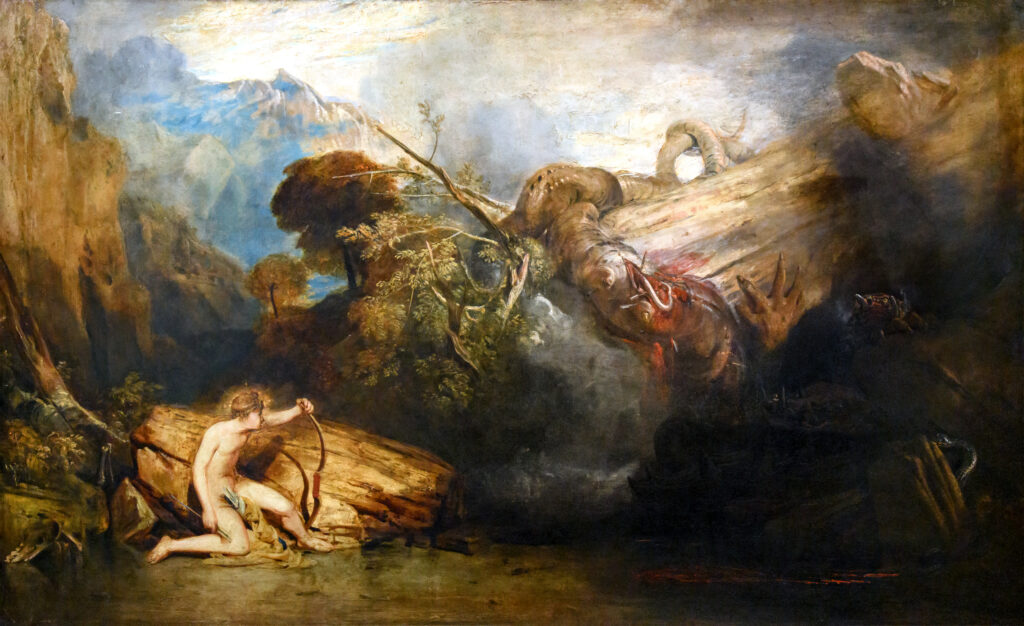
But Delphi did not remember the killing as a clean victory. Every eighth year, according to Plutarch, the sanctuary staged a strange rite. A structure was built near the threshing-floor. A boy whose parents were both living was led to it in silence by torchlight, along a path called “Dolon’s Way”; the structure was set on fire, the table inside overturned, and the participants fled through the doors of the temple without looking back. Then came “the wanderings and servitude of the boy and the purifications that take place at Tempê,” far to the north in Thessaly. Plutarch, who held office at Delphi himself, names the festival in another work: the Septerion, held every ninth year by the Greek inclusive count, every eighth by ours, which “represents by imitation the fight which Apollo had with Python, and both his flight and pursuit after the fight unto Tempe.” He knows two versions of the journey. In one, Apollo pursued the wounded serpent and found it already dead. In the other, “he fled, as needing purification by reason of the slaughter.” The second is the one Delphi told: a god polluted by a killing, going into exile to be cleansed. How far back the rite and the story were bound together, we cannot tell. Our witness is a Delphic official writing under the Roman Empire.
The Delphic version was contested even in Plutarch’s circle. One of the speakers in his dialogue On the Obsolescence of Oracles, a widely travelled Spartan named Cleombrotus, cannot stand it. He calls it the greatest error of “the theologians of Delphi.” “It is utterly ridiculous,” he says, “that Apollo, after slaying a brute creature, should flee to the ends of Greece in quest of purification and, after arriving there, should offer some libations and perform those ceremonies which men perform in the effort to placate and mollify the wrath of spirits whom men call the ‘unforgetting avengers.'” The objection is philosophically reasonable. Killing an animal does not pollute; killing a person does. But the objection is also the best evidence we have that the people who ran the sanctuary saw it otherwise. For them, the death of the serpent was a homicide. It had loosed avengers, and a god had to go into exile and be purified like any man with blood on his hands. The spring had been taken by force, and force had a price.
The killing left another trace, this one audible. The Pythian games, held at Delphi in Apollo’s honour, featured a solo composition for the aulos, the Greek reed-pipe, that told the story of the fight in movements. One of them, according to the ancient sources gathered by the historian of Greek music Sylvain Perrot, imitated the hissing of the dying serpent. The fight was told in words as well: Cleombrotus complains that the theologians of Delphi “permit poets and prose-writers to tell of this in their competitions in the theatres.” At each festival, Greeks from every city sat and listened to a musician reproduce the last breaths of the creature whose death had made the sanctuary.
It would be easy to conclude that the dragon-slaying is the founding myth of Delphi. It is not the only one. When Aeschylus opens his Eumenides in the same sanctuary, his priestess recites the succession of the oracle’s holders: first Earth, then her daughter Themis, then another of Earth’s daughters, Phoebe, who took the seat “with Themis’ consent and not by force” and “gave it as a birthday gift to Phoebus.” There is no serpent and no killing. An Athenian tragedian could tell the story of Delphi as an inheritance passed gently from a mother to her daughters and on to a grandchild of the family. A generation later, Euripides told it the other way. In his Iphigenia among the Taurians, the chorus sings of “the dark-faced serpent with brightly colored back,” “huge monster of the earth,” that “guarded Earth’s prophetic shrine,” and of Phoebus who “killed him” “while still a baby, still leaping in the arms of your dear mother,” and took his seat on the golden tripod. The taking had its price. Because Phoebus “sent Themis, the child of Earth, away from the holy oracle,” Earth “gave birth to dream visions of the night” that told men the present and the future, and so “took the office of prophecy away from Phoebus, in envy, because of her daughter”; only Zeus, coaxed by the child god, silenced the night voices and gave the privilege back. Athenian tragedy could tell it either way, and in Euripides the debt is owed to Earth for her oracle rather than for her serpent. That the version with the dead serpent survived, in the rite, in the music, in the god’s name, tells us how firmly it was attached to the place.
At Thebes, in Boeotia, the same structure appears with a different hero. Cadmus, a Phoenician prince searching for his abducted sister Europa, is told by the oracle at Delphi to follow a cow and found a city where she lies down. She lies down at the site of Thebes. Cadmus sends his companions to fetch water for a sacrifice from the spring of Ares, and the spring is guarded by a dragon, “which some said was the offspring of Ares,” which kills most of them. Cadmus kills the dragon. On Athena’s advice he sows its teeth in the ground, and armed men spring up, the Spartoi, “the Sown Men,” who slaughter one another until five are left. Through them, the Thebans could count the dragon among their ancestors. A foreign founder has taken the city’s soil, and the soil has produced its first citizens out of the dead guardian’s teeth.
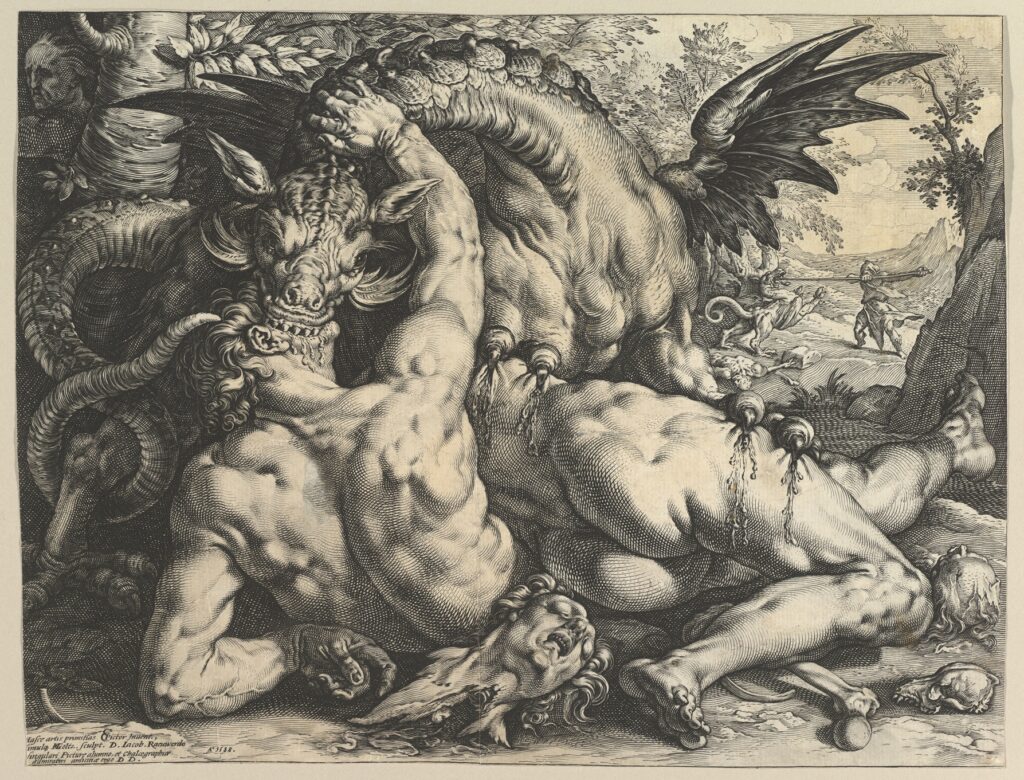
Then Cadmus pays. “To atone for the slaughter,” the Library says, he “served Ares for an eternal year; and the year was then equivalent to eight years of our reckoning.” Eight years of servitude for the killing of a serpent, the same cycle on which Delphi staged Apollo’s purification. It is also the price of homicide. When Apollo killed the Cyclopes, Zeus sent him “to serve as a thrall to a man for a year,” and he kept the cattle of Admetus; later writers stretched the term to nine years, and Frazer took both “years” to be the old great year of eight. The serpent’s death was paid for as a man’s would have been. Only after that does Athena procure the kingship for him, and Zeus gives him as his bride Harmonia, daughter of Aphrodite and Ares. The god whose dragon Cadmus killed becomes his father-in-law. The power of the spring has passed to the killer, but only once the killer has bound himself to the dragon’s own lineage: first as its father’s slave, then as its father’s son-in-law.
And at the end of his life, the story finishes the transfer. Cadmus and Harmonia leave Thebes, wander among the Illyrians, and Cadmus “was, along with Harmonia, turned into a serpent and sent away by Zeus to the Elysian Fields.” Ovid, telling the same ending in the fourth book of his Metamorphoses, puts the connection into Cadmus’s own mouth. Old, worn down by the disasters of his house, he wonders aloud whether the serpent his spear pierced long ago was sacred: “if the gods’ care avenges it with so unerring an anger, I pray that I myself may be stretched out into a serpent’s long body.” The prayer is granted as he speaks. Harmonia asks the gods to turn her into the same snake, and the two glide off into a wood, gentle dracones that “neither flee from men nor harm them with a wound,” remembering what they once were. The vase-painters, as the French scholar Laurent Gourmelen has shown, drew the conclusion visually. On three vases the dragon Cadmus kills is painted as a bearded snake, the type the Greeks associated with the household serpent that guarded a home; and Cadmus transformed appears as the same kind of bearded snake, beside the personified figure of Thebes. Francis Vian, the great historian of the Theban legends, put it in a sentence Gourmelen quotes: Cadmus is, “in certain respects, merely the beneficent aspect of the dragon.” The founder who killed the guardian of the spring ends as the guardian of the city.
The Romans told a version of the same story, except that theirs was set in recent history and supplied with eyewitnesses. During the First Punic War, the consul Atilius Regulus invaded Africa and camped by the river Bagradas. The historian Tubero, as reported by Aulus Gellius, left it in writing that Regulus there fought “a great and fierce battle against a single serpent,” which had to be attacked “with ballistae and catapults” by the whole army before it died; its skin, a hundred and twenty feet long, was sent to Rome. Livy’s account survives only in a summary, which adds that the serpent was killed “with great loss of soldiers.”
Valerius Maximus, citing Livy, tells the rest. The serpent had kept the Roman army from using the river at all. It had seized many soldiers in its jaws and crushed others in its coils; javelins could not pierce it. When it finally fell under the ballista stones, “it seemed more terrible to all the cohorts and legions than Carthage itself.” And then the detail that matters: even dead, it went on fighting. Its blood soaked the waters of the river, the “pestilential breath” of its corpse polluted the surrounding country, and it “drove the Roman camp away from that place.” The Romans had won the battle and lost the ground. They killed the serpent of the Bagradas, and the dead serpent evicted them.
More than three centuries after the event, the Flavian epic poet Silius Italicus turned the episode into a full narrative in his Punica, and gave it a meaning the prose writers do not. His serpent is “a deadly monster, born of the wrath of Earth”; it lives on “the lethal bank” of the river, by a sunless, Stygian grove, in a vast cave under the earth. When it dies, the place mourns it: “a groan burst from the sad river and murmurs poured from the depths of its waters, and suddenly the grove and the cave and the banks, echoing with the woods, howled mournfully.” The soldier who tells the story looks back on what came after, the disasters that followed Regulus’s campaign, and draws the conclusion: “Alas, with what losses did we soon atone for that sad battle, what punishments, what wrath did we endure!” The soothsayers, he says, did not keep silent. They warned the Romans that they had laid violent hands on “the servant of the Naiad sisters, whom the Bagradas nourishes in its warm waters.” This is a poet’s construction, and Edward Bassett has shown how much of it Silius modelled on Hercules and his monsters. Valerius Maximus, Gellius and Livy’s epitomator make no such link. What Silius shows is that, for a Roman poet of the first century CE, the reading was ready to hand: a river’s serpent could be the servant of its nymphs, and killing it a sacrilege.
Delphi, Thebes, the Bagradas: three places, two languages, several centuries of texts. In each, the serpent is tied to water, to a spring or a river. In each, someone kills it to take the place. And in each, the killing has to be paid for: in exile and purification, in eight years of servitude, and, in a poet’s telling, in a lost campaign. I cannot say what the Romans who kept the skin in a temple meant by it. But they kept it, as Apollo kept the name Pythian.
What the Dead Serpent Leaves
Hesiod gives Typhoeus a hundred heads “of a snake, a fearful dragon” (his word is drakōn) growing from his shoulders, with dark flickering tongues and fire in their eyes, and a hundred voices in them: one the gods could understand, one like a bellowing bull, one like a lion, one like whelps, and one that simply hissed until the mountains echoed. Earth bore him last of all her children, after the Titans had been driven from heaven, and he very nearly won. Zeus burned all his heads with the thunderbolt and lashed him until he fell, “a maimed wreck, so that the huge earth groaned,” and a great part of the earth, scorched by the blast, “melted as tin melts when heated by men’s art in channelled crucibles.” Then Zeus threw him into Tartarus. That should be the end of it.
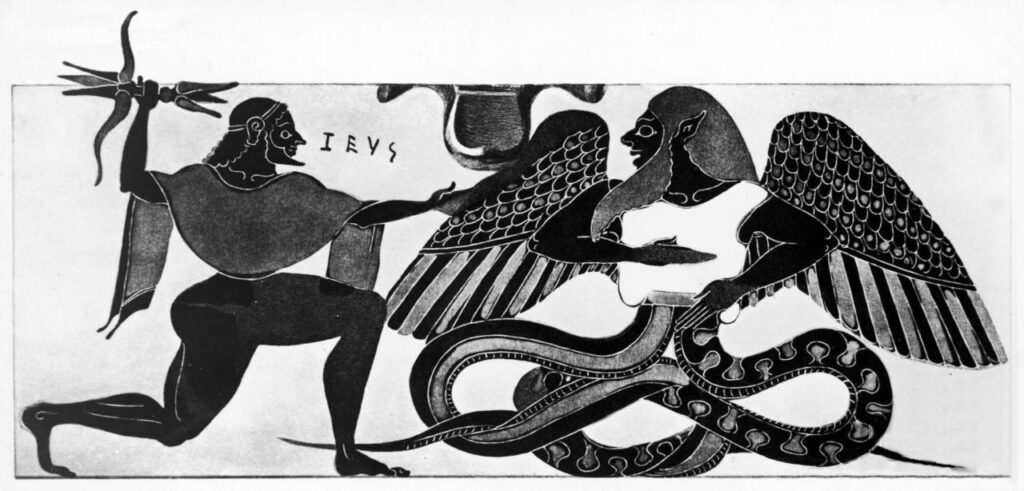
It is not. In the very next lines of the Theogony, Hesiod explains where the bad winds come from. “From Typhoeus come boisterous winds which blow damply,” not the regular, god-sent winds of the seasons, but the others, the ones that “rush upon the misty sea and work great havoc among men,” “scattering ships and destroying sailors,” or sweep over the land and “spoil the fair fields of men,” “filling them with dust and cruel uproar.” The defeated monster is still at work. He has simply changed medium.
The later tradition moved him under a mountain. In Pindar and in the Prometheus Bound attributed to Aeschylus, Typhon, struck by the thunderbolt, lies pinned beneath Etna, “crushed under the roots” of the mountain, as the tragedy puts it; the eruptions are his. The tragedy goes further. Its Typhon, “hissing fear from his horrible jaws,” is burnt to ashes by Zeus’s bolt, and still, from under the mountain, “one day will burst rivers of fire devouring with their rabid jaws the level fields of fruitful Sicily,” the anger he will boil up “though he is turned to ashes by Zeus’s thunder.” The Library of Apollodorus ends its long account of the battle the same way: as the monster fled through the Sicilian sea, “Zeus cast Mount Etna in Sicily upon him. That is a huge mountain, from which down to this day they say that blasts of fire issue from the thunderbolts that were thrown.” Down to this day. The French classicist Alain Ballabriga has argued that even the Iliad‘s single, cryptic mention of Typhoeus, in which Zeus lashes the earth around the place “where men say is the couch of Typhoeus,” describes not a past battle but an act endlessly repeated: Zeus has to keep striking, because the thing beneath the ground never stops being there.
Where Typhon came from is one of the open questions of Greek mythology, and it is open in a way that matters for a site like this one. The Hittite myth of the storm god and the serpent Illuyankas has been compared with Typhon ever since it was deciphered. The linguist Calvert Watkins pointed out that illuyankas is not a proper name at all, simply the Hittite word for “serpent,” as ahi is in Sanskrit and aži in Avestan, the word behind the Iranian Aži Dahāka. In one Hittite version, a mortal named Hupasiya binds the serpent with a cord before the storm god kills it. Watkins argued that this binding survived the crossing into Greek: it is why Pindar’s Typhon is “chained” beneath Etna, and why the old epic verb for what Zeus does to him, “to lash,” is built on himas, a strap, a word Watkins sets beside išḫimanta, the Hittite word for the cord. For Watkins, that is the trace of bilingual contact in Anatolia, in the second millennium BCE. Ballabriga, working on the same texts at almost the same moment, reached the opposite conclusion: Typhon is a Greek figure, shaped by Greek poets, who picked up Near Eastern colouring along the way without being borrowed from it. I cannot settle the disagreement. What both readings bring out is the shape of the thing: a monster defeated but not abolished, held down by force under a piece of the landscape that it continues to shake.
Typhon also had children. In the Theogony, he lies with Echidna, half nymph and half serpent, and she bears him, among others, the dog Cerberus and “the evil-minded Hydra of Lerna, whom the goddess, white-armed Hera nourished, being angry beyond measure with the mighty Heracles.” Before she is anything else, the Hydra is fed. She is raised by a goddess for one purpose, and her purpose has a name.
The Library gives the familiar version of the fight. The Hydra was “bred in the swamp of Lerna” and came out onto the plain to ravage the herds and the land; her den lay “on a hill beside the springs of the Amymone.” She had nine heads, “eight mortal, but the middle one immortal.” Every time Heracles smashed one with his club, two grew back, until his nephew Iolaus seared the stumps with burning brands. Then Heracles “chopped off the immortal head, and buried it, and put a heavy rock on it, beside the road that leads through Lerna to Elaeus.” He did not destroy it. He could not. He buried it at the side of a road, the way Zeus buried Typhon under a mountain, and anyone travelling between Lerna and Elaeus walked past it. Ballabriga notes in passing that the death of the Hydra, in the Theogony, stands in for the death of her father, as the death of the Delphic dragoness stands in for his in the Hymn to Apollo: each time, Zeus’s side prevails over Hera’s and over the powers of the earth.
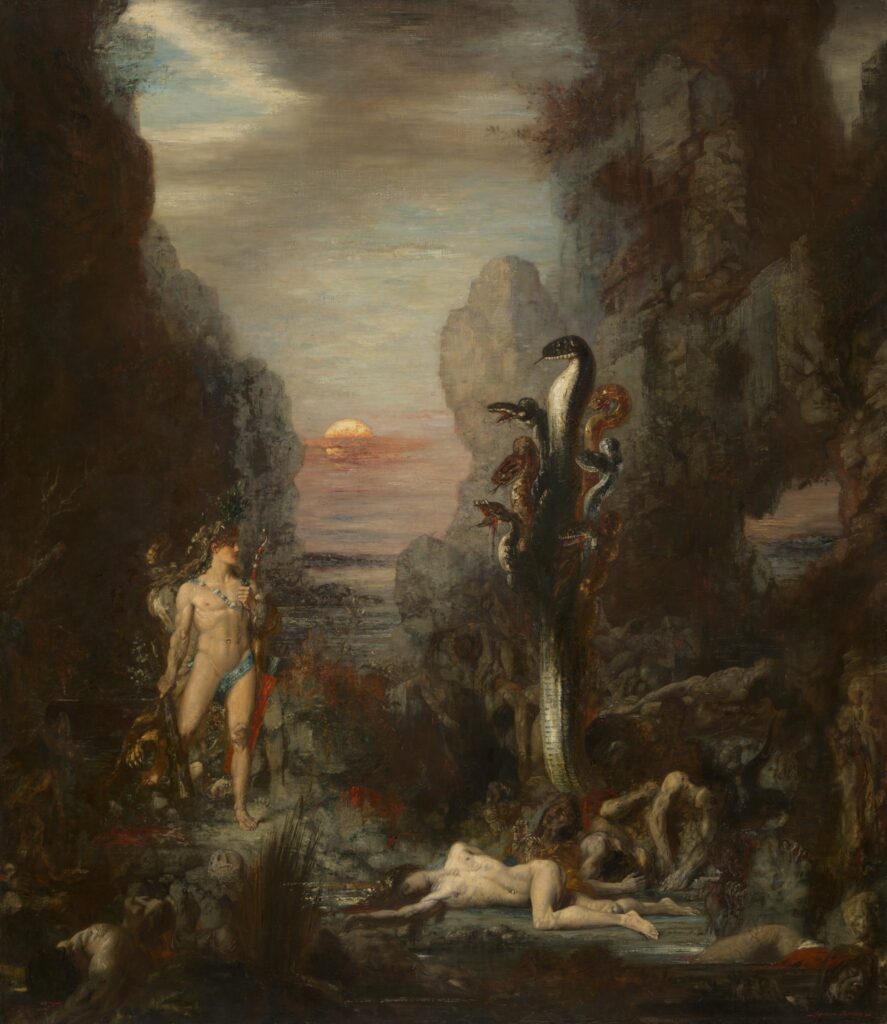
And then Heracles “slit up” the body “and dipped his arrows in the gall.” He took the creature’s power for himself, and for years it served him. It also killed him. When the centaur Nessus tried to violate his wife Deianira at a river crossing, Heracles shot him with one of those arrows. The dying centaur told Deianira to keep his blood, mixed with the seed he had spilled, as a love charm. Years later, afraid of losing her husband to a younger woman, she smeared it on a tunic and sent it to him. “No sooner was the tunic warmed than the poison of the hydra began to corrode his skin.” Heracles tore the garment off, and his flesh came with it; he made his way to Mount Oeta, built a pyre, climbed onto it and ordered it lit. The Hydra, dead and buried for years, killed the man who had killed her, through his own weapon, his enemy’s blood and his wife’s hands. Nobody in the story meant it to happen. The power simply went where it went.
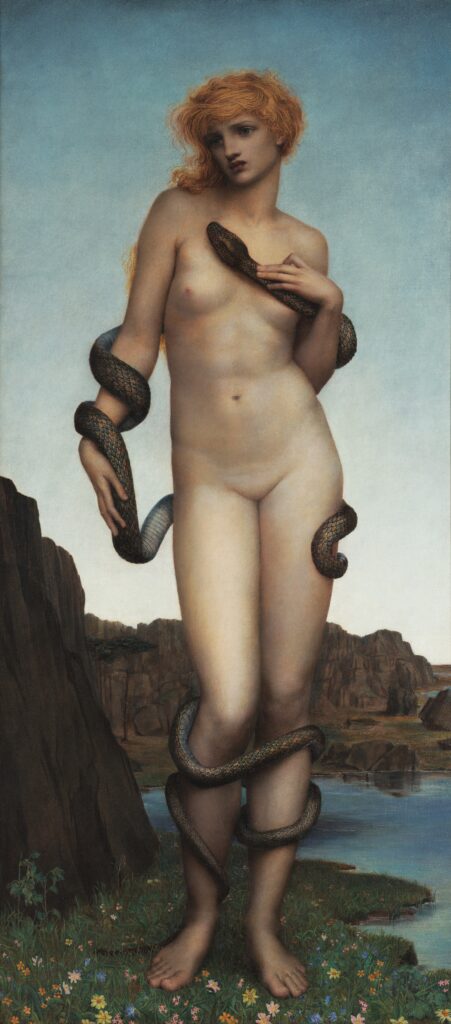
Medusa is a different case, because she is not a serpent, whatever popular culture has made of her. In Hesiod, the oldest text to name her, there are no snakes at all: she is one of three Gorgon sisters living at the edge of the world, the only mortal one; Poseidon lay with her “in a soft meadow amid spring flowers,” and when Perseus cut off her head, the winged horse Pegasus and the warrior Chrysaor sprang from her neck. In the Shield attributed to Hesiod, the Gorgons chasing Perseus have “two serpents” hanging “at their girdles,” worn like belts, with tongues flickering. The Library describes their heads as “twined about with the scales of dragons,” with “great tusks like swine’s, and brazen hands, and golden wings.” In the art of the archaic period, as Jean-Pierre Vernant described it, the Gorgon is above all a face seen head-on: a round, lion-like head, bulging eyes, a grimacing mouth with fangs or boar’s tusks, a lolling tongue, sometimes a beard, and hair “like an animal’s mane, or interwoven with snakes.” The snakes are one attribute among many. Medusa received no cult anywhere. She is a monster assembled from parts, and serpents are among them.
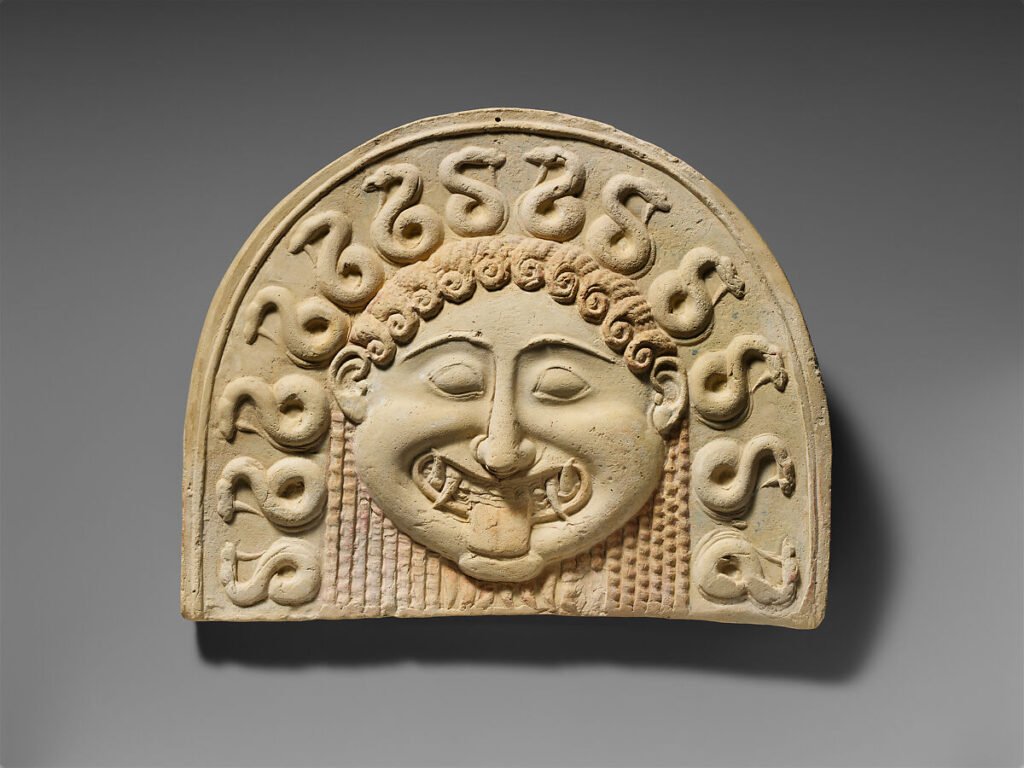
What she leaves when she dies is another matter, and here she behaves like the serpents of this article. Athena “inserted the Gorgon’s head in the middle of her shield” and wore it into battle from then on; some said, the Library adds, that Medusa had been killed for Athena’s sake in the first place, because she had tried to rival the goddess in beauty. The goddess carries the face of her rival as her weapon. Heracles, in another episode, receives from Athena “a lock of the Gorgon’s hair in a bronze jar” and gives it to the daughter of the king of Tegea: if an enemy army approaches, she is to hold it up three times from the walls, without looking before her, and the enemy will be turned to flight. A fragment of the dead monster defends a city. Even her blood is divided. Athena gave Asclepius “the blood that flowed from the veins of the Gorgon”: the blood from the left side he used “for the bane of mankind,” the blood from the right side “for salvation, and by that means he raised the dead.” And her death made music too. Pindar, in an ode for an aulos-player who had won at the Pythian games, tells how Athena invented the instrument, the same that at Delphi reproduced the last hissing of the Python, when she heard the dirge “pouring in slow anguish from beneath the horrible snakey hair” of the surviving Gorgons, and the shrill cry from the jaws of Euryale, as Perseus killed their sister.
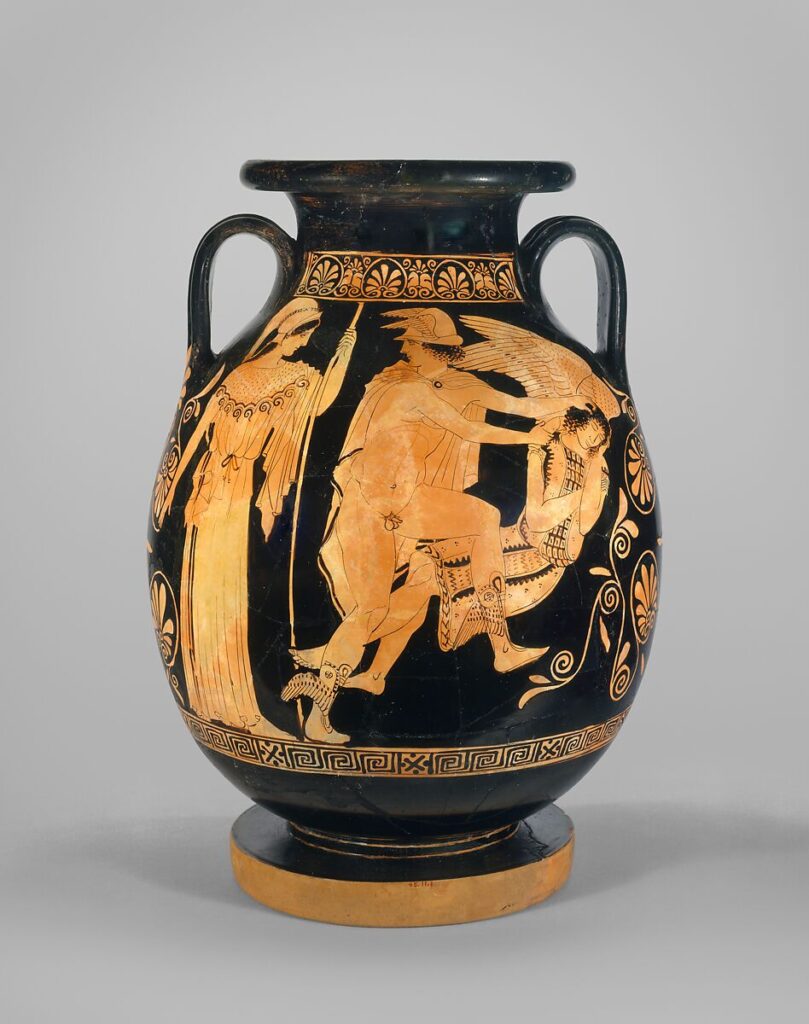
Two Roman poets took the inventory further. Ovid, telling Medusa’s story at the end of the fourth book of his Metamorphoses, makes her once a beautiful girl, famous above all for her hair, violated, it is said, by the ruler of the sea in Minerva’s temple; the goddess turned that hair into snakes, and still wears them on her own breast to terrify her enemies. The snakes become a punishment rather than a nature, and a punishment that ends up in the goddess’s own keeping. Ovid also has the drops of blood from the severed head fall on the Libyan sand as Perseus flies over it and come alive as snakes, “whence that land is thick with serpents and hostile.” And Lucan, in his epic on the civil war, marches the soldiers of Cato through the Libyan desert and stops to ask why Libya is so thick with deadly serpents. He does not pretend to know: “no care or labour of ours can learn” the cause, he says, “except that a story spread through the world has deceived the ages in place of the true one.” The story he then tells, developing the one Ovid had told in passing, is that Perseus flew over Libya with Medusa’s head, and her blood, dripping onto the sand, bred every venomous snake in the country. Then, in a single bitter line, he turns from myth to commerce: “we have made the asp an article of trade.” Even the poison of the dead Gorgon ended up with a price on it.
Typhon’s winds and Etna, the Hydra’s head under its rock and her gall on the arrows, Medusa’s face on the shield, her hair in a jar at Tegea, her blood in a healer’s phials and on Libyan sand: none of these monsters stays dead in the sense that matters. Each death is a distribution. What the monster held, the victors divide among themselves, and some of what they divide turns back against them.
Feeding the Guardian
In 480 BCE, with the Persian army approaching Athens, the Athenians had a serpent to consult. “The Athenians say,” Herodotus writes, “that a great snake lives in the sacred precinct guarding the acropolis,” and they put out a honey-cake for it every month “as if it really existed.” It had always been eaten. This time it lay untouched, and when the priestess made its meaning known, the Athenians, already evacuating their households, became “all the more eager to abandon the city since the goddess had deserted the acropolis.” Plutarch, retelling the episode centuries later in his Life of Themistocles, turns the omen into stagecraft. Themistocles, unable to move the people “by any human reasonings,” set up machinery “as a theatrical manager would for a tragedy,” and took the serpent’s disappearance as his sign from heaven; the priests, finding the offerings “left whole and untouched,” proclaimed that the goddess had abandoned her city and was showing the Athenians the way to the sea, “Themistocles putting the story into their mouths.” In Plutarch the offerings are daily rather than monthly; the hand on the omen is a politician’s. In both versions, the logic is the same. As long as the serpent eats, the place is held. When it refuses its food, the power has gone, and so must the people.
The serpent on the Acropolis was not a random animal. Athens told its own origins through serpentine figures. Its first king, Cecrops, was “a son of the soil, with a body compounded of man and serpent,” and it was Cecrops who stood witness when Athena and Poseidon disputed the land, and whose testimony made it hers. The historian Nicole Loraux suggested that he may have owed to that double body, half man and half snake, still tied to the monstrous creatures of the primordial Earth, the balance that let him respect the boundaries separating humans from gods and from beasts, and so bring civilization to Athens. A later king, Erichthonius, was born from the earth itself, after Hephaestus’s seed fell on the ground; Athena put the infant in a chest and entrusted it to Pandrosus, a daughter of Cecrops, forbidding her to open it. Her sisters opened it, and saw “a serpent coiled about the babe.” Some said the serpent killed them; others that they went mad and threw themselves from the Acropolis. A century ago, Frazer already suspected that the sacred serpent fed with honey-cakes every month “may have been Erichthonius himself in his original form of a worshipful serpent,” and historians of Greek religion have since read the story as that serpent’s founding myth. To feed it was to keep faith with the city’s own beginning.
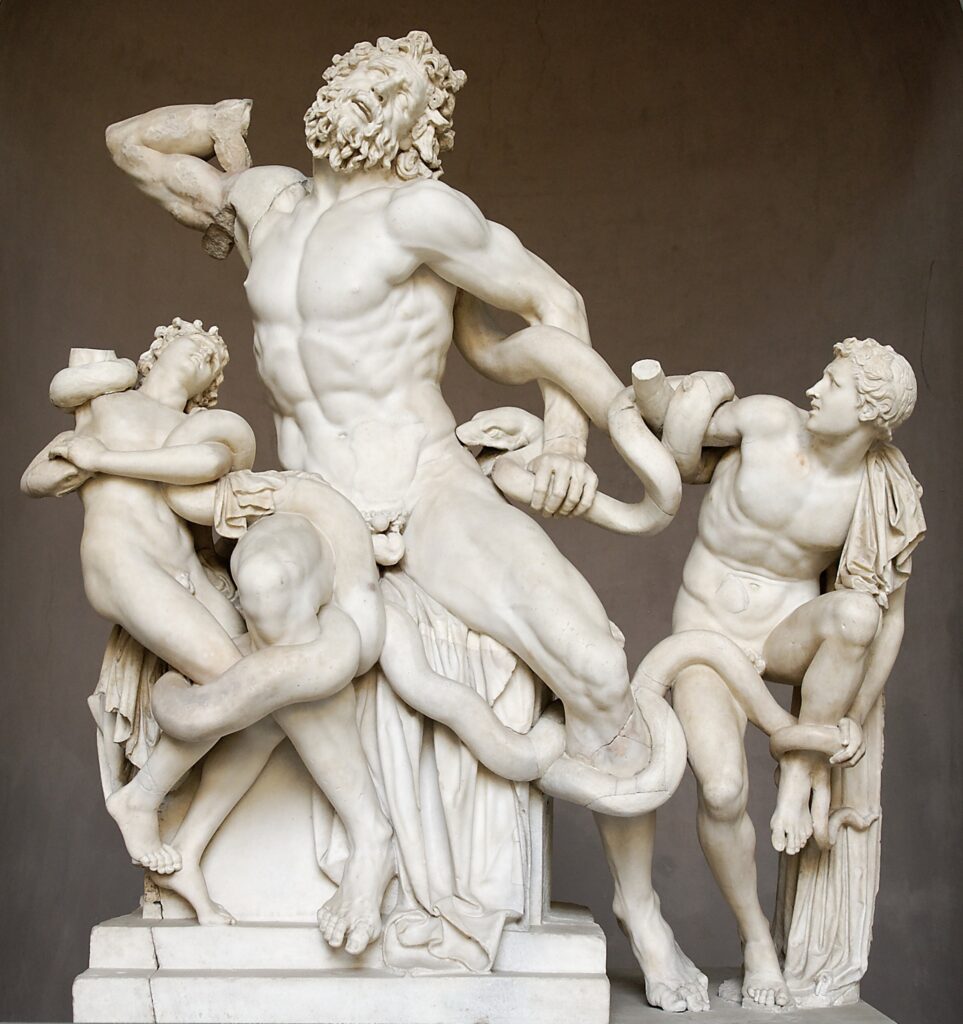
Greek epic remembered a second city that read its fall in serpents. In the summary that survives of the Sack of Ilium, a lost epic of the Trojan cycle, the Trojans have just dragged the wooden horse inside their walls and are feasting, “believing the war was at an end. But at this very time two serpents appeared and destroyed Laocoon and one of his two sons, a portent which so alarmed the followers of Aeneas that they withdrew to Ida.” Virgil, centuries later, made the scene famous, and moved it. In the second book of the Aeneid the horse is still outside the walls. Laocoon, the priest of Neptune who had driven his spear into its side, is sacrificing a bull when twin serpents come across the calm sea from Tenedos, crests blood-red above the waves; they wrap and devour his two small sons, then seize the father as he runs to help them; and then the serpents, angues while they crossed the sea and dracones now that they reach the citadel, as if the word grew with them, glide up to the temple and hide “beneath the feet of the goddess and the round of her shield.” The Trojans read the sign, and read it wrong: Laocoon, they say, has paid for wounding the sacred wood, and they drag the horse in. I read the two cities as mirror images. At Athens, the guardian serpent leaves the citadel before the enemy arrives, and the people leave after it. At Troy, foreign serpents arrive at the citadel and settle at the goddess’s feet; in the epic summary, those who can read the sign leave, and in Virgil, those who cannot breach their own walls to let the horse in. Either way, the serpent goes where the power of the place is about to be.
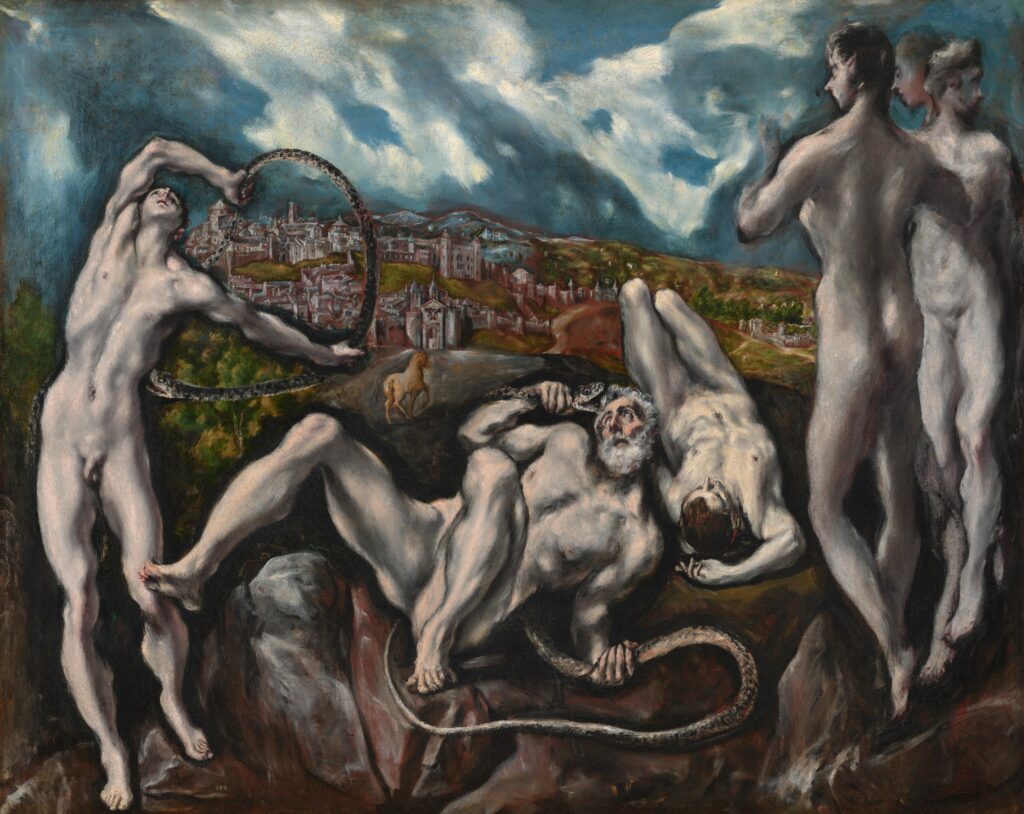
El Greco, Laocoön, ca. 1610/1614. Oil on canvas, 137.5 × 172.5 cm. National Gallery of Art, Washington, Samuel H. Kress Collection (1946.18.1). Public domain.
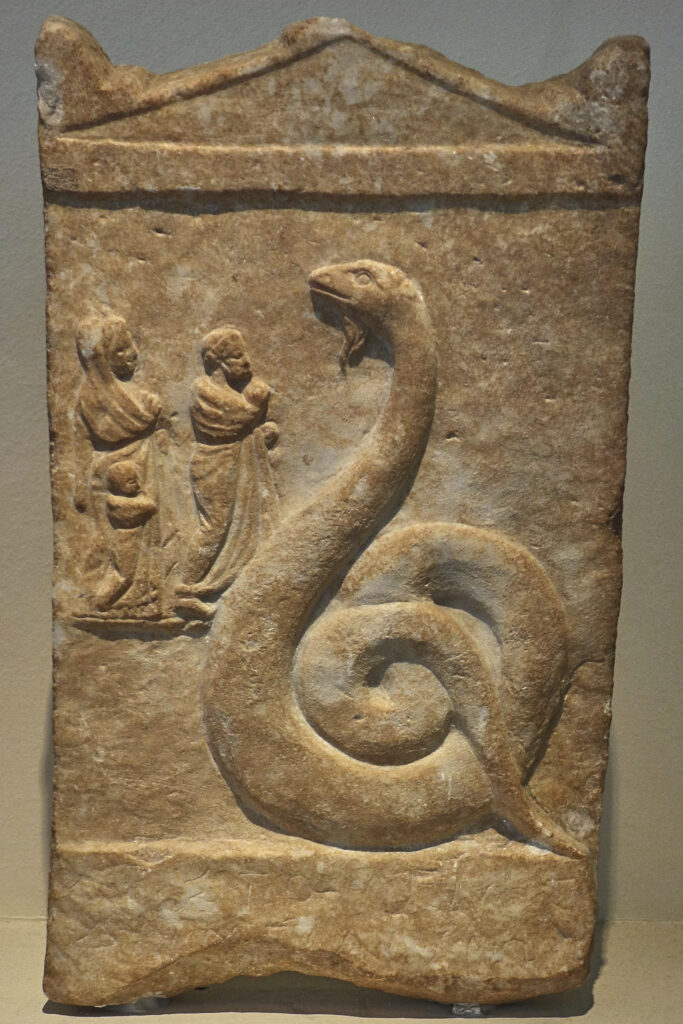
Feeding the serpent of a place is a recurring gesture of Greek religion, and some of its evidence is carved in stone. In 1878, at Munichia in the Piraeus, reliefs came to light showing worshippers approaching a large bearded serpent, labelled as Zeus Meilichios, Zeus “the gentle” or “the one who can be appeased.” Paul Foucart, publishing them in 1883, concluded that the serpent was “the god himself”; Laurent Gourmelen has since connected this bearded snake with the oikouros ophis, the household serpent that guarded a Greek home. Meilichios was a god of purification: it was at his altar, beside the river Cephisus, that Theseus was cleansed of the blood he had shed on the road to Athens. Caution is needed here, and the most careful study of the god supplies it. At Selinous in Sicily, where a long sacred law on lead regulates sacrifices to Meilichios and the purification of homicides, there is no serpent anywhere; the god there was represented by plain, aniconic stones. The serpent form of Meilichios is attested in Attica and in a handful of other places, not everywhere the god was honoured. But where it does appear, the law’s editors, Michael Jameson, David Jordan and Roy Kotansky, conclude that the serpent, whatever divine title it carried, protected the household.
Latium had its own fed serpent, at Lanuvium, south of Rome, in the sanctuary of Juno Sospita, “Juno the Saviour.” “Lanuvium,” Propertius writes, “has long been in the keeping of an ancient dragon”: tutela draconis, the serpent as the town’s guardian. Each year, when the fasting serpent demands its food and sends its hissing up from deep in the earth, girls are sent down a sacred passage into a dark chasm, pale with fear, the basket trembling in their hands as the snake snatches what they hold out. “If they have been chaste, they return to their parents’ arms, and the farmers cry, ‘It will be a fertile year.'” The Greek writer Aelian tells the same rite, with the girls going down blindfolded. Rianne Hermans, who has studied the cult in detail, considers the rite as described largely a literary topos; but the image of a girl feeding a serpent appears on Roman Republican coins of the first century BCE, well before Propertius wrote, and it is tied there to Juno Sospita. Whatever the girls actually did, Romans associated the goddess’s power over the land with a serpent that had to be fed.
The most famous fed serpent in Latin literature is in Virgil. In the fifth book of the Aeneid, a year after his father’s death, Aeneas brings offerings to Anchises’ tomb in Sicily, and a great serpent glides out from the depths of the shrine, in seven coils, gently embracing the mound, its back flecked with blue and its scales glinting gold; it moves among the bowls, tastes the offerings, and slips back into the tomb without harming anyone. Aeneas does not know what he has seen, and does the one thing that suits every answer: he renews the sacrifices with more zeal than before, uncertain whether it is “the genius of the place, or the attendant of his father,” geniumne loci famulumne parentis. One late antique reader knew what to make of the first possibility. The commentator Servius explains that Virgil “wants to prove by its size that it is the genius of the place; for no place is without a genius, which is most often shown in the form of a serpent,” and he immediately quotes the satirist Persius: “paint two snakes: ‘Boys, the place is sacred.'” In Persius the line goes on: “go and piss outside.” For the second possibility, the father’s attendant, Servius offers three explanations. Perhaps it was a favourite servant, put to death at the funeral, as was once the custom when kings were buried. Perhaps Anchises had become a god, and gods have lesser powers as their ministers. Or perhaps, following Pythagoras, the serpent had been born from the dead man himself, from the marrow of his spine: Ovid’s Pythagoras says that “there are those who believe that, when the spine has rotted in the closed tomb, human marrow is changed into a snake.” The serpent at the tomb could be the place, the dead man’s servant, or the dead man.
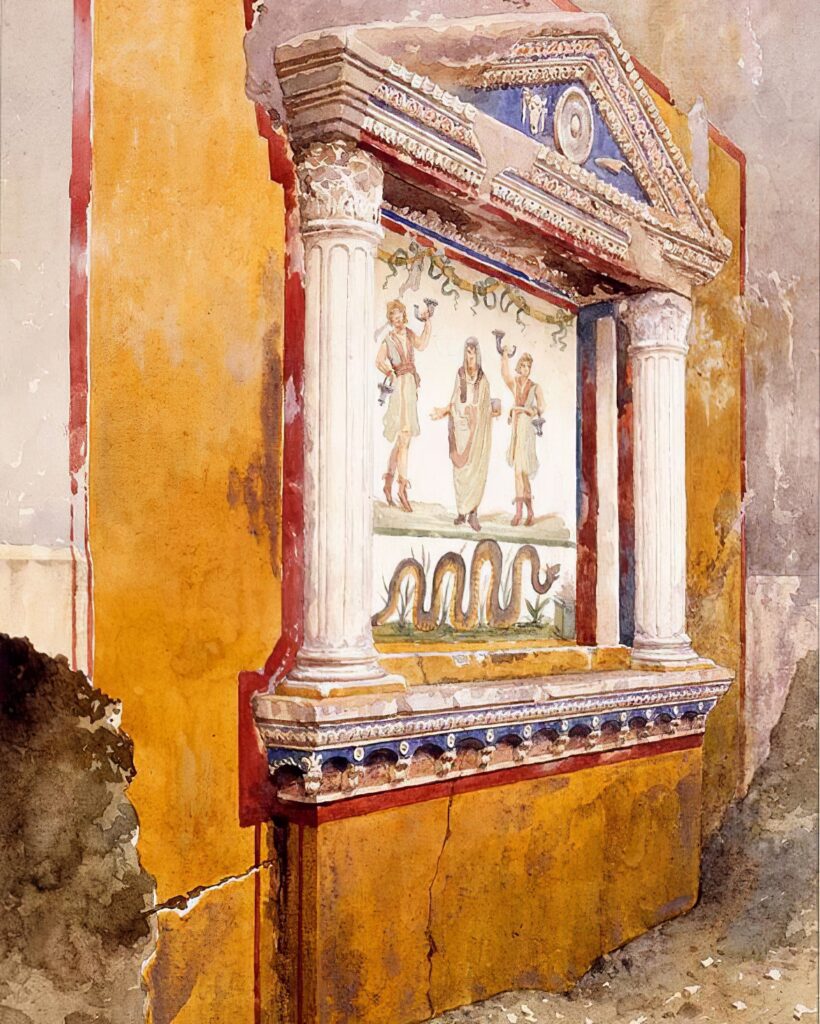
Persius’s two painted snakes were no metaphor. Across Pompeii, the household shrines called lararia show serpents painted below the dancing Lares, often approaching an altar on which lie eggs and pine cones. The historian Harriet Flower, as summarized by Emma-Jayne Graham, has argued that these serpents are not the Lares and not their attendants, but a separate pair of divinities: “gods of the natural environment that existed before, beneath, around, and in harmony with the communities built by men.” They received their own food. Graham has suggested, as a hypothesis rather than a finding, that the many repaintings of these shrines after the earthquake that struck Pompeii in 62 CE may have been an effort to placate the powers of the ground that had just moved.
A house’s serpents could also hold its owners’ lives. In Cicero’s dialogue On Divination, his brother Quintus tells, on the authority of Gaius Gracchus, that his father Tiberius Gracchus found two snakes in his house and consulted the haruspices. They told him that if he let the male go, his wife would soon die; if he let the female go, he would. He judged it fairer that he, the older, should die than his young wife, the daughter of Scipio Africanus. He released the female and died a few days later. Cicero, replying in his own voice in the second book, mocks the whole procedure: why snakes, and not lizards or mice? But Quintus tells the story without irony, and it assumes what every painted lararium assumes: the serpents of a house are bound to the house, and the house’s masters are bound to them.
By the first century CE, Romans were feeding serpents for a different reason as well. Pliny says that the serpent of Aesculapius, “brought to Rome from Epidaurus,” was “commonly fed even in private houses,” and that if fires did not destroy their eggs, nothing could stop them from overrunning the world. That serpent had been carried to Rome on a ship. Its story belongs to the last of the gestures this article follows, and before it, to the strangest.
Sons of the Serpent
Among the cures inscribed on the stelae of Asclepius’s sanctuary at Epidaurus is the case of Nicasiboula of Messene, who came to the sanctuary to ask for children. As she slept in the sacred dormitory, she dreamed that the god approached her with a serpent creeping behind him, and that she lay with the serpent. Within a year, she had two sons. Another woman, Agameda of Ceos, dreamed that a serpent lay on her belly; she went on to have five children. These are not myths. They are inscribed records, set up by the sanctuary for visitors to read, of what pilgrims believed had happened to them.
The same belief, scaled up, was claimed for some of the most powerful men of antiquity. The best known is Alexander the Great. Plutarch reports that a serpent was once seen lying stretched out beside Olympias as she slept, and that Philip’s ardour cooled after it, either because he feared her spells or because he believed her “the partner of a superior being.” Delphi told him he would lose the eye he had put to the chink in the door when he spied the god, “in the form of a serpent, sharing the couch of his wife.” Plutarch also records a less mystical explanation: Olympias, a devotee of Dionysian rites, used to bring “great tame serpents” to the revels. And he leaves the question open, as Olympias herself seems to have done: according to one account Olympias told Alexander the secret of his begetting; according to another, she protested that he “must cease slandering me to Hera.” Daniel Ogden, in a detailed study of what he calls “serpent-siring,” has pointed out that the earliest explicit attestations of Alexander’s serpent birth are, oddly, Latin, from the age of Octavian, but he argues that the story itself goes back to Alexander’s lifetime. One later Greek writer, Ptolemy Chennos, rationalized the father into an Arcadian man named Drakon.
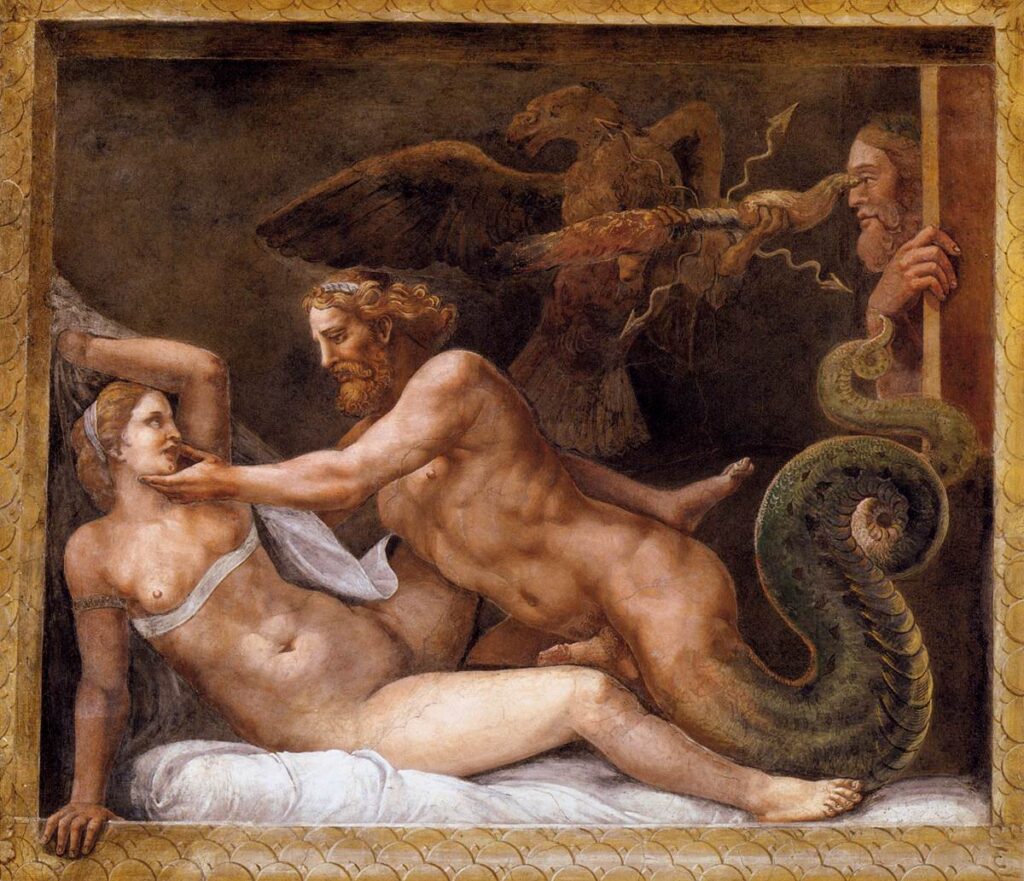
Attributed to Andrea Boscoli, Olympias, Mother of Alexander, Visited by Zeus in the Guise of a Serpent, 1595/99. Pen and brown ink, with brush and greyish-green wash, on laid paper. The Art Institute of Chicago, The Leonora Hall Gurley Memorial Collection (1922.619). Public domain (CC0).
The serpent father did not belong to Macedon alone. Pausanias, describing the hero of the Messenian resistance against Sparta, Aristomenes, reports that the Messenians, who still worshipped Aristomenes as a hero, asserted that “a spirit or a god united with his mother, Nicoteleia, in the form of a serpent.” He compares the claim with Olympias and with Aristodama, the mother of Aratus of Sicyon, whom the Sicyonians made a son of Asclepius. And Ogden draws attention to a detail that turns this into something sharper. At the moment the Heraclids divided the Peloponnese among themselves, according to the Library, each found a sign on his altar: those who received Argos found a toad, those who received Messene a fox, and those who received Lacedaemon, Sparta’s land, found a serpent, and the seers said they “would be terrible in attack.” The serpent, Ogden suggests, could stand for Sparta itself; he also notes that in Laconia and Messenia serpents could stand for the Dioscuri, Sparta’s divine twins. He therefore asks, and it is a question rather than a demonstration, whether some tradition made Aristomenes, Sparta’s most dangerous enemy, the son of Sparta’s own tutelary serpent. If so, the power of a land had been made to father the man who would turn against it.
Rome adopted the pattern for its own great men. Scipio Africanus, the conqueror of Hannibal, was said to have been conceived after a huge serpent was seen lying beside his mother, long thought barren, as she slept alone in her room; Aulus Gellius cites the story from the biographers Gaius Oppius and Julius Hyginus and compares it, explicitly, to the story of Olympias. He adds, drily, that Scipio was believed godlike “far more because of his exploits than because of that prodigy.” And a passage of Pliny’s on old trees closes the circle. At Liternum, where Scipio retired and died, there survived in Pliny’s day an olive tree and a myrtle planted by Scipio’s own hand, and “beneath them is a cave, in which a dragon is said to guard his shades.” The man born of a serpent was guarded by one in death. For Augustus, Suetonius preserves a story from a writer named Asclepiades of Mendes: Atia, his mother, fell asleep in a temple of Apollo during a night service, a serpent glided up to her and soon went away, and on waking she purified herself “as if after the embraces of her husband”; a mark like a snake then appeared on her body and could never be removed, so that she stopped going to the public baths. The child born in the tenth month after that was regarded as a son of Apollo. Nero’s case is the most revealing because it shows the claim being managed. A tale circulated that serpents had stood guard over him in infancy; Tacitus calls it a fable retouched to resemble foreign marvels, and records that Nero himself, never one to belittle himself, used to say that only a single snake had been seen in his bedroom. Suetonius gives the fuller version, which he presents as gossip: assassins sent by the empress Messalina to strangle the boy during his midday sleep had been frightened off by a snake darting from under his pillow. The only foundation for the story, Suetonius says, was a snake’s slough found in his bed near the pillow. At his mother Agrippina’s wish he had it set in a gold bracelet, and wore it on his right arm for a long time, until the memory of his mother became hateful to him and he threw it away. In his last extremity he looked for it again, in vain.
Most of these births have little to do with a place. Olympias’s serpent was a god’s disguise, Ammon’s according to the oracle Philip received; Atia’s was Apollo’s; the snake beside Scipio’s mother came from nowhere in particular. What the stories share is a claim to more than human descent, made through the animal that Greeks and Romans most readily took for a god’s visible form. The tie to a place appears only at their edges: in the question Ogden asks about Aristomenes and the serpent of Sparta, and in the dragon that guarded Scipio’s shades at Liternum. It is clearer when the movement runs the other way.
If a serpent can father a hero, a hero can become a serpent. Cadmus did, at the end of his life. Ovid and Servius both knew the belief that a dead man’s marrow turned into a snake in the tomb, and Plutarch shows it at work. When the Spartan king Cleomenes, who had died by his own hand in Alexandria, was flayed and hung up on Ptolemy’s orders, the guards saw “a serpent of great size coiling itself about the head and hiding away the face.” The Alexandrians began to worship him as a hero, until “the wiser men among them” explained that human bodies, “when the juices about the marrow collect together and coagulate, produce serpents,” adding that “it was because they observed this that the ancients associated the serpent more than any other animal with heroes.” The rationalists did not deny the serpent. They explained why it marked a hero.
The most instructive case is Cychreus of Salamis. The Library says he “became king of Salamis through killing a snake which ravaged the island.” Yet Pausanias, who records a sanctuary of Cychreus on the island, reports that when the Athenians were fighting the Persians at sea, “a serpent is said to have appeared in the fleet, and the god in an oracle told the Athenians that it was Cychreus the hero.” And the geographer Strabo, who notes that Salamis itself was once called Cychreia, preserves a third version, which he attributes to Hesiod: the serpent “Cychreides,” named after the hero, had been reared by Cychreus; Eurylochus drove it out because it was damaging the island, and Demeter received it at Eleusis and made it her attendant. The killer of the island’s snake, in one telling, became the island’s snake in another and its foster-father in a third; and the serpent, expelled, entered the service of another goddess in another place. Where a place is at stake, as at Salamis, the serpent father, the serpent ancestor and the serpent dead turn out to be positions in a single exchange: a lineage takes in the power of a place through the serpent, and gives it back, in the end, as a serpent.
Carrying the Serpent
A man named Thersander came from Halieis, a small city on the Argolid coast, to Epidaurus to be cured of consumption. He slept in the sanctuary and saw no vision. But as he was carried home on a cart, one of the sanctuary’s sacred serpents rode with him, coiled around the axle for most of the way; once Thersander lay in his own house at Halieis, the serpent came down from the cart and cured him. The city now had a problem. Should it send the serpent back to Epidaurus, or keep it? It consulted Delphi, and the oracle answered: keep it, found a sanctuary of Asclepius, and make an image of the god. The story is the thirty-third of the cures inscribed at Epidaurus, and it is a foundation story disguised as a healing.
Asclepius travelled as a serpent. Emma and Ludwig Edelstein, in their monumental collection of the god’s testimonies, observed that although Asclepius appeared to sleeping patients in human form, he was embodied in the serpent above all when his cult was moved: every transfer required acquiring and installing a token of the god, a statue, a stone or an animal. Of the three, only the serpent could make the journey on its own. He came to Athens in 420 BCE, according to an inscription set up by a citizen named Telemachus, who records that he had the serpent fetched and conveyed it on a cart; the word for serpent is partly restored on the damaged stone. Tradition said that the tragedian Sophocles had received the god in his own house, and after his death the Athenians honoured him as a hero under the name Dexion, “the Receiver.” At Sicyon, Pausanias was told, the god had arrived from Epidaurus on a cart drawn by two mules, “in the guise of a serpent.” And colonists bound from Epidaurus to Cos founded a city where they had not intended to: the sacred serpent they were carrying escaped when they touched land on the Laconian coast and disappeared into the ground near the sea, and they settled there and built altars to Asclepius at the spot. The place became Epidaurus Limera, a second Epidaurus. Wherever the serpent went into the earth, the god’s power had been planted.
The most elaborate transfer was to Rome. After a plague of three years, the Sibylline Books directed the Romans to bring Aesculapius from Epidaurus, and an embassy sailed there. Livy’s summary says that a serpent came aboard their ship, “in which it was agreed that the god himself was present,” and that it left the ship at the island in the Tiber, where a temple was built. Valerius Maximus adds that the serpent, “rarely seen,” glided through the city to the trireme and coiled itself in the tent of the ambassador Quintus Ogulnius; that when the ship stopped at Antium it went ashore to the local temple of Aesculapius and coiled around a palm tree for three days before returning; and that at Rome it chose the island itself.
Ovid, telling the same story at the very end of the Metamorphoses, saw what the prose writers left unsaid. When the Roman envoys ask the Epidaurians for their god, the council divides: “many urged them to keep their own help, and not to send away or hand over their gods.” The god settles the question himself, appearing in a dream to say that he will come, in the form of the serpent that coils around his staff, only larger. When the serpent appears in the temple, the priest cries out: “en deus est, deus est!” “Behold the god, it is the god!” Epidaurus is not giving away an animal, and its council knows it; in the end it is the god who chooses to go. Asclepius was no spirit of a single place. He was a god who could be present anywhere, and the serpent was how that presence travelled.
The transfer could be counterfeited, and the counterfeit proves how well everyone knew the procedure. In the second century CE, the satirist Lucian wrote a furious exposé of Alexander of Abonoteichus, a man who founded a new oracle of Asclepius in a small town on the Black Sea coast of Asia Minor. Lucian’s account is hostile, perhaps partly parody, and modern historians use it with care, but the steps it describes are revealing. First, Alexander buried bronze tablets in the sanctuary of Apollo at Chalcedon, announcing that “Asclepius, with his father Apollo, would pay a visit to Pontus.” When they were found, the news spread. Then, one night, he went to the foundations of the new temple, which were still being dug and had standing water in them, and hid there a goose egg into which he had inserted a newborn snake. The next day he “discovered” the egg in front of the crowd, broke it, and showed the newborn god. Later he displayed a much larger snake, bought at Pella in Macedonia, fitted with a linen head that had been given “a more or less human expression,” as the god Glycon. “Glycon my name, man’s light, son’s son to Zeus,” ran one of his oracles. The cult, the archaeologist Wiebke Friese notes, outlived its founder by more than a century, and the god’s image appeared on the town’s coins. Friese sets Alexander’s staging beside the great transfers of Asclepius, from Epidaurus to Athens and to Rome. The fraud worked because it followed the grammar exactly: an announcement from an established sanctuary, a serpent, and a foundation in the ground.
Coda: The Good Daimon of Alexandria
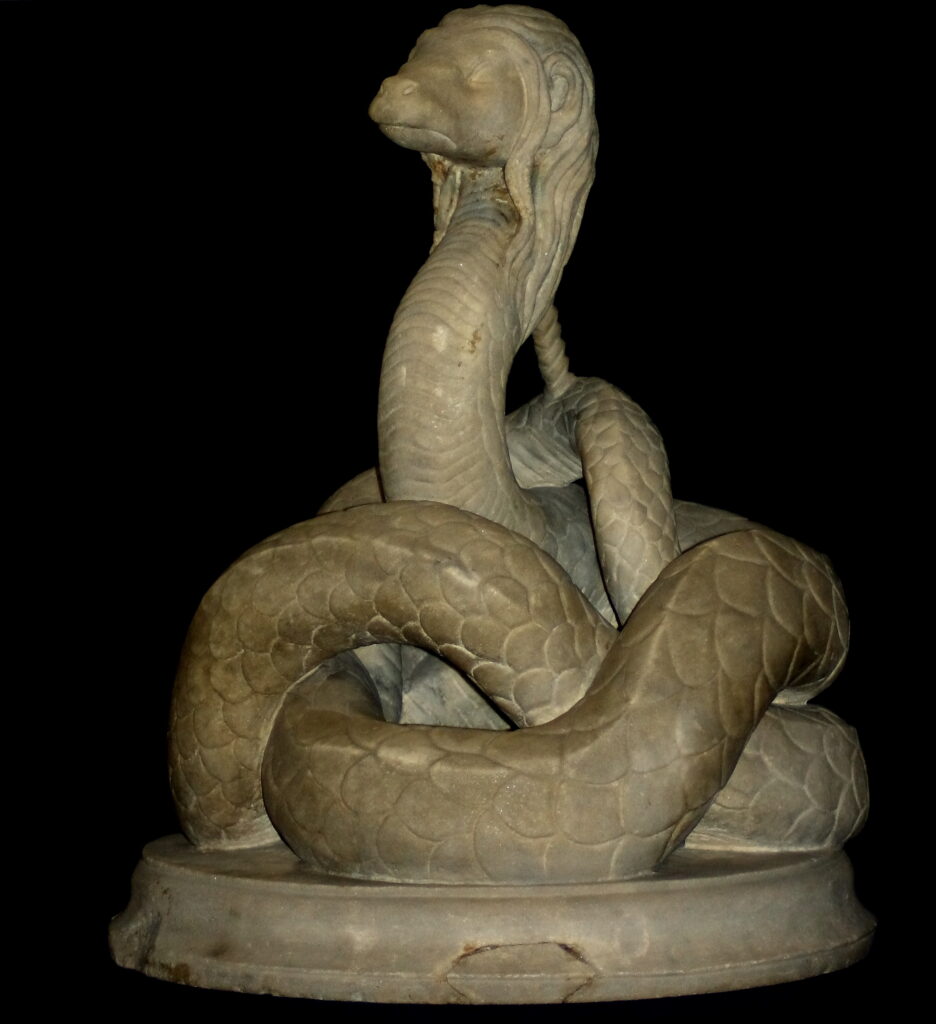
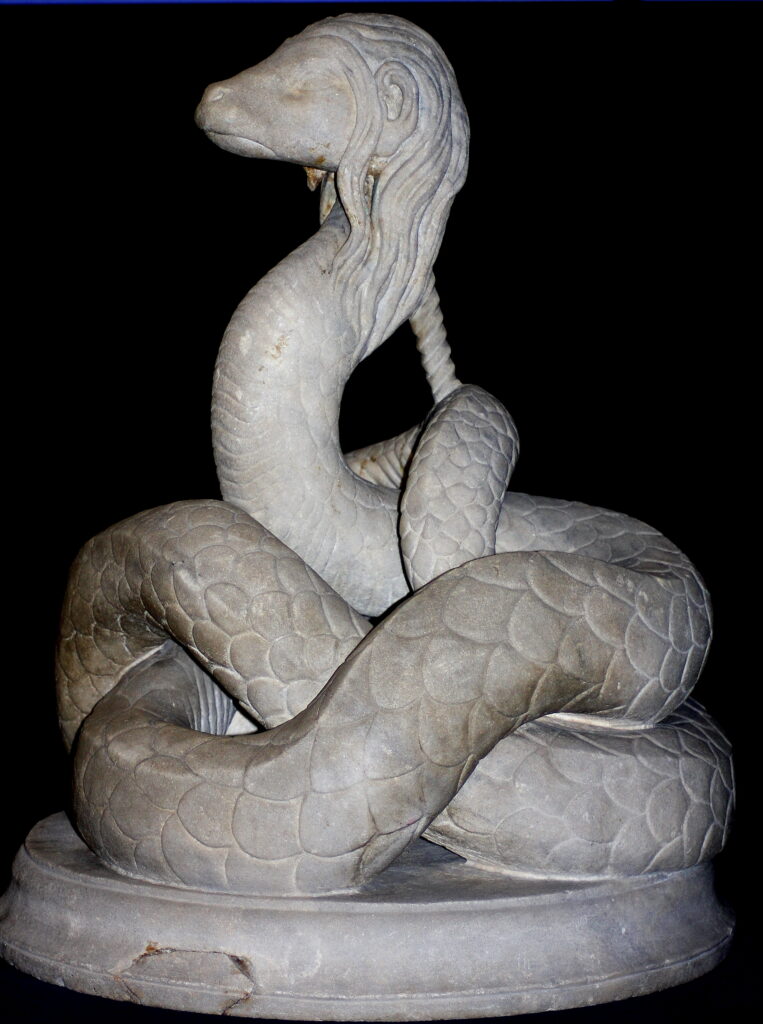
The city that bore Alexander’s name kept a serpent at its heart. According to the Alexander Romance, the many-layered popular biography of the king, a serpent appeared on the site while Alexandria was being founded and was killed, and the Alexandrians venerated it thereafter as the Agathos Daimon, the Good Daimon of the city. Daniel Ogden has argued that the cult itself was established by Ptolemy, Alexander’s general and successor, in the decades around 300 BCE. Aelian adds that live serpents were brought to Alexandria from Ethiopia under Ptolemy’s son, and more under his grandson, and kept in the city’s sanctuary of Asclepius. And four centuries after the foundation, Alexandrian coins struck under Nero gave the emperor the title “New Agathos Daimon”: the boy whose serpent’s slough had been set in gold had become, in Egypt, the city’s good serpent.
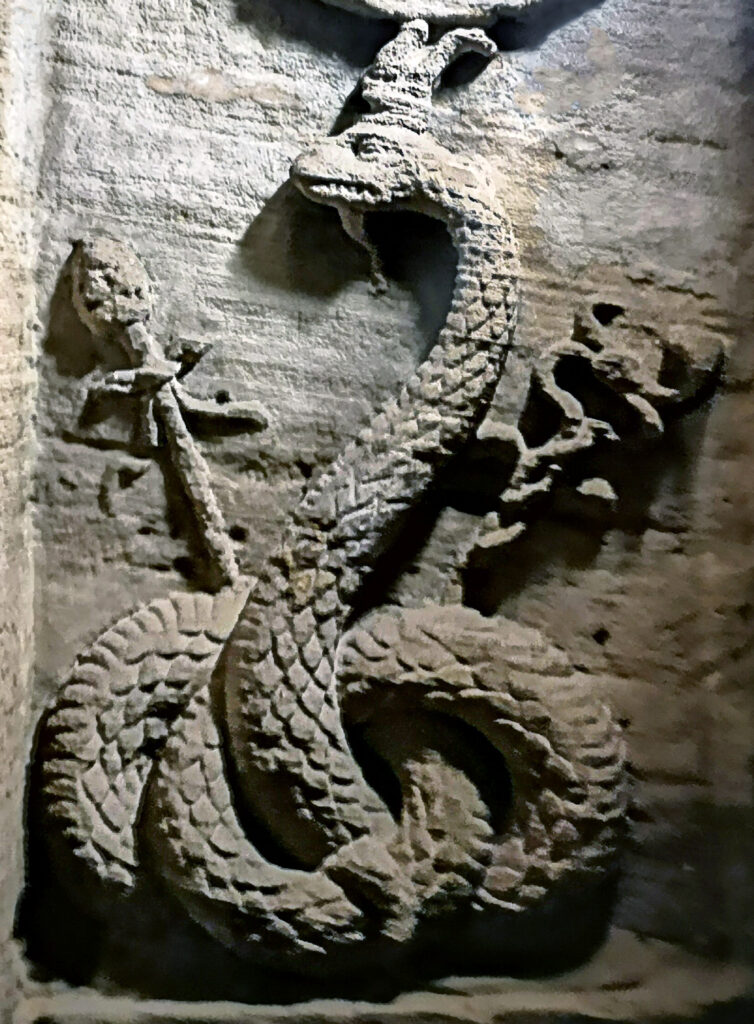
The Agathos Daimon of Alexandria did not stay Greek. In Roman Egypt he was identified with Kneph, and through him with Kematef, the Egyptian serpent “who has completed his time,” whose story I followed at the end of The Serpent in Ancient Egypt; from there, as the lion-headed and serpent-bodied figures on Roman magical gems, he passed into the material I traced in The Serpent in Gnosticism and Western Esotericism. But the Alexandrian story, by itself, already holds most of what this article has followed. A serpent belongs to a place. It is killed when the city is founded on that place. It is honoured afterwards as the city’s protector. A ruler takes its name. And more serpents are carried in from elsewhere to keep the cult alive. Alexandria killed its serpent and then made it the city’s good spirit.
A Note on Sources and Scholarly Uncertainty
The state of the documentation
Delphi. The Homeric Hymn to Pythian Apollo is quoted in H. G. Evelyn-White’s 1914 Loeb translation. Its date is disputed: Evelyn-White placed the Pythian part no later than 600 BCE, whereas Alain Ballabriga has argued, against the majority view, for a composition by the rhapsode Cynaethus of Chios in the late sixth century. The derivation of “Pytho” from a verb meaning “to rot” is the hymn’s own folk etymology; modern etymologies of the name remain uncertain, and the Semitic etymology proposed by L. Bayard in 1943 (and contested by René Cadiou in 1945) is speculative and has not been followed here. The Delphic festival is known here from two works of Plutarch: the dialogue On the Obsolescence of Oracles, read in full in F. C. Babbitt’s translation, where the Delphic interpretation of the rite is reported by a character, Cleombrotus, who rejects it; and Greek Questions 12, read in the nineteenth-century translation edited by W. W. Goodwin (ToposText), which names the festival as the Septerion and gives two versions of Apollo’s journey to Tempe. Plutarch is a late witness, writing in the late first or early second century CE, and his official position at Delphi is reported from Babbitt’s introduction; I have not checked Plutarch’s own statements about it. The age of the link between the rite and the Python story cannot be established from the sources I read. Euripides’ Iphigenia among the Taurians is quoted in Robert Potter’s translation, as reprinted by Oates and O’Neill (1938); I read the whole ode (lines 1234–1283). In it, Earth’s revenge answers the expulsion of Themis from the oracle, not the death of the serpent as such; I have kept that distinction in the text. The statement that the Pythian solo for the aulos imitated the serpent’s hissing rests on the ancient sources collected by Sylvain Perrot (2012); I have not consulted those sources independently. Cleombrotus’s complaint about the theatres concerns tellings of the fight in general; I do not take it to refer to the aulos piece. I know Joseph Fontenrose’s reading of Iliad 2.780–783 only through Ballabriga’s citation of it.
Thebes and the Bagradas. The Cadmus story and Apollo’s servitude with Admetus are quoted from the Library (3.4.1–2, 3.5.4, 3.10.4) in Frazer’s translation, read directly with his notes; Frazer’s notes on 3.4.2 and 3.10.4 are the source of the suggestion that the “eternal year” of servitude stood for eight years. Pliny (Natural History 8.37), Valerius Maximus (1.8 ext. 19), Aulus Gellius (7.3) and Livy’s summary (Periochae 18) were read in the Latin. Silius Italicus (Punica 6.118–293) was read in the Latin, and Edward Bassett’s study (1955), read in full, reads the episode against the model of Hercules, noting among other things that Lucan had already set Antaeus on the Bagradas. That Silius’s linking of the serpent’s death to Regulus’s later disasters is a literary construction rather than an attested Roman belief is my conclusion from the prose sources I read; Dio Cassius and Zonaras, which Bassett also lists, were not consulted.
Typhon. I treat Typhoeus (Hesiod), Typhaon (the Hymn) and Typhon (Pindar, the Prometheus Bound, Apollodorus) as one figure, as both Watkins and Ballabriga do; the different names and Ballabriga’s two competing genealogies (Earth and Tartarus in Hesiod, Hera alone in the Hymn) show how loosely the traditions were joined. The origin of Typhon is an open question, and I have presented the two positions I could read in full, Calvert Watkins’s (1992) case for an Anatolian origin through bilingual transmission and Alain Ballabriga’s (1990) case for a figure shaped within Greek epic, without taking a side. The Hittite form išḫimanta is given as I read it in Watkins’s article; the transliteration should be checked against a Hittite dictionary before publication. Pindar’s First Pythian was consulted only through Watkins’s quotations and discussion; the detail of Typhon “chained” under Etna rests on those quotations. The Prometheus Bound (lines 351–375) was read directly in the English translation published on ToposText. The page header announces Herbert Weir Smyth’s Loeb translation of 1926, but the text displayed is a modern translation introduced as Colin Young’s, and its wording is not Smyth’s; I quote it as Young’s. Its attribution to Aeschylus is doubted by many scholars, Young among them. The French translations of the Iliad quoted by Watkins and Ballabriga are Paul Mazon’s; the English wording of Iliad 2.783 quoted in the text is A. T. Murray’s (Loeb, 1924), read directly.
The Hydra and Medusa. I found no modern study devoted to the Lernaean Hydra that was both scholarly and freely accessible; the one chapter-length treatment I located defends an unconventional interpretation and is behind a paywall. The Hydra paragraphs therefore rest on the ancient texts themselves (Hesiod’s Theogony, Apollodorus’s Library, both read in full) and on Ballabriga’s comments. On Medusa, the claim that the snakes are only one of her attributes, and that she received no cult, follows Jean-Pierre Vernant’s La mort dans les yeux, which I read in its German translation (Tod in den Augen, 1988), pages 7–71 only; Erich Küster (1913) adds, citing Konrat Ziegler’s encyclopedia article, that the earliest gorgoneia are grimacing, often bearded masks without snakes. Kiki Karoglou’s Dangerous Beauty (2018) and the review by Lazarou and Liritzis (2022) were read in full; the latter is useful mainly as a bibliographical map, and some of its claims are insufficiently supported. Ovid’s account of Medusa (Metamorphoses 4.770–803), like his Libyan snakes (4.617–620) and the transformation of Cadmus (4.563–603), was checked against the Latin text. Pindar’s Twelfth Pythian is quoted in Diane Arnson Svarlien’s translation (1990). Lucan (Pharsalia 9.619–699) was checked against the Latin text; translations from Lucan, Silius Italicus, Valerius Maximus, Pliny, Ovid, Virgil, Cicero and Aulus Gellius 7.3 are my own; Gellius 6.1 is quoted in Rolfe’s translation.
Feeding. Herodotus 8.41 is quoted in A. D. Godley’s translation and Plutarch’s Life of Themistocles 10 in Bernadotte Perrin’s, both read directly; Jennifer Finn’s close reading of the two passages (2020) guided my approach to them. Robert Parker’s reading of the Erichthonius myth as the founding story of the Acropolis serpent (1987) is known to me only through Finn’s note. The Cecrops and Erichthonius stories are quoted from Apollodorus’s Library (3.14.1, 3.14.6) in Frazer’s translation, read directly together with his notes; Frazer’s conjecture identifying the Acropolis serpent with Erichthonius comes from his note 4 on 3.14.6; Loraux’s suggestion about Cecrops’s double nature (Né de la terre, 1996, p. 72) is explicitly hedged by her and draws on Philippe Borgeaud’s work on Pan, which I have not consulted. Godley’s “as if it really existed” may make Herodotus sound more sceptical about the snake than his Greek requires; I have not checked the Greek text, and the phrase should not be pressed. Virgil’s Aeneid 2.199–249 (Laocoon) and 5.42–103 (Anchises’ tomb) were read in the Latin; the translations are mine. The summary of the Sack of Ilium is quoted from Evelyn-White’s translation of Proclus. Servius’s notes on Aeneid 5.85 and 5.95 were read in Georg Thilo’s edition (1881); the later part of the note on 5.85 may belong to the expanded commentary known as Servius Danielis and has not been quoted. The Munichia reliefs and the interpretation of Zeus Meilichios follow Gourmelen (2012), and the caution about Selinous follows Jameson, Jordan and Kotansky (1993), both read in full. Propertius 4.8.3–14 was read in the Latin (the translation is mine); Aelian, On Animals 11.16, is cited through Rianne Hermans’s doctoral thesis (2017), of which the file I read contained only the chapter on Juno Sospita; Hermans considers the Lanuvium rite a literary topos, a judgement I have reported rather than assessed. The interpretation of the Pompeian lararium serpents as “gods of place” is Harriet Flower’s (The Dancing Lares and the Serpent in the Garden, 2017), which I did not consult; I report it through Emma-Jayne Graham (2021). Graham’s suggestion about repaintings after the earthquake of 62 CE is presented by her as a hypothesis. David Gerald Orr’s study of Roman lararia, cited for some leads (including the Alexandrian coins of Nero), is a Master’s thesis (University of Maryland, 1969), not a doctoral dissertation; it has been used as a pointer to primary evidence, not as an authority, and the coin legend “New Agathos Daimon” has not been verified against a numismatic catalogue.
Being fathered by the serpent. Plutarch’s Life of Cleomenes 39 is quoted in Bernadotte Perrin’s translation (Loeb, 1921), read directly. The cures from Epidaurus are quoted from the translation in Emma and Ludwig Edelstein’s Asclepius (1945), of which I read selected testimonies in full and selected pages of the interpretive volume. The account of Alexander’s, Scipio’s, Augustus’s and Nero’s serpent births follows Daniel Ogden’s article of 2009 for the overall argument. The ancient passages themselves were read directly in the Loeb translations: Plutarch’s Life of Alexander 2–3 (Perrin), Aulus Gellius 6.1 (John C. Rolfe), Suetonius’s Augustus 94 and Nero 6 (Rolfe), and Tacitus’s Annals 11.11 (John Jackson). Rolfe’s translation names the source of the Atia story “Asclepias of Mendes”; I have used the more usual form of the name, Asclepiades. The rationalization of Alexander’s father into an Arcadian named Drakon is reported from Ogden and has not been checked in its source. Pliny’s notice of the dragon guarding Scipio’s shades at Liternum (Natural History 16.234) was verified. The suggestion that Aristomenes may have been fathered by Sparta’s own serpent is explicitly framed by Ogden (Aristomenes of Messene, 2004, pp. 64–65) as a question, and I have kept it so; Pausanias 4.14.7 and 1.36.1 are quoted in the translation of W. H. S. Jones and H. A. Ormerod (1918); I read Ogden’s book only in selected pages. The continuation of 4.14.7, in which Pausanias explains how Aristomenes’ case differs from those of Olympias and Aristodama, I know only through Ogden, who reads the comparison as a deliberate contrast; Aristodama’s son Aratus as a son of Asclepius (Pausanias 2.10.3) is likewise reported from Ogden. The tale of the serpent of Cychreus received by Demeter at Eleusis was first located through Küster and then read in Strabo 9.1.9 (Horace Leonard Jones’s translation). Strabo attributes it to Hesiod; the Hesiodic fragment itself has not been consulted. Küster’s summary had left out both the attribution and the role of Eurylochus. Frazer’s note on Apollodorus 3.12.7, read directly, already brings together the three versions of the Cychreus story (Apollodorus, Hesiod via Strabo, Pausanias) and suggests that it may preserve a belief that kings and heroes turned into serpents after death; my reading of the three versions as one exchange builds on that note. Küster’s monograph of 1913 remains a useful repertory of passages and monuments, but its evolutionist framework and its comparisons with “primitive peoples” belong to its time; it has been used only as a guide to sources, never for interpretation.
Carrying the serpent. The testimonies on the transfers of Asclepius come from the Edelsteins’ collection, where I read them: the Epidaurian cure of Thersander (T. 423, no. 33, also checked against the Greek text of IG IV², 1, 122), the Telemachus inscription (T. 720), Pausanias on Sicyon and on Epidaurus Limera (T. 695, T. 757), Livy’s summary (T. 846), Valerius Maximus 1.8.2 (T. 848) and Ovid, Metamorphoses 15.622–744 (T. 850). The remark that only the serpent could make the journey on its own is mine, not the Edelsteins’. They date the arrival of the god in Rome to 292 BCE and the dedication of his temple to 291, whereas other authorities, including Küster, give 293; I have not given a date in the text. The Edelsteins’ broader thesis, that Asclepius was originally a hero rather than a chthonic god, dates from 1945 and has been debated since; I have not been able to compare it with more recent work on Epidaurus. Lucian’s Alexander is quoted in the translation of H. W. and F. G. Fowler (1905). Lucian is a hostile and possibly partly parodic witness, and the interpretation of the Glycon cult as modelled on earlier cult transfers is Wiebke Friese’s (2015).
The coda. The story of the serpent killed at the foundation of Alexandria and venerated as the Agathos Daimon is taken from Ogden (2009), who discusses the Alexander Romance (1.32); I have not read the Romance directly. Aelian’s notice of serpents brought to Alexandria under Ptolemy II and Ptolemy III is reported from the Edelsteins’ collection (testimony 696); I have not read Aelian directly. The identification of the Agathos Daimon with Kneph is treated, with its own sources, in the article on ancient Egypt on this site.
The limits of the inquiry
The argument. The pattern this article follows, that a drakōn bound to a place holds something of that place’s power, and that killing, feeding, claiming descent from, or carrying such a serpent are ways of dealing with that power, is my own synthesis, and I offer it as a recurring pattern, not a rule. I have not found it stated in these terms in the works I could read; Fontenrose’s Python and Ogden’s Drakōn, which I could not read, cover much of the same ground and may well anticipate it. The four gestures are not of one kind: feeding maintains a power rather than appropriating it; the serpent births belong first to the history of dynastic legitimation, and touch a place only at their edges; and Asclepius’s serpent carries a god, not the spirit of a place. Several connections in the text are mine and should be read as such: the reading of the Acropolis serpent and the Trojan serpents of Laocoon as mirror images; the treatment of Typhon, the Hydra and Medusa as a sequence of “distributions” of a dead monster’s power, which extends Ballabriga’s remark that the deaths of the Hydra and of the Delphic dragoness stand in for Typhon’s; and the reading of the three Cychreus stories as one exchange, which builds on Frazer’s note. The juxtaposition of Cadmus’s eight years with the Delphic cycle is not mine: Frazer’s notes on Apollodorus 3.4.2 and 3.10.4 make it, and Plutarch’s dialogue presupposes it when Cleombrotus, relaying a stranger’s revisionist account, denies that “an exile of eight full years” was imposed on the Python’s slayer. The consequence I draw, that the serpent’s killing was paid for as a homicide, is mine.
Counter-cases and witnesses not used. Many serpents in Greek myth die without any recorded price or transfer of power (the snakes strangled by the infant Heracles are an obvious example), and the article does not survey them. Several ancient witnesses that bear on the argument were identified but not read for this article: Euripides’ Ion on the golden serpents of the Erechtheids; Sophocles’ Philoctetes on the serpent that guarded the sanctuary of Chryse; Ovid’s account of Python in the first book of the Metamorphoses; Hyginus, Fabulae 140; and Apollonius of Rhodes on the Delphic serpent.
Words and categories. I have not made a systematic study of the Greek and Latin serpent vocabulary (drakōn, drakaina, ophis, echidna; draco, anguis, serpens, coluber); original terms are given only where I could check them in the text I read. The vocabulary was not fixed even within a single text: the Epidaurian cure of Thersander calls the same sacred animal drakōn and, a few lines later, ophis. The change from the female, nameless drakaina of the Hymn to the male Python of later sources is noted but not built upon. The Roman genius loci of Servius, the Greek household serpent (oikouros ophis), Zeus Meilichios in serpent form, and the Agathos Daimon of Alexandria are distinct categories in their own traditions; I bring them together by what they do, not by claiming that they are the same.
Dates and kinds of evidence. The texts used span more than eight centuries and are of different kinds. The Library is the work of an unknown compiler of the Roman imperial period (it is often called Pseudo-Apollodorus), generally dated to the first or second century CE. Plutarch, Silius, Pliny, Valerius Maximus, Suetonius, Tacitus, Aulus Gellius, Lucian and Aelian all write under the Roman Empire, often centuries after the events or rites they describe. I have tried to say in the text whether a story is attested as belief, as rite, or as literary construction; where the text does not say, the evidence does not allow me to decide.
Translations and editions. Most ancient texts were read in older public-domain translations (Evelyn-White, Frazer, Godley, Perrin, Jones and Ormerod, Murray, Babbitt, Goodwin, Potter, Rolfe, Jackson) and have not been compared with modern editions and translations (for Hesiod, M. L. West and G. W. Most; for the Library, R. Hard; the Budé editions generally). Latin texts were read on The Latin Library and LacusCurtius, which reproduce older editions without critical apparatus.
Works not consulted. Besides Fontenrose and Ogden, Walter Burkert’s work on Greek ritual and Robert Parker’s Miasma, the standard study of homicide pollution, were not available to me through any free and legal channel and have not been consulted. Their absence is the main limit of this article.
Further reading. Readers who want to go further should begin with Ogden’s Drakōn (2013) and Fontenrose’s Python (1959), which I could not consult; with Vernant on Medusa; with the Edelsteins on Asclepius; and with Flower (2017) on the Roman household serpents.
Bibliography
Primary sources (read directly)
Aeschylus. Eumenides. In Aeschylus, translated by Herbert Weir Smyth. Loeb Classical Library. Cambridge, MA: Harvard University Press, 1926. https://topostext.org/work/14.
[Aeschylus, attributed.] Prometheus Bound. Translated by Colin Young. ToposText. https://topostext.org/work/15. (Read: lines 350–375.)
Apollodorus [Pseudo-Apollodorus]. The Library. Translated by James George Frazer. 2 vols. Loeb Classical Library. London: Heinemann, 1921. https://topostext.org/work/150.
Aulus Gellius. Attic Nights. Book 6. Translated by John C. Rolfe. Vol. 2. Loeb Classical Library. Cambridge, MA: Harvard University Press, 1927. https://penelope.uchicago.edu/Thayer/E/Roman/Texts/Gellius/6*.html.
Aulus Gellius. Noctes Atticae. Book 7. Latin text. The Latin Library. https://www.thelatinlibrary.com/gellius/gellius7.shtml.
Cicero. De divinatione. Books 1 and 2. Latin text. The Latin Library. https://www.thelatinlibrary.com/cicero/divinatione1.shtml; https://www.thelatinlibrary.com/cicero/divinatione2.shtml.
Edelstein, Emma J., and Ludwig Edelstein, eds. and trans. Asclepius: A Collection and Interpretation of the Testimonies. Vol. 1, Testimonies. Baltimore: Johns Hopkins Press, 1945. https://archive.org/details/asclepiuscollect0000unse_d9n4. (Selected testimonies read: 3–4, 68–71, 423, 587–592, 686–706, 717–722, 756–762, 841–861.)
Euripides. Iphigenia in Tauris. Translated by Robert Potter. In The Complete Greek Drama, edited by Whitney J. Oates and Eugene O’Neill Jr., vol. 1. New York: Random House, 1938. Perseus Digital Library. https://www.perseus.tufts.edu/hopper/text?doc=Perseus:text:1999.01.0112:card%3D1234.
Herodotus. The Histories. Book 8. Translated by A. D. Godley. Cambridge, MA: Harvard University Press, 1920. https://www.perseus.tufts.edu/hopper/text?doc=Perseus:text:1999.01.0126:book=8:chapter=41.
Hesiod. Theogony; The Shield of Heracles. In Hesiod, the Homeric Hymns and Homerica, translated by Hugh G. Evelyn-White. Loeb Classical Library. London: Heinemann, 1914. https://www.gutenberg.org/ebooks/348.
Homer. The Iliad. Book 2. Translated by A. T. Murray. 2 vols. Loeb Classical Library. Cambridge, MA: Harvard University Press; London: Heinemann, 1924. https://www.perseus.tufts.edu/hopper/text?doc=Perseus:text:1999.01.0134:book=2:card=780.
Homeric Hymn to Pythian Apollo; Proclus, Chrestomathia (summary of the Sack of Ilium). In Hesiod, the Homeric Hymns and Homerica, translated by Hugh G. Evelyn-White. Loeb Classical Library. London: Heinemann, 1914. https://www.gutenberg.org/ebooks/348.
Livy. Periochae. Book 18. Latin text. The Latin Library. https://www.thelatinlibrary.com/livy/liv.per18.shtml.
Lucan. De bello civili (Pharsalia). Book 9. Latin text. The Latin Library. https://www.thelatinlibrary.com/lucan/lucan9.shtml.
Lucian. Alexander the False Prophet. Translated by H. W. Fowler and F. G. Fowler. Oxford: Clarendon Press, 1905. https://topostext.org/work/337.
Ovid. Metamorphoses. Books 4 and 15. Latin text. The Latin Library. https://www.thelatinlibrary.com/ovid/ovid.met4.shtml; https://www.thelatinlibrary.com/ovid/ovid.met15.shtml.
Pausanias. Description of Greece. Translated by W. H. S. Jones and H. A. Ormerod. 4 vols. Loeb Classical Library. Cambridge, MA: Harvard University Press, 1918–1935. https://www.perseus.tufts.edu/hopper/text?doc=Perseus:text:1999.01.0160. (Read: 1.36.1, 4.14.7.)
Persius. Satires. Latin text. The Latin Library. https://www.thelatinlibrary.com/persius.html.
Pindar. Odes. Translated by Diane Arnson Svarlien. 1990. Perseus Digital Library. https://www.perseus.tufts.edu/hopper/text?doc=Perseus:text:1999.01.0162:book%3DP.:poem%3D12. (Read: Pythian 12.)
Pliny the Elder. Naturalis historia. Books 8, 16 and 29. Latin text. LacusCurtius. https://penelope.uchicago.edu/Thayer/L/Roman/Texts/Pliny_the_Elder/8*.html; https://penelope.uchicago.edu/Thayer/L/Roman/Texts/Pliny_the_Elder/16*.html; https://penelope.uchicago.edu/Thayer/L/Roman/Texts/Pliny_the_Elder/29*.html.
Plutarch. Greek Questions. In Plutarch’s Morals, translated by several hands, corrected and revised by William W. Goodwin. 1878. ToposText. https://topostext.org/work/269.
Plutarch. Life of Alexander. In Lives, vol. 7, translated by Bernadotte Perrin. Loeb Classical Library. Cambridge, MA: Harvard University Press, 1919. https://penelope.uchicago.edu/Thayer/E/Roman/Texts/Plutarch/Lives/Alexander*/3.html.
Plutarch. Life of Cleomenes. In Lives, vol. 10, translated by Bernadotte Perrin. Loeb Classical Library. Cambridge, MA: Harvard University Press, 1921. https://penelope.uchicago.edu/Thayer/E/Roman/Texts/Plutarch/Lives/Cleomenes*.html.
Plutarch. Life of Themistocles. In Lives, vol. 2, translated by Bernadotte Perrin. Loeb Classical Library. Cambridge, MA: Harvard University Press, 1914. https://penelope.uchicago.edu/Thayer/E/Roman/Texts/Plutarch/Lives/Themistocles*.html.
Plutarch. The Obsolescence of Oracles (De defectu oraculorum). In Moralia, vol. 5, translated by Frank Cole Babbitt. Loeb Classical Library. Cambridge, MA: Harvard University Press, 1936. https://penelope.uchicago.edu/Thayer/E/Roman/Texts/Plutarch/Moralia/De_defectu_oraculorum*.html.
Propertius. Elegiae. Book 4. Latin text. The Latin Library. https://www.thelatinlibrary.com/prop4.html.
Servius. Servii Grammatici qui feruntur in Vergilii carmina commentarii. Vol. 1, part 2, Aeneidos librorum I–V commentarii. Edited by Georg Thilo. Leipzig: Teubner, 1881. https://archive.org/details/serviigrammatic00thilgoog.
Silius Italicus. Punica. Book 6. Latin text. The Latin Library. https://www.thelatinlibrary.com/silius/silius6.shtml.
Strabo. Geography. Book 9. Translated by Horace Leonard Jones. Vol. 4. Loeb Classical Library. Cambridge, MA: Harvard University Press, 1927. https://penelope.uchicago.edu/Thayer/E/Roman/Texts/Strabo/9A*.html.
Suetonius. The Lives of the Caesars: Augustus; Nero. Translated by John C. Rolfe. Loeb Classical Library. Cambridge, MA: Harvard University Press, 1913–1914. https://penelope.uchicago.edu/Thayer/E/Roman/Texts/Suetonius/12Caesars/Augustus*.html; https://penelope.uchicago.edu/Thayer/E/Roman/Texts/Suetonius/12Caesars/Nero*.html.
Tacitus. Annals. Book 11. Translated by John Jackson. Vol. 4. Loeb Classical Library. Cambridge, MA: Harvard University Press, 1937. https://penelope.uchicago.edu/Thayer/E/Roman/Texts/Tacitus/Annals/11A*.html.
Valerius Maximus. Facta et dicta memorabilia. Book 1. Latin text. The Latin Library. https://www.thelatinlibrary.com/valmax1.html.
Virgil. Aeneid. Books 2 and 5. Latin text. The Latin Library. https://www.thelatinlibrary.com/vergil/aen2.shtml; https://www.thelatinlibrary.com/vergil/aen5.shtml.
Primary sources cited through secondary literature (not read directly)
Aelian, On the Characteristics of Animals 11.16, 16.39; Alexander Romance 1.32; Aristophanes, Lysistrata 758–759; Hesiod fr. (Cychreides, via Strabo 9.1.9); Pausanias 2.10.3, 3.23.6–7, 4.14.8; Pindar, Pythian 1; Ptolemy Chennos (via Ogden). See the Note on Sources for the secondary source through which each is cited.
Secondary sources
Ballabriga, Alain. “Le dernier adversaire de Zeus. Le mythe de Typhon dans l’épopée grecque archaïque.” Revue de l’histoire des religions 207, no. 1 (1990): 3–30. https://www.persee.fr/doc/rhr_0035-1423_1990_num_207_1_1756.
Bassett, Edward L. “Regulus and the Serpent in the Punica.” Classical Philology 50, no. 1 (1955): 1–20. https://www.journals.uchicago.edu/doi/abs/10.1086/363852.
Bayard, L. “Pytho-Delphes et la légende du serpent.” Revue des Études Grecques 56 (1943): 25–28. https://www.persee.fr/doc/reg_0035-2039_1943_num_56_264_2967.
Cadiou, René. “À propos de : Pytho-Delphes et la légende du serpent.” Revue des Études Grecques 58 (1945): 278–279. https://www.persee.fr/doc/reg_0035-2039_1945_num_58_274_3058.
Calame, Claude. “Sacrifice des filles d’Érechthée et autochtonie : fondations étiologiques dans l’Athènes classique.” Classics@ 7, no. 1 (2011). https://classics-at.chs.harvard.edu/classics7-claude-calame-sacrifice-des-filles-derechthee-et-autochtonie/.
Edelstein, Emma J., and Ludwig Edelstein. Asclepius: A Collection and Interpretation of the Testimonies. Vol. 2, Interpretation of the Testimonies. Baltimore: Johns Hopkins Press, 1945. https://archive.org/details/asclepiuscollect0000unse. (Selected pages read.)
Finn, Jennifer. “Plutarch’s Themistocles: The Serpent of Hellas.” Histos 14 (2020): 185–205. https://histos.org/index.php/histos/article/download/444/438/447.
Friese, Wiebke. “Trick or Treat? Secrecy and Performative Space in the Sanctuary of Glycon Neos Asclepius.” In Revealing and Concealing in Antiquity: Textual and Archaeological Approaches to Secrecy, edited by Eva Mortensen and Sine Grove Saxkjær, 147–160. Aarhus Studies in Mediterranean Antiquity 13. Aarhus: Aarhus University Press, 2015. https://www.academia.edu/32137011/Trick_or_Treat_Secrecy_and_Performative_Space_in_the_Sanctuary_of_Glycon_Neos_Asclepius.
Gourmelen, Laurent. “Le serpent barbu : réalités, croyances et représentations. L’exemple de Zeus Meilichios à Athènes.” Anthropozoologica 47, no. 1 (2012): 323–343. https://sciencepress.mnhn.fr/sites/default/files/articles/pdf/az2012n1a10.pdf.
Graham, Emma-Jayne. “At Home with the Lares: Lived Religion Rematerialised at Pompeii.” Open Arts Journal 10 (2021): 33–50. https://doi.org/10.5456/issn.2050-3679/2021s02.
Hermans, Rianne A. M. “Latin Cults through Roman Eyes: Myth, Memory and Cult Practice in the Alban Hills.” PhD diss., University of Amsterdam, 2017. Chapter 3. https://pure.uva.nl/ws/files/7936887/03.pdf.
Jameson, Michael H., David R. Jordan, and Roy D. Kotansky. A Lex Sacra from Selinous. Greek, Roman and Byzantine Monographs 11. Durham, NC: Duke University, 1993. https://grbs.library.duke.edu/public/journals/11/grbs-supplemental-files/LexSacra.pdf.
Karoglou, Kiki. Dangerous Beauty: Medusa in Classical Art. The Metropolitan Museum of Art Bulletin 75, no. 3 (Winter 2018). https://www.metmuseum.org/met-publications/dangerous-beauty-medusa-in-classical-art-the-metropolitan-museum-of-art-bulletin-v75-no-3.
Küster, Erich. Die Schlange in der griechischen Kunst und Religion. Religionsgeschichtliche Versuche und Vorarbeiten 13.2. Giessen: Töpelmann, 1913. https://archive.org/download/dieschlangeinder13kste/dieschlangeinder13kste.pdf.
Lazarou, Anna, and Ioannis Liritzis. “Gorgoneion and Gorgon-Medusa: A Critical Research Review.” Journal of Ancient History and Archaeology 9, no. 1 (2022): 47–62. https://jaha.org.ro/index.php/JAHA/article/download/741/463.
Loraux, Nicole. Né de la terre. Mythe et politique à Athènes. Paris: Seuil, 1996. https://archive.org/details/nedelaterremythe0000lora. (Selected pages read.)
Ogden, Daniel. Aristomenes of Messene: Legends of Sparta’s Nemesis. Swansea: Classical Press of Wales, 2004. https://archive.org/details/aristomenesofmes0000ogde. (Selected pages read.)
Ogden, Daniel. “Alexander, Scipio, and Octavian: Serpent-Siring in Macedon and Rome.” Syllecta Classica 20 (2009): 31–52.
Orr, David Gerald. “Roman Domestic Religion: A Study of the Roman Lararia.” MA thesis, University of Maryland, 1969. https://www.ostia-antica.org/fulltext/orr/orr-1972.pdf.
Perrot, Sylvain. “Le sifflement du serpent : du son inarticulé à la mise en musique.” Anthropozoologica 47, no. 1 (2012): 345–361. https://sciencepress.mnhn.fr/sites/default/files/articles/pdf/az2012n1a11.pdf.
Sebillotte-Cuchet, Violaine. “Aglauros, une héroïne à Athènes.” In Femmes médiatrices et ambivalentes. Mythes et imaginaires, edited by Nathalie Ernoult and Anna Caiozzo. Paris: Armand Colin, 2012. https://shs.hal.science/halshs-01853893/document.
Vernant, Jean-Pierre. Tod in den Augen: Figuren des Anderen im griechischen Altertum. Artemis und Gorgo. German translation of La mort dans les yeux (1985). Frankfurt am Main: Fischer Taschenbuch Verlag, 1988. https://archive.org/details/todindenaugenfig0000vern. (Pages 7–71 read.)
Watkins, Calvert. “Le dragon hittite Illuyankas et le géant grec Typhôeus.” Comptes rendus des séances de l’Académie des Inscriptions et Belles-Lettres 136, no. 2 (1992): 319–330. https://www.persee.fr/doc/crai_0065-0536_1992_num_136_2_15099.
Identified but not consulted
Borgeaud, Philippe. Recherches sur le dieu Pan. Bibliotheca Helvetica Romana 17. Geneva: Institut suisse de Rome, 1979.
Flower, Harriet I. The Dancing Lares and the Serpent in the Garden: Religion at the Roman Street Corner. Princeton: Princeton University Press, 2017.
Foucart, Paul. “Bas-relief du Pirée, le culte de Zeus Milichios.” Bulletin de correspondance hellénique 7 (1883): 507–514. https://www.persee.fr/issue/bch_0007-4217_1883_num_7_1. (Cited through Gourmelen 2012.)
Fontenrose, Joseph. Python: A Study of Delphic Myth and Its Origins. Berkeley: University of California Press, 1959.
Gourmelen, Laurent. Kékrops, le roi-serpent. Paris: Les Belles Lettres, 2004.
Jouanna, Danielle. Le serpent chez les Grecs : mythologie, savants, devins et médecins. Paris: Les Belles Lettres, 2025. https://www.lesbelleslettres.com/livre/9782251457413/le-serpent-chez-les-grecs.
Knox, Bernard M. W. “The Serpent and the Flame: The Imagery of the Second Book of the Aeneid.” American Journal of Philology 71 (1950): 379–400.
Ogden, Daniel. Drakōn: Dragon Myth and Serpent Cult in the Greek and Roman Worlds. Oxford: Oxford University Press, 2013.
Parker, Robert. Miasma: Pollution and Purification in Early Greek Religion. Oxford: Clarendon Press, 1983.
Parker, Robert. “Myths of Early Athens.” In Interpretations of Greek Mythology, edited by Jan Bremmer. London: Croom Helm, 1987.
Ziegler, Konrat. “Gorgo.” In Paulys Real-Encyclopädie der classischen Altertumswissenschaft, vol. VII.2. (Cited through Küster 1913.)
Vian, Francis. Les origines de Thèbes : Cadmos et les Spartes. Paris: Klincksieck, 1963.